Uber to Deploy Fleet of Rivian R2 Robotaxis
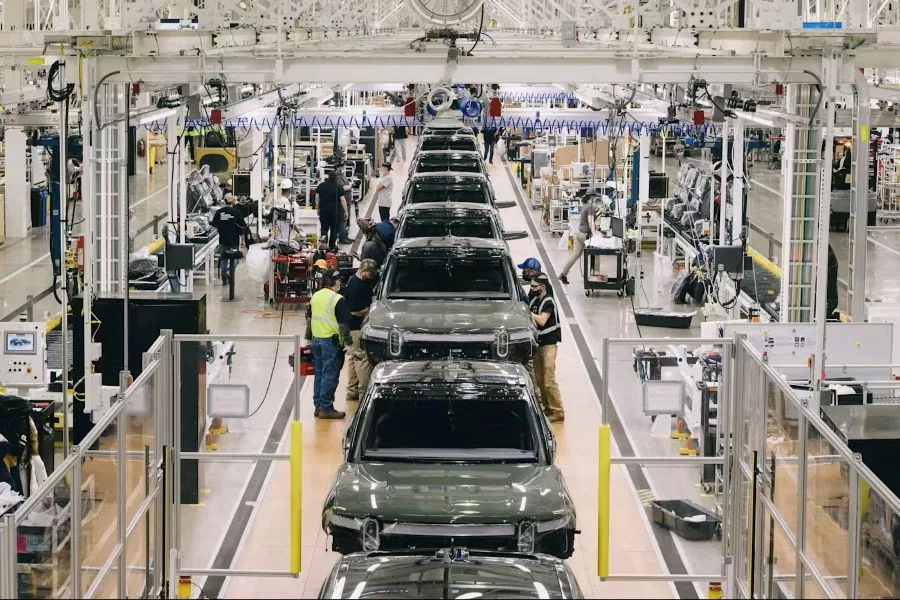
Uber has formed a strategic partnership with Rivian. Photo courtesy Rivian Automotive Inc.
SAN FRANCISCO—Uber Technologies Inc. has formed a strategic partnership with Rivian Automotive Inc. aimed at accelerating both companies’ autonomous vehicle plans. It plans to deploy 10,000 R2 robotaxis in the first phase of the initiative. Rivian is currently ramping up production of the new vehicle at its assembly plant in Normal, IL.
Initial deployments of the next-generation sport utility vehicles are expected to begin in Miami and San Francisco in 2028, and will eventually expand to 25 cities by 2031. Uber also plans to invest more than $1 billion in Rivian over the next five years.
“We’re big believers in Rivian’s approach—designing the vehicle, compute platform and software stack together, while maintaining end-to-end control of scaled manufacturing and supply in the U.S,” says Dara Khosrowshahi, CEO of Uber. “That vertical integration, combined with data from their growing consumer vehicle base and experience managing the complexities of commercial fleets, gives us conviction to set these ambitious but achievable targets.”
“We couldn’t be more excited about this partnership with Uber,” adds RJ Scaringe, CEO of Rivian. “It will help accelerate our path to level 4 autonomy to create one of the safest and most convenient autonomous platforms in the world.
“The scale of [our] growing data flywheel coupled with RAP1, our state-of-the-art in-house inference platform, and our multimodal perception platform make us incredibly excited for the rapid advancement of autonomy over the next couple of years,” notes Scaringe.
According to Scaringe, Rivian’s third-generation autonomy platform will be “one of the most powerful combinations of sensors and inference compute in a consumer vehicle in North America when launched in R2 in late 2026. It will feature 11 cameras, five radars and one lidar unit. The consumer platform is driven by two of Rivian’s in-house RAP1 chips, capable of 1600 TOPS of AI compute performance.
“This platform, including advanced connectivity and onboard intelligent data collection, utilizes data from all onboard sensors to power [our] data flywheel with real-world data, including the critical 3D lidar point clouds essential to the rapid progression of advanced end-to-end Physical AI,” explains Scaringe.
Looking for quick answers on assembly and manufacturing topics? Try Ask ASM, our new smart AI search tool. Ask ASM
Looking for a reprint of this article?
From high-res PDFs to custom plaques, order your copy today!