Robotics
See Spot Reason: Google Advances Robotics AI, but Manufacturing Readiness Remains a Challenge
MOUNTAIN VIEW, CA—Google has introduced an updated robotics AI model designed to improve how robots interpret and act in real-world environments, a development that could expand automation into more complex industrial tasks over time.
The model, Gemini Robotics-ER 1.6, focuses on “embodied reasoning," the ability for robots to understand physical surroundings, interpret visual inputs and determine whether tasks have been completed successfully. The system improves capabilities such as spatial reasoning, multi-view perception and instrument reading, including the ability to interpret gauges and indicators in manufacturing environments.
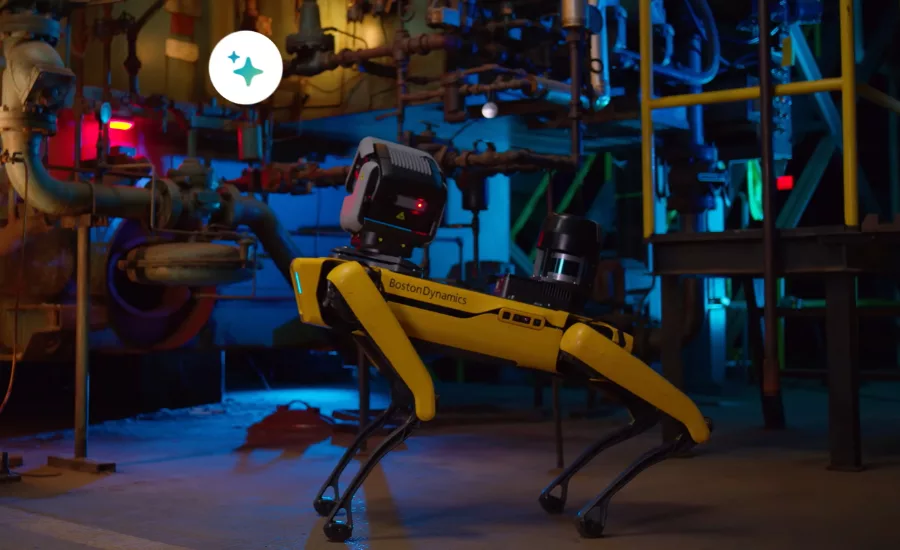
Similar inspection tasks are already performed by mobile robots such as Boston Dynamics’ Spot, which has been used to navigate industrial facilities and capture images of gauges and other equipment. In that context, the latest update is less about introducing a new manufacturing capability than improving the reasoning layer behind how those systems interpret visual data and respond to it.
While the update is positioned as a step toward more autonomous robots, its immediate significance lies in enabling more reliable inspection and monitoring tasks. In manufacturing plants, robots equipped with these capabilities could support routine checks by reading pressure gauges, fluid levels and other critical indicators without human intervention.
The system also introduces improved “success detection,” allowing robots to determine whether a task has been completed correctly before moving on. That capability is considered a key requirement for expanding automation beyond simple, repetitive actions into multi-step workflows.
More broadly, the model reflects ongoing efforts to address one of the main limitations in industrial robotics: handling variability. Traditional automation systems perform well in structured environments, but struggle with inconsistent lighting, occlusions or changing part positions. Improvements in visual and spatial reasoning are aimed at helping robots operate more effectively under those conditions.
At the same time, industry experts caution that advances in reasoning do not automatically translate into manufacturing readiness. In production environments, robots are expected to perform tasks with near-perfect consistency, particularly in quality-critical and safety-critical operations.
Looking for quick answers on assembly and manufacturing topics? Try Ask ASM, our new smart AI search tool. Ask ASM
“Reasoning is the wrong frame for manufacturing tasks. When a robot is reading a gauge on a production line, you don’t want it to reason about whether the reading is acceptable. You want it to be correct — every time. In quality-critical or safety-critical contexts, ‘pretty good reasoning’ isn’t good enough,” said Ken Macken, CEO of Workr Robotics.
“The whole reason manufacturers bring robots into a factory is to do jobs that require 100% precision, every single time. That’s the bar humans can’t consistently meet, and it’s why automation exists. A robot that can interpret the world but doesn’t get it right every time doesn’t clear that bar,” Macken added.
Despite the advances, the technology remains an enabling layer rather than a production-ready solution for most assembly applications. The model’s capabilities are currently focused on perception and decision-making, and would still require integration with robotic hardware and control systems to be deployed on factory floors.
The development highlights a broader shift in robotics, as companies work to move beyond fixed automation toward systems that can interpret and respond to real-world conditions, an evolution that could gradually expand the range of tasks suitable for automation in manufacturing environments.
Looking for a reprint of this article?
From high-res PDFs to custom plaques, order your copy today!