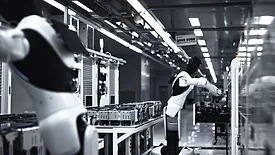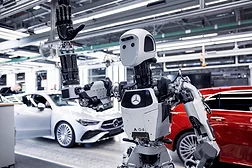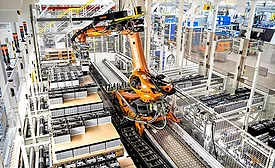
MUNICH—A new report by Roland Berger Strategy Consultants claims that recent advances in AI and humanoids wlll enable manufacturers to address the skilled labor shortage.
Overall, the United States-Mexico-Canada Agreement (USMCA) has been net positive for all three countries, and it has contributed to a dynamic, robust North American economy. However, the Trump Administration has indicated that without concessions from Mexico and Canada, the U.S. will not renew the agreement.
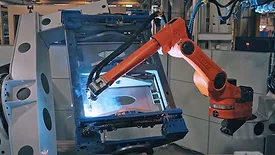
Volvo's skilled workers were spending more time on non-value-added tasks—moving material, hooking it up to a crane, and setting it in a fixture—instead of doing what they do best: complex welds. The automated process has improved ergonomics and requires less manual intervention.
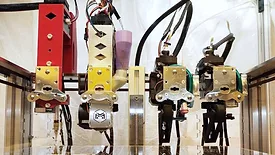
CAMBRIDGE, MA—Engineers at the Massachusetts Institute of Technology have developed a multimaterial additive manufacturing platform that can be used to print electric machines in a single step.
Siemens Energy plans to invest $1 billion to expand U.S. production of grid and gas turbine equipment and hire more than 1,500 workers as electricity demand surges from data centers, artificial intelligence infrastructure and industrial electrification.
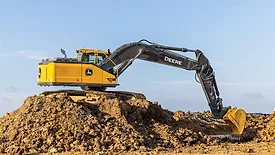
AUSTIN, TX—John Deere and Mercedes-Benz are among several companies that are investing more than $500 million in Apptronik, a startup that has developed a humanoid robot called Apollo.
PFLUGERVILLE, Texas—EOS is expanding metal additive manufacturing assembly and logistics operations in Texas as part of a $3 million investment aimed at increasing U.S.-based production capacity and shortening delivery times for North American customers.