Austin has been senior editor for ASSEMBLY Magazine since September 1999. He has more than 25 years of b-to-b publishing experience and has written about a wide variety of manufacturing and engineering topics. Austin is a native of Chicago and a graduate of the University of Michigan.
Today, GM's Lordstown assembly plant is celebrating its 50th anniversary. Although the facility appears to have a bright future, it also has a checkered past.
Adult coloring books are a popular fad today. They're touted as an easy, fun way to relieve stress and energize creativity. Some manufacturers are also getting in on the action.
It’s not unusual to find alternative lifestyle activities on or around college campuses. But, at Georgia’s Kennesaw State University, the word “alternative” refers to new types of energy systems.
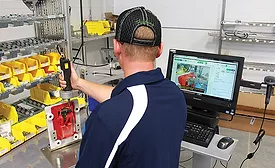
Manufacturers today are producing a wider range of products than ever. Life cycles are shrinking and demand for customization is increasing. As a result, assembly lines must be as flexible as possible without compromising efficiency. That’s why companies producing everything from pumps to pistols and caskets to chainsaws depend on mixed-model assembly.
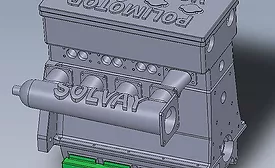
Back in the day, engines were the exclusive domain of cast iron and steel. But, during the past decade, more lightweight materials, such as aluminum and hard thermoplastics, have been slowly creeping under the hood. The Holy Grail, an engine made almost entirely out of plastic, is finally close to reality.
When Boeing was founded 100 years ago, engineers were concerned about how to use wiring to brace wings. As aircraft became more complex, engineers turned their attention to solving numerous wire harness assembly challenges. Many of their innovative solutions have been chronicled in the pages of ASSEMBLY magazine.
Airbus is investing in automation to tackle huge backlogs for its commercial jetliners. Bernard Duprieu, head of manufacturing technologies research at the Airbus Centre of Competence, Industrial Strategy and System, tells ASSEMBLY about the company’s FuturAssy automation strategy.
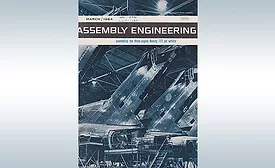
When the first issue of ASSEMBLY rolled off the printing press in October 1958, the jet age was just beginning. Aerospace manufacturers were busy churning out bigger, faster, quicker and lighter products for a wide range of commercial and military applications.
When it comes to developing new production tools and assembly processes, it’s hard to beat Boeing. The company has always been ahead of the curve implementing new technology on its assembly lines.
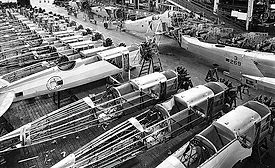
Boeing and its heritage companies, such as Douglas Aircraft Co., McDonnell Aircraft Corp. and North American Aviation Inc., have produced hundreds of different types of airplanes, helicopters, missiles, rockets, satellites, spacecraft and other flying objects over the last 10 decades.