Fastening: It's a Lock
Lockbolts produce joints with high clamp loads and excellent resistance to vibration.
Southern Europe is known worldwide for its sunny weather. The balmy climate that attracts countless tourists to the shores of the Mediterranean also makes Southern Europe an ideal location for solar energy plants.
One such plant, Andasol 1, is located in Andalusia, Spain. It’s the largest solar power plant in the world. The plant, which went online in November 2008, uses two vast fields of trough-shaped parabolic mirrors to concentrate sunlight and generate heat. This heat is stored in reservoirs containing a molten salt mixture. At night, or when the sky is overcast, this heat is tapped to run a steam turbine that generates 50 megawatts of electricity.
Positioning the mirrors in optimal relation to the sun is critical to maximize efficiency. That’s why the mirror frames are put together with lockbolts. These permanent, high-strength fasteners will not lose clamp load when subjected to vibrations from constant repositioning or exposure to the elements.
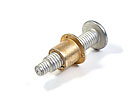
A lockbolt is a two-piece fastener that’s part bolt and part blind rivet. It consists of a short, nonthreaded, cylindrical collar and a long, headed pin with nonhelical threads. “At first glance, the pin looks like a threaded bolt, but it has annular rings rather than helical threads,” explains Pete Beecher, director of sales and distribution at Avdel USA LLC.
The pin is inserted from one side of the assembly; the collar is inserted from the other. (A lockbolt variation is available for blind fastening applications.) Initially, the collar slips loosely over the pin.
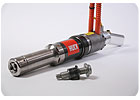
The fastener is tightened with a tool similar to that used to install blind rivets, explains Bob Corbett, director of technical services for Alcoa Fastening Systems. The nosepiece of the tool is a cylindrical die for forming the collar. Jaws inside the die grip the threads on the pin. To tighten the fastener, the nosepiece is slipped over the pin until it contacts the collar. When the trigger is actuated, the jaws grip the threads and pull. This applies tension to the pin while simultaneously forcing the collar through the die. The collar is elongated and compressed against the pin, and the collar material flows into the threads. Like a blind rivet, the pin breaks off at a predetermined location when a specific tension is reached. The collar is locked in place and so, too, is the clamp load in the joint.
“No torque is used to install a lockbolt,” says Corbett. “Tension is applied directly to the bolt. That gives you really tight control over clamp load. Scatter on clamp load is ±5 percent.”
Lockbolts are available in diameters ranging from 0.1875 to 1.375 inch. The grip range of the fastener varies with the diameter of the pin and size of the collar. For example, with a full-size collar, one model of lockbolt 0.1875 inch in diameter has a grip range of 0.062 to 0.187 inch with the shortest pin and 0.875 to 1 inch for the longest. A lockbolt 0.375 inch in diameter has a grip range of 0.125 to 0.375 inch with the shortest pin and 1.875 to 2.125 inches for the longest.
Lockbolts can be made from steel, stainless steel, aluminum or titanium. Various coatings and platings can be applied to prevent corrosion.
“Lockbolts are one of the few bolt designs that can be made of aluminum,” says Corbett. “With [helical threads], you could have galling in the threads during run-down. With the swaging action of a lockbolt, you avoid that. ...In fact, a manufacturer of snowmobiles uses more than 100 quarter-inch aluminum lockbolts in one of its products. It chose aluminum lockbolts to reduce the weight of the vehicle.”
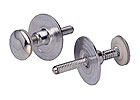
Because the head does not need to be held for installation, pins are produced with round, brazier, truss, mushroom and countersunk heads. Collars can be made with or without flanges.
Lockbolts are used in buses, trucks, trailers, recreational vehicles, car seats, railcars, mining equipment, passenger jets, and heating and ventilation equipment. They’re also used in architectural applications, such as bridges and electrical towers.
Because of the high strength and consistency of lockbolts, engineers can often specify a smaller diameter fastener than they would need if using a nut and bolt. “The clamp load applied by a 12-millimeter lockbolt overlaps with the low-end clamp load applied by a 16-millimeter nut and bolt,” says Corbett. “That’s because the clamp load on a nut and bolt can vary by as much as 25 percent.”
Another advantage of lockbolts is installation speed. “A 5/8-inch lockbolt can be installed in less than 3 seconds,” says Corbett.
Unlike a nut and bolt, a lockbolt cannot be removed easily, says Beecher. The assembly can be removed with a grinder, a torch or a specialized cutting tool called a collar cropper. As a result, lockbolts may not be the best choice for assemblies that require frequent servicing. On the other hand, the permanence of the fastener also prevents theft or tampering.
Although lockbolts and blind rivets are installed with similar equipment, the fasteners aren’t comparable. Blind rivets don’t provide much clamp load, nor do they provide similar pull-out strength to lockbolts. Blind rivets are designed to provide shear strength by filling the hole in which they are inserted.
Engineers need not worry about accounting for foreign object damage, since there’s no pin tail to get lost. And without a breakaway, there’s no initiation point for corrosion.
“With some lockbolts, the pin tail can represent 40 percent of the fastener material,” says Corbett. “With the Bobtail, nothing breaks off. There’s no waste. There’s no cleanup.”
Another innovation can be found in the Bobtail’s collar. Bumps along the flange show creases when the collar has been fully swaged. This gives operators an easy visual cue that the fastener has been installed correctly.
Another lockbolt variation is the Avtainer from Avdel. This lockbolt was designed for joining aluminum or composite panels to metal supports. The body of the collar is thin-walled to extend into the hole. The collar also has a thin, wide flange to better distribute the clamp load and avoid crushing the panels. The head of the bolt is equally wide and equipped with a Santoprene seal to ensure a watertight joint.
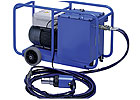
These tools are usually operated manually, but semiautomated workcells can be built, particularly for installing lockbolts ranging from 0.1875 to 0.25 inch in diameter, says Beecher. In such an application, an operator would manually load the parts and insert the pins and collars. Then, with the press of a button, multiple tools mounted on linear actuators would descend to swage all the collars simultaneously.
Because lockbolts are designed to provide maximum clamp load at the break point of the pin tail, engineers rarely, if ever, monitor installation in the same way they scrutinize installation of threaded fasteners. Technology is available to measure installation time, swage distance, and the force applied to the pin tail or the collar over time, but most assemblers rely on simple visual inspection for quality assurance.
“The break point of the fastener is carefully controlled during manufacturing to provide consistent installation,” says Daniel Pilsworth, product and business development manager at Avdel. “Because of that, you reduce a lot of the cost associated with maintenance and calibration of tools for nuts and bolts.”
To facilitate visual inspection, lockbolt manufacturers can provide data on the minimum and maximum lengths and widths of adequately swaged collars. “We can even provide templates or handheld gauges that fit over the collar,” says Pilsworth.
Southern Europe is known worldwide for its sunny weather. The balmy climate that attracts countless tourists to the shores of the Mediterranean also makes Southern Europe an ideal location for solar energy plants.
One such plant, Andasol 1, is located in Andalusia, Spain. It’s the largest solar power plant in the world. The plant, which went online in November 2008, uses two vast fields of trough-shaped parabolic mirrors to concentrate sunlight and generate heat. This heat is stored in reservoirs containing a molten salt mixture. At night, or when the sky is overcast, this heat is tapped to run a steam turbine that generates 50 megawatts of electricity.
Positioning the mirrors in optimal relation to the sun is critical to maximize efficiency. That’s why the mirror frames are put together with lockbolts. These permanent, high-strength fasteners will not lose clamp load when subjected to vibrations from constant repositioning or exposure to the elements.
A lockbolt is a two-piece fastener that’s part bolt and part blind rivet. It consists of a short, nonthreaded, cylindrical collar and a long, headed pin with nonhelical threads. “At first glance, the pin looks like a threaded bolt, but it has annular rings rather than helical threads,” explains Pete Beecher, director of sales and distribution at Avdel USA LLC.
The pin is inserted from one side of the assembly; the collar is inserted from the other. (A lockbolt variation is available for blind fastening applications.) Initially, the collar slips loosely over the pin.
The fastener is tightened with a tool similar to that used to install blind rivets, explains Bob Corbett, director of technical services for Alcoa Fastening Systems. The nosepiece of the tool is a cylindrical die for forming the collar. Jaws inside the die grip the threads on the pin. To tighten the fastener, the nosepiece is slipped over the pin until it contacts the collar. When the trigger is actuated, the jaws grip the threads and pull. This applies tension to the pin while simultaneously forcing the collar through the die. The collar is elongated and compressed against the pin, and the collar material flows into the threads. Like a blind rivet, the pin breaks off at a predetermined location when a specific tension is reached. The collar is locked in place and so, too, is the clamp load in the joint.
“No torque is used to install a lockbolt,” says Corbett. “Tension is applied directly to the bolt. That gives you really tight control over clamp load. Scatter on clamp load is ±5 percent.”
Lockbolts are available in diameters ranging from 0.1875 to 1.375 inch. The grip range of the fastener varies with the diameter of the pin and size of the collar. For example, with a full-size collar, one model of lockbolt 0.1875 inch in diameter has a grip range of 0.062 to 0.187 inch with the shortest pin and 0.875 to 1 inch for the longest. A lockbolt 0.375 inch in diameter has a grip range of 0.125 to 0.375 inch with the shortest pin and 1.875 to 2.125 inches for the longest.
Lockbolts can be made from steel, stainless steel, aluminum or titanium. Various coatings and platings can be applied to prevent corrosion.
“Lockbolts are one of the few bolt designs that can be made of aluminum,” says Corbett. “With [helical threads], you could have galling in the threads during run-down. With the swaging action of a lockbolt, you avoid that. ...In fact, a manufacturer of snowmobiles uses more than 100 quarter-inch aluminum lockbolts in one of its products. It chose aluminum lockbolts to reduce the weight of the vehicle.”
Because the head does not need to be held for installation, pins are produced with round, brazier, truss, mushroom and countersunk heads. Collars can be made with or without flanges.
Advantages of Lockbolts
Lockbolts are ideal for applications requiring excellent vibration resistance, high shear strength and high tensile strength. Data from Junkers tests-a standard test that exposes fastened joints to transverse vibrations-indicate that lockbolts maintain consistent clamp load over time. “With nuts and bolts, the clamp load drops right off within 10 or 20 seconds,” says Corbett. “With lockbolts, there’s no need for secondary devices, such as lock washers or thread-locking compounds.”Lockbolts are used in buses, trucks, trailers, recreational vehicles, car seats, railcars, mining equipment, passenger jets, and heating and ventilation equipment. They’re also used in architectural applications, such as bridges and electrical towers.
Because of the high strength and consistency of lockbolts, engineers can often specify a smaller diameter fastener than they would need if using a nut and bolt. “The clamp load applied by a 12-millimeter lockbolt overlaps with the low-end clamp load applied by a 16-millimeter nut and bolt,” says Corbett. “That’s because the clamp load on a nut and bolt can vary by as much as 25 percent.”
Another advantage of lockbolts is installation speed. “A 5/8-inch lockbolt can be installed in less than 3 seconds,” says Corbett.
Unlike a nut and bolt, a lockbolt cannot be removed easily, says Beecher. The assembly can be removed with a grinder, a torch or a specialized cutting tool called a collar cropper. As a result, lockbolts may not be the best choice for assemblies that require frequent servicing. On the other hand, the permanence of the fastener also prevents theft or tampering.
Although lockbolts and blind rivets are installed with similar equipment, the fasteners aren’t comparable. Blind rivets don’t provide much clamp load, nor do they provide similar pull-out strength to lockbolts. Blind rivets are designed to provide shear strength by filling the hole in which they are inserted.
Variations on a Theme
Alcoa recently introduced a new lockbolt called the Bobtail. As its name implies, the Bobtail lockbolt does not have a breakaway pin tail. As a result, 40 percent less force is needed to install Bobtail lockbolts compared with standard designs. That means installation is faster and quieter, and the tool is smaller and lighter. For example, a tool to install a Bobtail lockbolt 0.625 inch in diameter weighs 10 pounds, whereas a tool to install a standard lockbolt of the same size weighs twice as much.Engineers need not worry about accounting for foreign object damage, since there’s no pin tail to get lost. And without a breakaway, there’s no initiation point for corrosion.
“With some lockbolts, the pin tail can represent 40 percent of the fastener material,” says Corbett. “With the Bobtail, nothing breaks off. There’s no waste. There’s no cleanup.”
Another innovation can be found in the Bobtail’s collar. Bumps along the flange show creases when the collar has been fully swaged. This gives operators an easy visual cue that the fastener has been installed correctly.
Another lockbolt variation is the Avtainer from Avdel. This lockbolt was designed for joining aluminum or composite panels to metal supports. The body of the collar is thin-walled to extend into the hole. The collar also has a thin, wide flange to better distribute the clamp load and avoid crushing the panels. The head of the bolt is equally wide and equipped with a Santoprene seal to ensure a watertight joint.
Installation Equipment
The tool for installing lockbolts can be pneumatic or hydraulic. Pneumatic or hydropneumatic tools are best for lockbolts under 0.5 inch in diameter. Hydraulic tools are necessary for anything larger. The tools are somewhat flexible, in that a single tool can install a range of fastener diameters. However, the nosepiece of the tool does need to be changed to match the diameter of the fastener.These tools are usually operated manually, but semiautomated workcells can be built, particularly for installing lockbolts ranging from 0.1875 to 0.25 inch in diameter, says Beecher. In such an application, an operator would manually load the parts and insert the pins and collars. Then, with the press of a button, multiple tools mounted on linear actuators would descend to swage all the collars simultaneously.
Because lockbolts are designed to provide maximum clamp load at the break point of the pin tail, engineers rarely, if ever, monitor installation in the same way they scrutinize installation of threaded fasteners. Technology is available to measure installation time, swage distance, and the force applied to the pin tail or the collar over time, but most assemblers rely on simple visual inspection for quality assurance.
“The break point of the fastener is carefully controlled during manufacturing to provide consistent installation,” says Daniel Pilsworth, product and business development manager at Avdel. “Because of that, you reduce a lot of the cost associated with maintenance and calibration of tools for nuts and bolts.”
To facilitate visual inspection, lockbolt manufacturers can provide data on the minimum and maximum lengths and widths of adequately swaged collars. “We can even provide templates or handheld gauges that fit over the collar,” says Pilsworth.
Looking for a reprint of this article?
From high-res PDFs to custom plaques, order your copy today!