Building Bobcats Better
Even after 50 years of manufacturing excellence, the Bobcat Co. still finds there’s always room for im-provement.
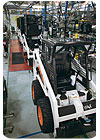
Located in Gwinner, ND, the Bobcat assembly plant produces 29 base models of skid-steer loader in small-, medium and large-frame sizes. Photo courtesy Ingersoll-Rand Co.
However, visitors to the efficient, innovative factory where Bobcats are assembled will quickly see how the company keeps one paw ahead of its imitators.
Located in Gwinner, ND, the facility encompasses 750,000 square feet of manufacturing space spread across 11 acres. The facility produces 29 base models of skid-steer loader in small-, medium- and large-frame sizes. All totaled, the plant assembles approximately 40,000 loaders annually for customers all over the world. “Those machines over there,” says plant manager Dan Antrim, pointing to a series of bright orange loaders progressing down the assembly line, “are headed to Australia.”
The plant operates around the clock, running three shifts per day, five days per week. It employs approximately 1,000 hourly workers and 300 salaried workers. Every employee is graded on four criteria: safety, quality, delivery and cost. “In that order,” emphasizes Chris Young, environmental, safety and health manager for the plant. “Safety always comes first.”
Indeed, new employees must complete a 3-day orientation program before they start on the floor. The second day is a 10-hour safety program for general industry designed by the federal Occupational Safety and Health Administration (OSHA). The third day consists of job-specific safety training conducted by hourly workers. Because newly hired workers are the most likely to be injured, employees who’ve been with the plant less than 90 days must wear a distinctive shirt and are paired with experienced workers for safety mentoring. Even independent contractors at the plant must certify to Bobcat that they follow strict safety practices.
The plant processes 1 million pounds of steel per day. Steel coils weighing 40,000 pounds each arrive at the plant on railcars. The plant’s three coil lines can process steel sheets up to 0.5 inch thick. After the steel is unrolled and cut to length, various shapes are punched out in dies or cut out by high-power lasers.
Then, the steel parts are transferred to automated cells, which fabricate cabs, frames, tailgates, booms, buckets and other parts for the loaders. Some 200 six-axis robots “man” the cells, loading fixtures and welding parts. “Ninety percent of the welding on the cab is done robotically,” says Antrim.
After welding, the assemblies are transferred to the paint line. First, an undercoat is applied via electrodeposition. The assembly is immersed in a bath of water-thinned paint. When an electric current passes between the assembly and another electrode, a thin layer of paint is deposited on every sur-face. The finish coat is applied through a powder coating process. The paint is applied to the surface as a dry, finely ground powder. The assembly is then heated above the melting point of the powder, so that the particles melt and flow together.
The entire process is automated, except for powder application, which is performed manually. Only one operator per shift is needed to paint all the loaders.
After painting, the assemblies are automatically conveyed to the assembly line via overhead power-and-free conveyors.
The welding cells aren’t the only place where robots can be found. Six-axis robots also see duty in the transmission assembly cell, where they are used for material handling and machine tending. Assisted by the robots, only nine operators per shift are needed to assemble all the transmissions for the loaders.
Three drive options are available for the loaders: skid-steering, all-wheel steering or rubber tracks. Nuts and bolts on the transmissions are tightened with DC electric spindles from Bobcat’s sister company, Ingersoll-Rand Productivity Solutions (Annandale, NJ). The spindles are mounted on a vertical linear slide. Computer control allows Bobcat’s engineers to program torque, angle, run-down speed and fastening sequence.
The transmissions are assembled on carts. When the transmissions are completed, the carts are wheeled to the front of the main assembly line. In the near future, Bobcat may use automated guided vehicles to move the transmissions. The plant’s engineers have already scratch-built a couple of prototypes for that purpose.
On the main line, the transmission is matched with an engine, frame, hydraulics and other subassemblies. Buckets, forks, grippers and other attachments are also added. Bobcat offers some 76 attachments for its loaders, including augers, bale handlers, brooms, brush cutters, graders, sweepers, snowblowers and trenchers.
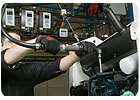
From Sept. 15, 2005, to Jan. 28, 2006, Bobcat employees worked 1,122,560 hours without an accident that caused someone to miss work. Photo courtesy Ingersoll-Rand Co.
Three From One
Until recently, final assembly of all three sizes of skid-steer loader was done on the one central, asynchronous line. That arrangement worked for a long time, but it also created some inequalities. Because Bobcat assembles loaders to order, it was common for, say, one small loader to follow on the heels of two large ones. And since a large loader takes longer to assemble than a small one, production of the small loader would be needlessly delayed.Moreover, the old central line was paced by the operators. That is, when all the assembly operations at a particular station were completed, workers released the loader to the next station. “It was difficult to balance an asynchronous line,” says Antrim.
Bobcat’s managers wanted to assemble the loaders on moving lines that are synchronized with the plant’s takt time. So last year, Bobcat began rearranging its facility to assemble tractors not on one line, but three-one for each size. In January 2007, the small-loader line began operating, while the medium-loader line was still under construction. Once that is complete, the old main line will be remodeled to assemble the large loaders exclusively.
Assembling the loaders on moving lines provides two key benefits. The first is psychological. “People know how much time they have to do something,” explains Antrim. “If the line is moving, they know intuitively that they have to keep pace. When the line is not moving, people tend to take their time.
“A moving line breeds teamwork. If you know the whole line is linked, you’re less likely to ‘starve’ the person downstream from you.”
The second benefit is feedback. On a moving line, production problems are discovered instantly: the line stops. “If there’s a problem, I want to know about it right away,” says Antrim. “On an asynchronous line, when there’s a problem, the line doesn’t stop, you just get a gap in production.”
At start of the new line, newly assembled and painted chassis arrive on carts, which are hooked to a tow-line conveyor on the floor. The carts and the conveyor were designed and built in-house by Bobcat’s own engineers. The conveyor moves the carts 13 inches per minute, which is fast enough to meet takt time requirements, but not so fast that an operator could be seriously hurt if struck by a cart.
By building the conveyor in-house, “we got exactly what we wanted and we know how to fix it,” says Bobcat engineer Jeremy Waliser.
Each assembly station is equipped with a flat-panel display. When a cart arrives at a station, a scanner reads a bar code on the assembly, and the display tells the operator who has ordered the loader and what subassemblies and options to install in the machine.
The new lines are also designed for flexibility and mobility. The tow-line runs just above floor level, rather than a trench. Power and Ethernet control cabling rides in tracks above the line. “If the line had to be reconfigured or even moved to another part of the building, it could easily be done in a few days,” says Waliser.
As part of the renovation, the plant invested heavily in new power tools, particularly computer-controlled DC electric nutrunners from Ingersoll-Rand. The controller automatically configures the tool to the correct torque and angle settings for installing whatever parts were ordered by the customer. The controller also monitors each fastening cycle. If a fastener is omitted or tightened incorrectly, the controller will not let the loader leave the station until error has been corrected. The controller even monitors how much current the tool draws during assembly. If it starts to draw too much current, that could be a sign of wear, and the controller sends an e-mail to a supervisor who can ad-dress the problem.
The plant is also being used as a test site for Ingersoll-Rand’s new IQV series of cordless impact wrenches. Cordless tools eliminate a lot of wasted motion: reaching up and pulling down a corded tool from a tool balancer, or moving a cord over or around an obstacle, says Antrim. With a cordless tool, the operator can keep the tool at his side, ready for use. “You want the people who add value to always be adding value,” says Antrim. “Everything needed for assembly should be at hand, right in front.”
That philosophy is evident at the wheel-assembly station, where operators use a scratch-built hydraulic lifter to raise the loader’s wheels into position for assembly onto the axle. A set of fixtured DC electric spindles tightens the lugs in a specific sequence.
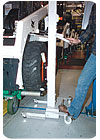
Bobcat emphasizes ergonomics. For example, a scratch-built hydraulic lifter is used to raise a loader’s wheel into position for assembly onto the axle. Photo courtesy Ingersoll-Rand Co.
Sidebar: Gwinner Plant Recognized for Safety, Environmental Management
In December 2006, Bobcat’s Gwinner plant was certified as meeting the requirements of both the ISO 14001 standard for environmental management, and the OSHAS 18001 standard for occupational safety and health. It’s the first Bobcat facility to earn such a distinction.ISO 14001 was developed by the International Organization for Standardization. The standard does not set forth specific environmental performance targets. Rather, it obliges organizations to prevent pollution wherever possible; to constantly improve their environmental performance; and to meet or exceed regulatory requirements. Specifically, the standard requires organizations to:
* implement an environmental management system and regularly review its performance.
* identify and remediate all aspects of its activities, products or services that could significantly affect the environment, including those that are not regulated.
* set goals for environmental performance and measure progress toward achieving them.
The Occupational Health and Safety Assessment Series 18001 standard was developed by a consortium of international standards organizations. It was written to help organizations identify and control health and safety risks; to reduce the potential for accidents; and to comply with state and federal laws govern-ing worker safety.
The plant decided to get certified in May 2006 and achieved the goal in just 7 months, says Chris Young, environmental, safety and health manager at the plant.
The plant’s efforts have paid off dramatically. From Sept. 15, 2005, to Jan. 28, 2006, employees worked 1,122,560 hours without an accident that caused someone to miss work.
The next goal for the plant is to earn a Star Award through the OSHA’s Voluntary Protection Program (VPP). Facilities that earn such a designation are exempt from routine OSHA inspections. On average, injury and illness rates at VPP sites are more than 60 percent below industry norms. And, fewer injuries and illnesses mean less money spend on workers’ compensation premiums and other costs. VPP work-sites have saved more than $1 billion since the program began in 1982.
Looking for a reprint of this article?
From high-res PDFs to custom plaques, order your copy today!