Special Conveyors Transfer Solar Panels on Assembly Line
Surprisingly fragile, solar panels present special challenges for the conveyors transporting them from station to station.
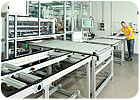
Heckert Solar assembles enough solar panels annually to generate 140 megawatts of electricity. Employing some 125 people, our highly automated factory operates four shifts, 24 hours a day, seven days a week.
The efficiency of the solar panels-the amount of electrical energy the panel is able to convert from light energy-is approximately 15 percent, which is higher than the industry average of 13 percent. Their relatively small size, 1,485 millimeters by 995 millimeters, allows technicians to lift them onto a roof without the need for an elevator. The high demand for this type of environmentally friendly power generation can only be fulfilled with a faultless production technology that includes safe transfer of the modules.
Our polycrystalline and monocrystalline solar panels consist of 54 photovoltaic cells enclosed by a thin, clear film; a super-transparent glass pane; and a warp-resistant aluminum frame. The glass is 4 millimeters thick, slightly curved and prestressed.
These high-tech assemblies present special challenges for the conveyor transporting them from station to station. The panes must not contact each other, accumulate or stop quickly under any circumstances, since the prestress would cause them to break immediately into a thousand shards. And, there’s plenty of starting and stopping on the line: The solar panels change direction seven times on their way through the assembly process.
The TSsolar transfer system from Bosch Rexroth Corp. safely transports the glass panes throughout the factory.
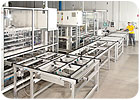
If the glass breaks after the cells have been installed, costs shoot up due to damaged cells, the time required to carefully clean up, and possible damage to the transfer belts and laminating machines. That’s why we decided to go with the TSsolar transfer system. The system was delivered and commissioned just six weeks after design approval.
Based on the TS 2plus, the TSsolar conveyor was developed specifically to meet the demands of the solar industry. Each section element is equipped with its own drive. Frequency converters ensure soft starts and stops. The toothed belts have a closed surface and exhibit low wear and friction thanks to a densely woven textile coating. Lift transverse units adapted to the sections ensure a smooth change in direction when transporting parts. The system is silicone-free, which rules out contamination by silicone, grease or oil. A static-safe version prevents electrostatic charging, which attracts dust particles that could cause problems when the cells are interconnected.
The degree of utilization for the entire system is 80 percent. System integrator Mondragon Assembly set great store by the precise design and programming of the TSsolar. “We visualized all of the belt sections, so users can call them up individually, activate them, and even operate them manually during an emergency,” says Victor Maurer, project manager at Mondragon Assembly.
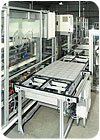
The shock-absorbing lift transverse units must work with the same high level of precision. The cells are placed on the glass at distances accurate to less than a millimeter, interconnected and then laminated. Sliding of the individual cells due to imprecise stops or jerky movements in the lift transverse units would be immediately visible to the naked eye in the finished modules.
The seven changes in direction in the system present a special challenge. The TSsolar deals with this task through optimum synchronization of the two belts that directly support the glass panes. In addition, the maximum speed of 12 meters per minute is slowed down to approximately 30 percent before the stops. Work processes on two levels also require that the glass panes be raised and lowered. Soft decelerations, rather than jerking movements, are preferred here, too.
At the beginning of the process, six individual belt sections carefully transport the glass panes between the washing station and the two soldering machines, which are also called stringers. Here, the solar cells are soldered to each other in single rows and exactly positioned on the prepared glass pane. Two lift transverse units distribute the panes to the stringers. Differences in the transport levels and glass pane deflection are compensated for by two roller sections in addition to the toothed belts. Additional belt sections and lift transverse units then move the glass panes from the stringers to the interconnection unit.
After passing through a preparation section where the modules are inspected, they are then transported to two laminating machines working in parallel, due to the longer processing time required.
For more information on conveyors, call 800-322-6724 or visit www.boschrexroth-us.com.
* Conveyors and Lean.
* Timely Mainenance Extends Conveyor System Life.
* How to Guide: Design Lean Cells for Flexibility.
Heckert Solar assembles enough solar panels annually to generate 140 megawatts of electricity. Employing some 125 people, our highly automated factory operates four shifts, 24 hours a day, seven days a week.
The efficiency of the solar panels-the amount of electrical energy the panel is able to convert from light energy-is approximately 15 percent, which is higher than the industry average of 13 percent. Their relatively small size, 1,485 millimeters by 995 millimeters, allows technicians to lift them onto a roof without the need for an elevator. The high demand for this type of environmentally friendly power generation can only be fulfilled with a faultless production technology that includes safe transfer of the modules.
Our polycrystalline and monocrystalline solar panels consist of 54 photovoltaic cells enclosed by a thin, clear film; a super-transparent glass pane; and a warp-resistant aluminum frame. The glass is 4 millimeters thick, slightly curved and prestressed.
These high-tech assemblies present special challenges for the conveyor transporting them from station to station. The panes must not contact each other, accumulate or stop quickly under any circumstances, since the prestress would cause them to break immediately into a thousand shards. And, there’s plenty of starting and stopping on the line: The solar panels change direction seven times on their way through the assembly process.
The TSsolar transfer system from Bosch Rexroth Corp. safely transports the glass panes throughout the factory.
Each section elements of the conveyor is equipped with its own drive. Frequency converters ensure gentle acceleration and deceleration.
No Touching Allowed
To ensure quality, incoming materials are inspected prior to assembly, including the individual cells that make up each panel. Employees shake each cell, since microcracks are audible when the cell rattles. Visual and technical inspections follow this process. Meanwhile, the glass panes are washed, placed on the conveyor, and covered with film.If the glass breaks after the cells have been installed, costs shoot up due to damaged cells, the time required to carefully clean up, and possible damage to the transfer belts and laminating machines. That’s why we decided to go with the TSsolar transfer system. The system was delivered and commissioned just six weeks after design approval.
Based on the TS 2plus, the TSsolar conveyor was developed specifically to meet the demands of the solar industry. Each section element is equipped with its own drive. Frequency converters ensure soft starts and stops. The toothed belts have a closed surface and exhibit low wear and friction thanks to a densely woven textile coating. Lift transverse units adapted to the sections ensure a smooth change in direction when transporting parts. The system is silicone-free, which rules out contamination by silicone, grease or oil. A static-safe version prevents electrostatic charging, which attracts dust particles that could cause problems when the cells are interconnected.
The degree of utilization for the entire system is 80 percent. System integrator Mondragon Assembly set great store by the precise design and programming of the TSsolar. “We visualized all of the belt sections, so users can call them up individually, activate them, and even operate them manually during an emergency,” says Victor Maurer, project manager at Mondragon Assembly.
Once they’re outfitted with 54 solar cells, the panels are transported to the stringer, which solders them together.
An Air-Cushioned Stop
Fixed stops with air nozzles are another feature of the transfer system. An air cushion quickly raises the film, which protrudes just beyond the glass pane, enabling the stops to only grip the pane and correctly align it. This enables the conveyor to position the panels with a precision of 0.5 millimeter with the stops and prevents the film from sliding or being pulled off the glass. This precise positioning is especially essential before the panes reach the stations where the cells are laminated on the module. This solution is the result of cooperation between Heckert Solar, Mondragon Assembly and Rexroth’s technicians.The shock-absorbing lift transverse units must work with the same high level of precision. The cells are placed on the glass at distances accurate to less than a millimeter, interconnected and then laminated. Sliding of the individual cells due to imprecise stops or jerky movements in the lift transverse units would be immediately visible to the naked eye in the finished modules.
The seven changes in direction in the system present a special challenge. The TSsolar deals with this task through optimum synchronization of the two belts that directly support the glass panes. In addition, the maximum speed of 12 meters per minute is slowed down to approximately 30 percent before the stops. Work processes on two levels also require that the glass panes be raised and lowered. Soft decelerations, rather than jerking movements, are preferred here, too.
At the beginning of the process, six individual belt sections carefully transport the glass panes between the washing station and the two soldering machines, which are also called stringers. Here, the solar cells are soldered to each other in single rows and exactly positioned on the prepared glass pane. Two lift transverse units distribute the panes to the stringers. Differences in the transport levels and glass pane deflection are compensated for by two roller sections in addition to the toothed belts. Additional belt sections and lift transverse units then move the glass panes from the stringers to the interconnection unit.
After passing through a preparation section where the modules are inspected, they are then transported to two laminating machines working in parallel, due to the longer processing time required.
For more information on conveyors, call 800-322-6724 or visit www.boschrexroth-us.com.
ASSEMBLY ONLINE
For more information on conveyors, visit www.assemblymag.com to read these articles:* Conveyors and Lean.
* Timely Mainenance Extends Conveyor System Life.
* How to Guide: Design Lean Cells for Flexibility.
Looking for a reprint of this article?
From high-res PDFs to custom plaques, order your copy today!


