Specialty Fasteners
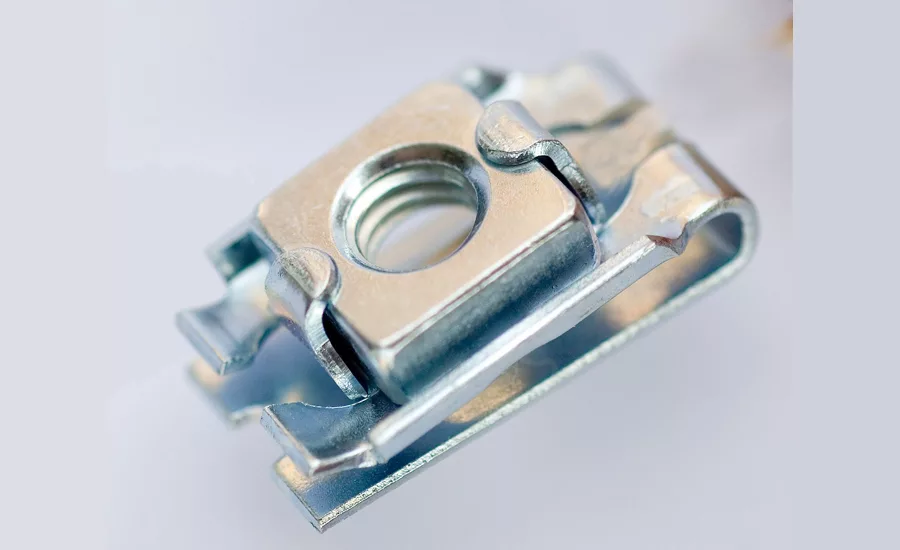
Speed Nuts
A Speed Nut is a reusable, one-piece, self-locking fastener made of thin, heat-treated spring steel. Two prongs arch upward from the screw hole, and the fastener base is usually bowed. When the screw is tightened, the arch in the base diminishes, forcing the prongs inward and upward at the root of the threads. The prongs provide an inward thread lock and an arched spring lock that are energized as the screw tightens. The combined forces of this double-locking action resist loosening caused by vibration.Speed Nuts can be used instead of threaded nuts, lock washers or spanner washers, and they do not require special tools to install. Unlike ordinary threaded nuts, Speed Nuts do not have to be tightened with a great amount of torque. In fact, any torque applied beyond the recommended installation torque could cause a loss of spring tension resiliency.
Speed Nuts are available in many shapes, finishes and variations. For example, greater strength can be achieved by increasing the material thickness of the nut and using A- or B-type sheet metal screws. However, because A- or B-type screws taper at the end, longer screws must be used. Sheet metal screws must protrude two to three threads beyond the prongs to ensure adequate grip on the full root diameter of the screw. (Machine screws should protrude 1.5 threads beyond the Speed Nut, the same as with any nut.)
The thread of the Speed Nut can also vary. For example, making the prongs longer and more resilient enables the assembler to "zip" the fastener down over the screw threads. Only one or two turns are then necessary to tighten the screw. This type of nut is good for rapid assembly, but not for heavy loads. The prongs can also be made to provide a restraining torque at any location on the screw threads. This fit is recommended when the fastener is used as an adjustment nut.
The profile of Speed Nuts can be altered for special applications. For example, J- and U-type Speed Nuts are used for blind assembly or hard-to-reach locations. They are pressed into position over panel edges or in center-panel locations. This gives the assembler the ability to float alignment, speeding production and decreasing rejects.
Expansion-type nuts are another Speed Nut variation for blind or center-panel locations. These fasteners snap into square or round holes and are self-retained by spring legs. Special locking tabs can be provided when permanent fastener retention is desired. As the screw is driven, it expands the spring legs, locking them over the panel thickness and at the same time providing a double-locking action on the screw.
Retaining Rings
Retaining rings are circular fasteners that, when installed in a groove, hold components on a shaft or inside a bore. They are commonly used to hold gears or cams on shafts. Manufacturers have used the fasteners to hold the cutters on a shredder's shaft, retain a valve on an automotive fuel rail assembly and keep components on a washing machine's drive shaft. Retaining rings are even used on the tread adjustment mechanism of the M1 tank.These fasteners are removable and reusable. They often do the job of several parts by replacing cotter pins, nuts and washers.
Retaining rings can be axial, radial or self-locking. Axial retaining rings are slipped, horizontally, over a shaft along its axis. They have lugs and lug holes to facilitate installation. Once installed, they make almost complete circular contact with the groove, which enables them to withstand significant thrust loads. Also known as open rings, radial retaining rings are for low-thrust load applications. They don't have lugs or lug holes, and they do not extend as far around the circumference of the groove as axial rings. Self-locking retaining rings do not require a groove for installation. They are used in small applications with very low thrust loads.
Looking for quick answers on assembly and manufacturing topics? Try Ask ASM, our new smart AI search tool. Ask ASM
Axial retaining rings can be further classified as external or internal. An external ring goes over a shaft, snaps into a groove, and exerts radial tension toward the ring center. An internal ring goes through a housing or bore, snaps into a groove and exerts radial tension outward from the ring center.
All radial retaining rings are external. They are applied vertically toward the center of the circular shaft along its radius. Although they handle less force than axial rings, radial rings have their own advantages. They can be installed on a stepped shaft in place of an axial ring, which could be overstressed during installation. The same size radial ring can be installed on a larger shaft by deepening the groove. And because they're made of less material, radial rings cost less than axial ones.
Retaining rings are usually made from carbon spring steel with a hardness rating of 42 to 53 on the Rockwell C scale and a tensile strength of 192,000 to 280,000 psi. A variety of finishes is available.
The rings can be made in various cross-sectional profiles, depending on their function and the shapes of the mating components. The most popular cross-sectional shapes are rectangular, square and round. However, they can also be made in tongue, beveled, tapered, chamfered and other shapes.
In addition, both internal and external axial retaining rings can be bowed to help assemblers overcome problems with accumulated tolerance variations. For example, if the components on the shaft are slightly less than the specified dimensions, the assembly will be loose if it is fastened with a flat retaining ring. A bowed retaining ring solves the problem. Its curved shape acts as a spring, compensating for the slightly undersized pieces and holding the assembly firmly in place.
Retaining rings can be installed with hand tools or pneumatic tools, or with fully or semiautomatic equipment.
Rivet Nuts
Most fasteners that provide permanent load-bearing threads in thin materials require both sides of the workpiece to be accessible during installation and final assembly. When the workpiece can only be accessed from one side, threaded rivet nuts provide a solution.Threaded rivet nuts are made from aluminum, brass, steel or stainless steel and can be used instead of tapped holes, weld nuts, rivets and self-drilling or tapping screws. Installed from the accessible "front" side of the workpiece, rivet nuts provide strong, permanent metal threads in metal or plastic sheets as thin as 0.02 inch. Rivet nuts do not require additional hardware beyond a mating screw.
Unlike weld nuts or self-clinching nuts, rivet nuts can be installed anywhere in a shop without requiring dedicated assembly locations. They can also be installed in the field for maintenance and repair. Rivet nuts can be installed after product finish is applied.
To install a rivet nut, the operator begins by threading it onto the tip of a pneumatic installation tool and inserting the fastener into a drilled or punched hole. When the tool is acti-vated, the tip spins and retracts, bulging the unthreaded portion of the rivet nut shank against the reverse side of the sheet and locking the nut permanently in place. The tip then reverses direction so the tool can be removed. A mating screw completes the assembly. An experienced operator can typically install 500 rivet nuts per hour.
In automobiles, rivet nuts are used to attach mirrors, lights, luggage racks, radiators, spoilers and antilock braking modules. Rivet nuts are used to attach trays to aircraft seats, and handles and hinges to appliances. They are often installed in electronics cabinetry, as well as in roll forms, tubing, extrusions and other closed structures.
Rivet nuts can be classified in two basic groups: standard and heavy duty. Standard rivet nuts are available in unified thread sizes from #6-32 to 1/2-16 and metric thread sizes from M4 to M10. Heavy duty rivet nuts typically come in unified thread sizes of #6-40 to 1/2-13 and metric thread sizes of M3 to M12. Both types come in various head and body configurations to meet spe-cific parameters.
Sidebar: Bushing and Rings Control Vibration
Rubber or plastic isolators, such as grommets, washers or bushings, provide a relatively inexpensive, off-the-shelf way to control vibration in equipment containing fans, motors, actuators or other mechanical devices. For example, by using a small elastomer donut to make a soft connection, it is possible to stop the cooling fan in a notebook computer from transmitting vibration to other components or to the plastic shell.A two-piece isolator--or ring or bushing--provides an ideal solution when the thickness of the mounting area varies from case to case, or if it does not match the dimensions of standard grommets. In some applications, particularly those involving manual assembly, a grommet that comes apart may be easier to insert than a one-piece grommet. Generally, an elastomeric one-piece grommet is preheated to increase pliability and ease the installation process.
In many cases, a ring and bushing combination gives engineers more fastening flexibility, by making the connection adjustable. The ring can be positioned anywhere along the length of the bushing's shank. Another option would be to use two bushings for the installation, either shank to flange or shank to shank.
As with one-piece grommets, design engineers will need to calculate the load per isolator and the expected operating temperature before they can choose the geometry of the bushing and the material from which it will be molded. They also must identify the specific vibration frequencies that need to be isolated.
If an isolation problem entails a single, predictable vibration source, an isolator molded from virtually any elastomeric material will decouple the source from its environment and stop the transmission of vibration. However, if there are several energy sources, including devices that start and stop or cycle through a series of functions, shock impulses must be addressed as well. In that case, an elastomer with damping capabilities can both provide a soft connection and absorb and dissipate potentially damaging shock energy.
For more information, call E-A-R Specialty Composites at 877-327-4332 or visit www.earsc.com.
Looking for a reprint of this article?
From high-res PDFs to custom plaques, order your copy today!