Automation Helps EU Manufacturer Compete
Conventional wisdom tells us that running an electronics manufacturing operation within the mainland European Union (EU) is not cost-effective against the lower labor costs of Central Europe, Mexico or the Far East. This is especially the case when odd-form components are involved. A new Siemens manufacturing facility at Siegendorf, 70 kilometers south of Vienna, embodies a unique manufacturing philosophy that allows it to offer a consistently high-quality product and compete effectively against lower cost geographic regions.
The new operation produces circuit boards for the control panels on a broad range of high-profile brand-name white goods such as washing machines and dishwashers. Variants of many boards are required by the OEMs to accommodate specific functions offered in different models.
A common feature of white goods consumer electronics is the high number of through-hole components, large power devices and connectors. This was a major issue when Siemens proposed to build a new greenfield facility in Austria to take over assembly of products being built at its factory in Frenstat (Czech Republic).
Maximize Automation
The boards being built in Frenstat were designed for manual insertion, except for some parts of the boards that featured surface mount components. At the time, the Frenstat facility was being changed over to focus on automotive production. This presented an ideal opportunity to move production of the boards for the white goods products into a new factory that maximized automation.
The principal objective was to minimize, or even eliminate, any manual assembly operations. Achieving this objective was by no means straightforward because all board designs already existed. Hence, changing entirely to surface mount to ease the automation burden was not an option. Worse yet, all of the boards featured many components that are notoriously difficult to assemble with automated equipment.
Requirements to eliminate errors in handling non-soldered components, manual insertion and wave soldering added to the challenge. Additional goals included clinching the leads of all through-hole components, reduced cycle times, and fast changeover capability.
Another objective was to gain a competitive edge in quality and speed. Maximizing the use of automation to minimize manual insertion of odd-form components was the key to achieving this objective. The result is a "5+1 policy"-5 days of continual production plus one day for product changeover.
Looking for quick answers on assembly and manufacturing topics? Try Ask ASM, our new smart AI search tool. Ask ASM
Success depended entirely upon being able to match low labor costs, which was a challenge despite the fact that 25 percent of the cost of the Siegendorf plant was subsidized by a rural development grant from the EU.
Lines and Cells
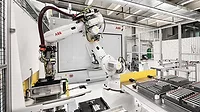
For surface mount and through-hole components, the assembly process is straightforward. The major challenge was in automating odd-form component assembly, but this also offered the largest opportunity to both reduce labor costs and maintain consistently high quality. Polaris Assembly Cells from Universal Instruments Corp. (Binghamton, NY) were installed to perform odd-form component assembly.
The current factory floor configuration consists of two parallel production lines. Installation of a third production line is imminent.
Each line includes automated equipment for placing surface mount components, inserting through-hole components, and inserting or placing odd-form components. No manual handling of individual multiboard panels is required as the panels move through the sections.
One final stage of hand assembly is still required for some product variants, typically to install power devices attached to large heat sinks. After assembly and soldering, all boards are subjected to in-circuit and functional testing.
Each of the current lines includes three Polaris cells assembling a wide range of odd-form components, including connectors, relays, potentiometers and custom wound devices. In addition to standard Polaris features, the Siegendorf cells have some unique features, including a modified underside clinch system that handles sensitive three-leaded components such as potentiometers. Here, two leads are clinched first, then the clinch mechanism is moved to secure the third lead.
The Polaris Servo-Gripper Assembly Cell derives its name from a servo-gripper head mounted to a servo-driven X-Y-Z-Θ Cartesian robot. Each of the Siegendorf machines is equipped with a servo-driven X-Y-Θ and span clinch assembly. The standard triple-stage board handler transfers boards in 1.7 seconds. Pin locators are included with the board handler, eliminating the need for fiducials. Each Polaris cell places three to five components ranging from 8-millimeter long, single-row connectors to 50-millimeter square safety switches on each board.
The Polaris lines are extremely flexible in that each consists of three identically configured machines. The same product can be run on each line as needed to meet market demands. Interchangeable feeders allow components to be transferred from one Polaris cell to another. Although the performance of the cells was not always 100 percent, the original goals have been achieved. More importantly, performance to date has shown clearly how else the equipment resources can be deployed to further improve the process.
Feeders, IT and Deadlines
Three significant challenges faced the application engineers: the provision of custom feeders, interfacing with a sophisticated factory information system, and a very tight deadline for production startup. Although 95 percent of the component feeders were standard, some feeders customized for odd-form components were required. Design of the custom feeders was delayed by lack of packaging specifications for the odd-form components. Once these were obtained, a fast turnaround by Universal allowed production to start on schedule.
The entire production flow had to be paperless, and traceability was a top priority. This was not a demand from the customers, but rather from the foresight to set up the factory in a way that would increase the scope of products it could manufacture in the future.
At every step of the manufacturing process, 2D bar code readers track the progress of multiboard panels during assembly. Readers also track individual boards through the test area after they are separated from the panels. A centralized factory information system holds data on all board types and every board manufactured. It also logs faults and errors with each board as it moves through the production process.
The Polaris machines can access this central data base to retrieve board data for validating the assembly program and activating the feeders required. Proprietary modular software called Change Over Control was developed to handle the communication interface to the factory server for time-stamping, traceability, product setup, validation and quality data.
Less than 5 months were allowed from breaking ground in Siegendorf to commencing the first production run. Considering the complexity of the project, and that it was carried out with 300 new employees from the local vicinity, meeting the implementation deadline was a significant accomplishment.
Going Forward
Among the objectives for greater cell utilization is to enable the cells to handle a wider range of odd-form components, such as radial components with 15-, 20- and 21-millimeter lead spacing. The packaging for these devices does not lend itself to consistent lead accuracy, and that is difficult to change because the components were not designed to facilitate automation. These devices can be placed using machine vision, but that takes longer and impacts the overall cycle time goals.
The next move will be to integrate the stand-alone process sections into a single contiguous line. This will reduce handling of multiboard panels, increasing throughput and productivity.
If one were to begin anew, the ideal approach would be to design the boards to eliminate the axial- and radial-lead components and replace them entirely with surface mount components. That remains as a long-term goal, but current product designs are fixed. So, for the immediate future it will be necessary to develop and adapt feeders so that the Polaris cells can handle as many through-hole and odd-form components as possible.
Boards assembled in the Siegendorf factory ship to 12 facilities worldwide, with 90 percent going to Europe and the rest going to China and the United States. The facility proves that the right manufacturing philosophy, backed up by the correct equipment and resources, can make manufacturing in the heartland of Europe viable compared with the traditional low-labor-cost regions of the world.
For more information on odd-form component insertion and placement, call 607-779-5092 or visit www.uic.com.
Looking for a reprint of this article?
From high-res PDFs to custom plaques, order your copy today!