Assembly Magazine logo
search
Ask ASSEMBLY AI
cart
facebook twitter linkedin youtube
  • Sign In
  • Create Account
  • Sign Out
  • My Account
Assembly Magazine logo
  • TRENDS
    • Ask ASSEMBLY AI
    • Trends
    • News
    • New Products
  • INDUSTRIES
    • Aerospace
    • Appliance
    • DFMA Assembly
    • Medical Devices
    • Green Manufacturing
    • Lean Manufacturing
    • Machinery Assembly
    • Electronics Assembly
    • Automotive
  • TECHNOLOGIES
    • Adhesives & Dispensing
    • Assembly Presses
    • Automated Assembly Systems
    • Manufacturing Management
    • Manufacturing Software
    • Motion Control
    • Screwdriving & Riveting
    • Robotics
    • Test & Inspection
    • Plastics & Metal Welding
    • Wire Processing
    • Workstations
  • AUTONOMOUS & ELECTRIC MOBILITY
    • AEM Magazine Archives
    • Autonomy
    • Electrification
    • Mobility Services
    • Assembly & Testing
    • AV/EM News
  • MEDIA
    • Ask ASSEMBLY AI
    • Podcasts
    • Assembly News Now
    • Assembly TV
    • Webinars
    • eBooks
  • EVENTS
    • Calendar
    • The ASSEMBLY Show
  • MORE
    • Exclusives >
      • Plant of the Year
      • Capital Spending
    • Buyers Guide >
      • Supplier Insights
    • Classifieds
    • Featured Products
    • Newsletters
    • Store
    • White Papers
    • Columns
    • Sponsor Insights
  • INFOCENTER
    • Assembly & Test Solutions
  • EMAGAZINE
    • eMagazine
    • Archive Issues
    • Advertise
    • Contact Us
    • Sign Up
IndustriesTechnologiesAutomotive AssemblyAutomated Assembly SystemsRobotics AssemblyAssembly and TestingAV/EM NewsElectrification

Automotive

Robotic Automation Helps Auto OEMs Navigate EV Market Uncertainty

In addition to designing and engineering an entirely new class of vehicle, manufacturers have had to figure out a way of building them, and to do so in a way that achieves optimum quality levels.

By Alex Miller
Battery Pack Assembly

Image Source: Source: ABB

February 12, 2025

With a new administration assuming control of the federal government in January 2025, there is much uncertainty for U.S. automakers.

What will become of aggressive automotive emissions-reduction policies? Are the Inflation Reduction Act’s consumer tax credits for electrical vehicle (EV) purchases soon to be eliminated? How will tariffs on foreign-made products reshape the marketplace? Will the UAW’s stronghold on automotive labor policies erode?

These are just a few of the challenges, and potential opportunities, that face the U.S. auto industry as it balances long product development and lifecycle timelines alongside political influences that seem to oscillate every four years.

One thing that is certain, however, is that we are entering a critical period in the transition from internal combustion engine (ICE) vehicle to EVs. OEMs and Tier Suppliers have made massive investments to develop essential energy storage resources, supply chain relationships and production capabilities. Though the market has not taken off quite as rapidly as many expected, it is a matter of ‘when’, not ‘if,’ EVs become the standard mode of over-the-road personal and commercial transportation.

Battery Module Assembly
Image Source: ABB

EVs: A new Class of Vehicle Manufacturing

In addition to designing and engineering an entirely new class of vehicle, manufacturers have also had to figure out a way of building them, and to do so in a way that is cost-effective, sustainable, and achieves optimum quality levels.

“EV plants have radically different layouts and production methods. ICEs may have traditionally been built elsewhere and shipped to an assembly plant as a completed unit,” said Patrick Matthews, global group manager of ABB Robotics’ EV assembly business. “But with EVs the powertrain is often integrated far earlier in the production process. Battery packs are increasingly assembled on-site from their individual modules in a parallel process, with the completed units – now designed as a structural element in many new EVs – joining the body at a much earlier stage.”

To compound matters, EV powertrain systems are still evolving rapidly, with changes that affect, to varying degrees, how a production facility is designed. Solving this dilemma demands unprecedented flexibility. As with ICE vehicles, the flexibility of robotic automation will play a key role in the manufacturing of EVs of all types.

Looking for quick answers on assembly and manufacturing topics? Try Ask ASM, our new smart AI search tool. Ask ASM →

AMR transporting in process car frame.
Image Source: ABB

Robotic Automation helps OEMs adapt Production to Market Demand

With robotic automation, OEMs can start small and ramp up production as demand increases. Key to this approach has been the adoption of AGVs (automated guided vehicles) and AMRs (autonomous mobile robots). These robotic platforms transport parts throughout the production facility, perhaps from logistics to the point of need on the line. While AGVs tend to follow pre-defined routes, AMRs are capable of intelligently navigating within their space, avoiding obstacles and even optimizing their journey.

“AMRs and AGVs help auto manufacturers unravel traditional long-line production architectures and deploy dedicated modular cells, providing the ability to modify or even replace individual cells without incurring costly production interruptions,” says Joerg Reger, managing director of ABB Robotics’ automotive business. “These zero-loss production changes allow OEMs to start small and scale up key parts of the assembly process by adding or redeploying cells as demands change. By engineering flexibility into the process, we create the means to not just manage this rising complexity, but to turn it into an opportunity.”

Gone is the traditional two-week shutdown to allow lines to be reconfigured with each model year; these changes can now be made almost on the fly, and without the need for the huge capital expenditure that comes from wholesale layout changes.

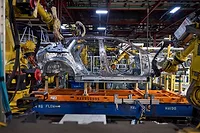
AMR transporting in process car body.
Image Source: ABB

Challenges Specific to EV Manufacturing

EVs may use fewer parts overall, but those parts tend to be heavier than their ICE vehicle equivalents. Gas tanks have been replaced by batteries, while electric motors with rotors and stators are replacing engine blocks, pistons and cylinder heads. Complex transmissions are being replaced by much simpler gearboxes. This is changing well-known and well-defined manufacturing processes and driving both suppliers and OEMs to re-think their automation solutions. Robots and AGVs working together will be a key driver in this transformation, with many typical use cases calling for high payload and extended reach, a challenging process for the typical automotive six-axis robot.

As well as weight and reach, the industry demands speed. Thanks to advances in control software, robots can operate at higher speeds without sacrificing accuracy. Even when manipulating heavy payloads at maximum extension, fine control can be preserved, and this has allowed the new generation of more powerful six-axis robots to replace long and winding conveyor routes to transport vehicle bodies within a far more compact footprint than before, saving space, time, and creating flexibility.

Improvements in vision systems over recent years have opened the door to a range of exciting new developments that are already helping to drive even greater levels of efficiency in manufacturing. Although modern car production appears as a continuously moving stream, in reality at key points in the cycle the vehicle must stop to receive a key component or undergo a critical process, such as the installation of the pre-assembled powertrain.

Battery Module Assembly II
Image Source: ABB

Vision- and Force-Control Enabled Robots

With vision- and force control-enabled robots interacting with AGVs, it’s now possible to install components such as underbody battery packs while the vehicle is still in motion, with the moving platform matching its speed to that of the suspended body while the on-board cameras detect and synchronize with critical mounting points.

This moving-line assembly isn’t just faster; with the requirement to stop removed, floor-mounted shock pins are no longer needed. That increases flexibility that can ripple throughout the factory, and makes the assembly line less model specific, making it possible to use the same line or production cell for a variety of different models. That, in turn, leads to a smaller overall factory footprint, as well as a significantly reduced capital expenditure.

Vision systems are improving the speed and quality of welding operations, too, and when coupled with advanced artificial intelligence and machine learning systems, their ability to spot minute defects can now match or even surpass that of the most experienced human operative. Using models trained on millions of examples, these automated systems can automatically assess the quality of a weld in a fraction of a second just by analyzing a few rapid-fire photographs.

Of course, this approach generates and relies upon vast quantities of data. From tracking information for each individual component to the torque delivered to every bolt and screw, the challenge once all this data has been gathered is to figure out how best to use it. One possible solution is to create a machine-based equivalent of the experienced and reliable human that customers call on whenever a problem arises. By understanding the steps the human follows when presented with a particular situation, a machine can be made to replicate that diagnostic process, supported by the reams of collected data. As a result, production cells can address problems automatically, while optimizations can be made that cut installation times and improve cycle times.

That learning process is even being applied to the humble fastener. With force control, a robot can ‘feel’ their way around a mounting point, making minute adjustments to its position and sensing when the part begins to locate, adapting the force applied all the while, much as a human would.

Battery Pack Assembly II
Image Source: ABB

Summary

Robotic automation in EV manufacturing is not just a matter of improving efficiency, reducing costs, and ensuring product quality, it is also a valuable means to innovate and adapt to new market demands with unmatched flexibility. From battery production to final assembly, robots will continue to play a central role in scaling up EV production, and, as technology advances, more sophisticated systems will emerge, further integrating AI, vision and data analysis into a highly advanced manufacturing algorithm.

Chassis Manufacturing - Battery Tray Placement
Image Source: ABB
Chassis Manufacturing - Spot Weld
Image Source: ABB


Common Components of Robotically Automated EV Production

Fast, accurate and flexible robots are available in a range of payloads and reaches, enabling more cost-effective production, with enhanced quality control and improved safety for workers.

Battery Tray Manufacturing

Fabricating a structural base to securely hold and protect the battery pack. Robotic processes include various forms of welding, gluing, sealing, painting and inspection.

Battery Module Assembly

A multi-stage process involving the integration of individual battery cells into larger, functional modules. SCARA robots are typically used for their speed and precision in handling smaller parts.;

Battery Pack Assembly

Combining the modules into the final battery pack. The pack assembly process includes arranging the modules within the battery pack housing, ensuring that the weight distribution is balanced, and that cooling is optimized.

E-motor Assembly

Key tasks include rotor and stator assembly, and screwing electronic components into power electronic boxes. Robotic processes include gluing, screwing, 3D quality inspection, handling and final assembly and parts transfer between stations

Chassis Component Manufacturing

Core automotive joining technologies for chassis components, including the main automotive parts, from pillars, doors, bumpers, cross-car beams, battery tray, frames, axles and seats. Robotic processes include various forms of welding, gluing, sealing, painting and inspection.

Megacasting Machining

A large-scale, high-pressure die-casting process where multiple parts are combined into one large aluminum piece that can be quickly produced in a single process. Reduces the time, cost and footprint of vehicle manufacturing.


READ MORE

  • Collaborative Robots Emerge as Viable Automation Options for SMEs
  • Robots Pave Way For Sustainable Mobility
  • Electric Vehicles and a Systematic Approach to Climate Change


This article was originally posted on www.qualitymag.com.
KEYWORDS: electric car manufacturing electric vehicle manufacturing factory automation

Share This Story

Looking for a reprint of this article?
From high-res PDFs to custom plaques, order your copy today!

Alex Miller, Contributing Writer

Recommended Content

JOIN TODAY
To unlock your recommendations.

Already have an account? Sign In

  • Made in the U.S.A.

    Consumer Products Manufacturing: Made in the USA

    Supply chain lessons learned during the coronavirus...
    Automated Assembly Systems
    By: Austin Weber
  • Best Practices for Press-Fit Assembly

    Best Practices for Press-Fit Assembly

    In manufacturing, ironclad formulas for success are hard...
    Assembly Presses
    By: Jim Camillo
  • aem0523leader-tesla1.jpg

    Tesla Rethinks the Assembly Line

    Engineers at Tesla Inc. have developed a new process that...
    Industries
    By: Austin Weber
Manage My Account
  • eMagazine Subscription
  • Assembly Newsletters
  • Online Registration
  • Subscription Customer Service
  • Manage My Preferences

More Videos

Sponsored Content

Sponsored Content is a special paid section where industry companies provide high quality, objective, non-commercial content around topics of interest to the ASSEMBLY audience. All Sponsored Content is supplied by the advertising company and any opinions expressed in this article are those of the author and not necessarily reflect the views of ASSEMBLY or its parent company, BNP Media. Interested in participating in our Sponsored Content section? Contact your local rep!

close
  • ultrasonic welding
    Sponsored bySonobond Ultrasonics

    Engineering Efficiency in High-Performance Assembly: How Ultrasonic Welding Enhances Throughput, Reliability and Quality

  • UV curing system
    Sponsored byDymax

    Why UV Intensity Alone Doesn’t Define Curing Performance

  • wooden pallets
    Sponsored byLEAN Manufacturing Products

    Eliminating Waste on the Shop Floor: Applying Lean Principles to Improve Manufacturing Efficiency

Popular Stories

ASSEMBLY News Now, episode-30: Volvo Redesigns EV Manufacturing

Volvo Redesigns EV Manufacturing

Boeing CEO Kelly Ortberg announces 1 billion investment

Boeing Plans $1 Billion Wichita Investment, Workforce Training Center

automated consumer goods assembly system

Best Practices for Cycle Time Optimization

Watch the latest episode of ANN now!

Events

July 24, 2025

From Shop Floor to CFO: How Manufacturers Are Closing the Loop Between Operations and Finance

On Demand Learn how manufacturers are bridging the gap between the shop floor and ERP systems to gain real-time visibility, streamline operations, and kick-start digital transformation—without waiting years.

Sponsored by:

PicoStratusGreen
July 30, 2025

Buffer Analysis and Design Fundamentals for Manufacturing Excellence

On Demand In this presentation, Dr. Herman Tang shares practical insights from his industry experience and research on buffer management in manufacturing operations.

View All Submit An Event

Poll

Difficult Assembly Processes

Which assembly process gives you the most difficulty?
View Results Poll Archive

Products

Manufacturing Cost Policy Deployment (MCPD) Profitability Scenarios: Systematic and Systemic Improvement of Manufacturing Costs

Manufacturing Cost Policy Deployment (MCPD) Profitability Scenarios: Systematic and Systemic Improvement of Manufacturing Costs

See More Products
Register for webinar - Modernizing Automotive Assembly: Why Upgrading Legacy MES is a Business Imperative

Related Articles

  • Plastic Helps Auto Engineers Tackle Weight Challenge

    See More
  • GMSpringHill.jpg

    Honda Discontinues GM-Built Acura ZDX Amid EV Market Headwinds

    See More
  • New VW Plant Helps Launch Auto Industry Comeback

    See More

Related Products

See More Products
  • Robotic Micro-Assembly

  • Assembly Processes: Finishing, Packaging, and Automation

See More Products

Related Directories

  • Swift Navigation

  • AutoGuide Mobile Robots

  • Ergo-Help Inc.

×

Never miss the latest news and trends driving the manufacturing industry

Stay in the know on the latest assembly trends.

JOIN TODAY!
  • RESOURCES
    • Advertise
    • Contact Us
    • Directories
    • Manufacturing Division
    • Store
    • Want More?
  • SIGN UP TODAY
    • Create Account
    • eMagazine
    • Newsletters
    • Customer Service
    • Manage Preferences
  • SERVICES
    • Marketing Services
    • Reprints
    • Market Research
    • List Rental
    • Survey/Respondent Access
  • STAY CONNECTED
    • LinkedIn
    • Facebook
    • Instagram
    • YouTube
    • X (Twitter)
  • PRIVACY
    • PRIVACY POLICY
    • TERMS & CONDITIONS
    • DO NOT SELL MY PERSONAL INFORMATION
    • PRIVACY REQUEST
    • ACCESSIBILITY

Copyright ©2026. All Rights Reserved BNP Media, Inc. and BNP Media II, LLC.

Design, CMS, Hosting & Web Development :: ePublishing