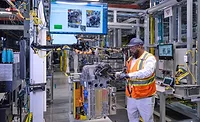
Fuel Cells: Fact, Not Fiction
Fuel cells are no longer science fiction. They're a fact. However, most fuel cells are still assembled one at a time in laboratories. To achieve their true promise and potential, fuel cells will need to be mass-produced in a cost-effective manner.
ASSEMBLY magazine hosted a panel discussion at the recent Assembly Technology Expo in Rosemont, IL, to explore the challenges of fuel cell manufacturing. Four experts examined some of the mass production issues that must be addressed before fuel cells can become cost-effective for commercial applications. The panelists were:
Mike Krumpelt, manager of the fuel cell development program at Argonne National Laboratory (Argonnne, IL). He has been researching fuel cell technology since 1978. The U.S. Dept. of Energy facility has been at the forefront of hydrogen power research for more than 20 years, creating a wide variety of fuel cell designs and applications.
Rodger McKain, president of SOFCo-EFS Holdings (Alliance, OH). His company is developing planar solid oxide fuel cell technology using a low-cost approach to manufacturing. Working in conjunction with Cummins Power Generation Inc. (Columbus, IN), the company is producing a fuel cell for distributed power applications that will be commercially available by the end of 2005.
Stan Ream, automotive market leader at the Edison Welding Institute (Columbus, OH). He specializes in developing solutions to the joining challenges facing the auto industry. The organization has been researching alternative methods to assemble fuel cell components with adhesives, brazing and laser welding.
Chris Tynan, director of the Illinois 2H2 Coalition (Chicago). He is responsible for establishing public-private partnerships to spur the growth of the fuel cell industry. The organization's goal is to make Illinois a world leader in the fast-growing hydrogen economy.
Big Potential
After years of fuel cell research and development, questions of "if" are finally becoming "when." As a result, fuel cells will be to the 21st century what the steam engine was to the 19th century and the internal combustion engine was to the 20th century.
A fuel cell is a device that produces electrical energy from the chemical reactions between hydrogen and oxygen. The continuous process is environmentally friendly because it emits pure water vapor.
Looking for quick answers on assembly and manufacturing topics? Try Ask ASM, our new smart AI search tool. Ask ASM
Fuel cells seem simple, but they are complex devices that include many different components, including fuel cell stacks that resemble a sandwich, a fuel tank, a fuel processor, an air supply subsystem, a cooling subsystem and controls.
According to Principia Partners (Exton, PA), production of fuel cells is predicted to grow at rates exceeding 40 percent per year over the next decade. The market for these trend-setting devices is expected to reach $20 billion by 2010.
A recent study conducted by PricewaterhouseCoopers (New York) is even more bullish. It predicts that the global fuel cell industry will reach $46 billion by 2011.
Manufacturers around the world are scrambling to harness the potential of fuel cells. They're currently spending millions of dollars in research and development, hoping to reap huge rewards down the road. For instance:
- General Motors Corp. (Detroit) is investing $50 million annually in fuel cell technology and has a team of more than 600 engineers working on the project.
- Boeing Co. (Chicago) is currently developing an electric-motor-driven airplane powered by fuel cells.
- General Electric Co. (Fairfield, CT) is investing more than $10 million a year in fuel cell development.
- Motorola Inc. (Schaumburg, IL) is developing miniature fuel cells for powering cell phones, laptop computers, digital cameras and other portable electronic devices.
- NEC Corp. (Tokyo) plans to market a notebook PC with a built-in fuel cell by the end of next year.
In addition, numerous companies have sprung up in Canada and the United States, such as Ballard Power Systems Inc. (Burnaby, BC) and Fuel Cell Energy Inc. (Danbury, CT), to develop and produce fuel cells that they plan to market to original equipment manufacturers. For instance, General Motors is still weighing the pros and cons of manufacturing fuel cells in-house or outsourcing production to third parties.
Numerous products and industries will be affected by fuel cells. Most attention focuses on the auto industry. But, everything that rolls, flies or floats will someday be powered by fuel cell technology. Indeed, entreprenuers have recently unveiled fuel cell-powered forklifts, golf carts, boats, motor scooters, lawn mowers and locomotives. And, new applications keep cropping up in numerous industries, ranging from home appliances to medical devices.
Numerous Applications
According to Krumpelt, the first mass-market application for fuel cells will be stationary power systems. Many devices have already been installed as backup units in hospitals, police stations, hotels, office buildings, schools, military installations and government facilities. There are currently more than 600 stationary fuel cell systems operating worldwide. In fact, more than 65 systems have been installed in 2003.
The next big stationary power market will be individual home owners. In the near future, 5-kilowatt fuel cells located in basements and garages will power appliances, furnaces and lights. General Motors plans to enter the marketplace within 4 years-several years before it expects to sell fuel cell-powered vehicles. However, the big challenge is to slash the cost per unit to under $5,000; today, hand-built stationary systems cost more than $500,000.
Eventually, fuel cells will be widely used in automobiles, trucks and off-road vehicles. One million fuel cell vehicles are expected to be on the road in the United States by 2015.
"At first, you'll see a lot of bus applications," says Ream. For instance, many cities around the world are currently experimenting with hydrogen-powered public transit. Various vehicle configurations and fuel cell platforms are being evaluated, along with issues such as durability, emissions, maintenance and safety.
"The auto industry is not waiting around for the government to fund [fuel cell development]," says Ream. "General Motors has been the most aggressive [in the United States]. They don't want to be in the business of making fuel cells. They want to develop them, license them and buy them from somebody who makes them.
"So, there's a role to play for people who want to be manufacturers of these devices," adds Ream. "To the extent that you can work with GM in helping them with their development, there's an opportunity."
Other automakers are exploring alternative strategies. "Ford talks about fuel cell development after diesel, which is coming back, believe it or not," notes Ream. "Hybrid systems are probably the next thing on the list. [A fuel cell] and internal combustion [vehicle] is an interesting transitional step because it helps you along the way to developing the hydrogen infrastructure, which is an enormous obstacle to the further development of fuel cell technology. If you can't go buy the hydrogen, you're not going to develop a fuel cell vehicle.
"In fact, GM has said to the government and to the energy community, ‘We're spending our hard-earned money developing fuel cell vehicles. We want you [the big oil companies] to work as hard giving us the hydrogen we need to run them.' So, there's a chicken-and-egg thing there."
"The small island nation of Iceland is actually talking about 100 percent of their energy being generated by hydrogen by 2025," adds Tynan. They are getting support from companies such as Royal Dutch Shell (London), which recently opened a hydrogen filling station in Reykjavik. The oil company has also opened facilities in Japan, Luxembourg and the Netherlands this year.
How Fuel Cells Work
A fuel cell is an energy conversion device. It converts fuel, such as hydrogen, to electricity. Fuel cells come in many different shapes and sizes.
"There are more designs out there than you can imagine," notes Ream. "No two fuel cell stack designs are the same. [Few] applications are really that close to each other in terms of power and intended area of use. We see a lot of variety."
However, two main technologies have emerged for commercial applications: Proton exchange membranes, or polymer electrolyte fuel cells, and planar solid oxide fuel cells. Polymer electrolytes are the favored fuel cell technology for vehicular applications. They operate at low temperature-typically 80 C; have high power density; and can quickly vary output. According to Krumpelt, most of the material used in that type of fuel cell is Teflon plastic. On the other hand, a solid oxide fuel cell is a high-temperature device that operates at 800 C. It is made out of ceramic materials.
"In the last few years, the automotive industry has put a lot of money into the low-temperature, polymer electrolyte fuel cell, so solid oxide technology is a little bit further behind," says Krumpelt. "It is fairly easy to build a low-temperature polymer electrolyte fuel cell. However, it is difficult to make a system in solid oxide [although] the system is simple."
The heart of a fuel cell is the membrane electrode assembly where hydrogen and oxygen are combined to form water and create electricity and heat. Individual membrane electrode assemblies are stacked to boost voltage. The fuel cell stack assemblies are inserted in a horizontal configuration so the flow through them goes from left to right.
To produce a fuel cell, catalyst-coated membranes are sandwiched between pairs of electrodes made from a conductive sheet material to form units called membrane-electrode assemblies. They are sandwiched between molded flat plates with mazelike channels in both sides.
Hydrogen is delivered to one side of the membrane where it is separated into electrons and ions. The membrane allows ions to pass through but it blocks electrons from passing. The electrons must pass through an electric circuit to get to the other side of the membrane, where they combine with the ions and oxygen to form water.
"Fuel cells operate without any moving parts," says Krumpelt. "There are no pistons moving. There is no alternator converting mechanical energy into electricity. It is just a solid box. And it does that with high efficiency. And it is clean. One of the attractive features of fuel cells is that it has very low emissions."
Fuel cell systems involve a lot of complex technology. It is not just the fuel cell. "There is a lot of other stuff inside," says Krumpelt. "In fact, the fuel cell [itself] represents only 25 percent [of the total cost]. All the other components have to be adapted to suit the [operating] environment. There are many opportunities; that's why so many companies are involved in it now."
"Numerous components must operate at elevated temperatures," explains McKain, "such as the fuel cell stack, the fuel processor, the heat exchangers, the inlet and outlet manifolds, and the insulated enclosure. To get the most benefit from the efficiency of the fuel cell, we must have very tight thermal integration."
Assembly Challenges
Although millions of dollars are being spent on fuel cell research and development, most efforts have been devoted to chemistry and physics. Researchers have spent little time worrying about manufacturing costs. "Many fuel cells haven't been designed for manufacturability," claims Ream.
"When you look at the way these funding pies are divided, the word ‘manufacturability' is nowhere to be found," Ream points out. "It's a big missing piece. When I ask people about this, they say ‘that will be next.' But, if we don't address the cost of manufacturing [fuel cells], the technology will die on the vine. We need to focus more on that word."
"The challenge for fuel cells ever seeing the light of day is getting the cost in line with the competitive options that are out there," adds McKain. "We've got to get the costs [down] so it can compete."
One challenge to cost-effective fuel cell production is the high number of components involved, all of which are critical to cell operation. Quality and repeatability are essential.
"With fuel cells, every one of those things in the stack is going to have to work, not leak, and be affordable and inspectable," warns Ream. Heat exchangers are a good example of a fuel cell component with unique quality requirements.
"Radiators, trim heat exchangers, bipolar plates, interconnects, recuperators and fuel processors have extremely high quality requirements," says Ream. "Because of their requirements, they are almost always [made out of] thin stainless steel. Assembling thin stainless steel rapidly, cost-effectively and efficiently is [critical]. We need aerospace quality parts at automotive prices. It's a tough, tough challenge."
According to Ream, Six Sigma will not work in the fuel cell world. "There are way too many parts," he points out. "Six Sigma would say that one in every seven of these assemblies has a leak. It's just not good enough." To achieve the manufacturing quality needed to mass-produce fuel cells, Ream believes "[we've] got to get much better than we've been asking ourselves to get for the last decade, because of the high number of repeated components.
"One little leak will ruin that whole stack," warns Ream. "Emerging technologies, such as lasers, are going to permit faster welding speed. Aggressive automation is the only way to [keep production costs competitive]."
Most fuel cells are still assembled manually. According to McKain, the industry must develop automated assembly techniques or borrow solutions from other manufacturing segments. For instance, he points to the interconnect device used in his company's fuel cells. The tiny part is used to separate the fuel and the air in a manifold base so that the cell on alternate sides can see either fuel or air. McKain says it is a highly engineered part that's made of seven ceramic layers using multi-layer ceramic processing.
The interconnect device is made for SOFCo-EFS by an electronics manufacturer. The same mass production techniques that are used in the electronics industry are used to make that part. However, McKain says many other fuel cell components cannot be assembled with automation. Manual assembly is used to build those parts into a stack. McKain's product requires 50 cells per stack.
"That's one component," says McKain. "We're making those at about 25 a month. The stacks that we have to make to hit our target have to be $150 a kilowatt. That's $1,000 for 10 watts right now. It gives you a sense of where we have to go.
"Right now, each one of those is put together individually," adds McKain. "Eventually, whole stacks will be made at one time and fired at one time in the process. When we start making those up to 40,000 a month, then we'll see the cost benefits of volume and we'll see the price of the material come down."
McKain says his company is trying to develop a fuel cell system that can be manufactured for a cost of $400 to $500 a kilowatt. "The rest of that cost has to be squeezed out of heat exchangers, power conditioning, power controls, the insulation and the fabrication steps," notes McKain. "As far as I know, no one has put time into managing the whole manufacturing part. Our company has tried very hard to design for manufacture. [But, many] things are yet to be accomplished."
Opportunity Knocks
Despite the huge potential, there is a tremendous amount of risk inherent in fuel cells. "There's a massive prize to whoever gets it right," claims Tynan. "But, at this point of development, we're still talking about an extreme amount of risk."
For instance, SOFCo-EFS has spent $100 million over the past decade to get where it is today. "Our hope is that the prize is great enough to take that risk," says McKain.
To reduce that risk, Tynan believes public-private partnership is essential. "There needs to be partnership with the public sector, with the private sector, and then again with academia and with research institutions," he points out. "[Individual] companies cannot bear this risk alone." However, Tynan believes the opportunities may outweigh the risks.
"If I was out there looking for innovations, I would look [for opportunities to make fuel cell components]," says Tynan. "These are big cost problems that need to be reduced. [Many fuel cell components] are things that are currently being made by American manufacturers."
For instance, Tynan says humidifier and radiator manufacturers chould adapt their product lines so they are compatible with fuel cell systems. "If you work out solutions, you can sell to [fuel cell developers] who would love to have a cheaper component. I would start looking at some of these problems and talking to [fuel cell developers] to see what they need."
All of the components that go into fuel cells look conventional. But, new products need to address temperature extremes and cost concerns. "That is a great opportunity for those that succeed in them," says McKain. "Many components, such as heat exchangers, have been around a long time, but we can't just buy what we need off the shelf. We need to increase efficiency from 80 percent to 95 percent or more. And, we have to decrease the cost by nearly a factor of 10.
"When confronted with that, the power conditioning and power component electronics people would say ‘no' if the volume was perceived to be very small," adds McKain. "But, if it's perceived to be a large, growing market, then the opportunity starts to arise."
Looking for a reprint of this article?
From high-res PDFs to custom plaques, order your copy today!