Leak Testing With Hydrogen
Compared with other methods, leak testing with hydrogen has many advantages.
Leak testing is an essential part of quality assurance testing for a wide range of industries. In fact, for many suppliers to the automotive industry, leak testing is an integral part of production: 100 percent of their parts are tested against a leak standard.
Leak testing is almost always a matter of exactly measuring the leak rate of a part or product. Nothing is ever absolutely tight, but leak testing will ensure that the product meets a carefully established specification for maximum allowable leakage.
Leak testing is done for several reasons. It can ensure that flammable, toxic or corrosive substances remain within an object, or it can make certain that outside elements, such as water, can't get inside the product. Leak testing also ensures that a liquid or gas that is essential to the function of a system, such as brakes, air conditioners or hydraulic valves, is contained within that system for the necessary period of time.
Bursting the Bubble
A variety of leak testing methods are available, but the simpler methods have been the most popular. Methods prevalent in every industry include water dunk testing and pressure decay. Each of these methods offers the advantage of minimal investment, but each also has major drawbacks.
Dunking an object into water can be effective for determining if and where an object has a leak. When an object is immersed, bubbles form at the source of the leak as a result of air pressure. The amount of bubbles per minute signifies the size of the leak.
But, this method provides minimal quality assurance. A very small leak might make a few miniscule bubbles. If the leak is within a recess, air from the leak may collect inside the recess and stay there. Whether air bubbles rise to the surface or stick to the test object depends on surface tension.
Looking for quick answers on assembly and manufacturing topics? Try Ask ASM, our new smart AI search tool. Ask ASM
Also, water dunking depends on the operator's involvement. When an object is dipped into the water, it can pull down air bubbles with it that can mask bubbles from a small leak. As a result, the operator must wait until the object has cleared itself of bubbles that aren't related to any leaks. Also, the operator's perspective can be limited; he may be unable to see a small leak if it is on the opposite side of the object.
One final drawback to the water dunking method is tied to the water itself. Many products can't be immersed in water due to the risk of corrosion or contamination.
Pressure Decay Method
The most common method for leak testing is pressure decay. In this method, the test object is pressurized with air and monitored with a pressure gauge. A drop in pressure signifies a leak; the greater the pressure drop, the larger the leak. This method is convenient, in that it's dry and easily automated. However, pressure decay testing cannot be used to pinpoint the location of a leak, and its accuracy depends on the temperature, size and material of the test object.
As air is compressed inside the object, its temperature rises. The pressure will not stabilize until the temperature stabilizes. Additionally, temperature can be affected by elements outside the test. For example, when testing an aluminum object, the heat from a hand or a breeze from an open door can throw off the test results.
Pressure decay testing may not be the best choice for testing large objects, such as gasoline tanks, because they take too long to pressurize. Pressure decay testing works best with small test volumes.
Finally, the technique works better with objects made of rigid materials than flexible materials. Products made of rubber or flexible plastic counteract the drop in pressure by reducing their volume.
Testing With Tracer Gases
In recent years, testing with tracer gases has proven to be the most effective method for detecting and measuring leaks.
Helium is the most commonly used tracer gas for leak testing, because it is the lightest of the inert gases and mass spectrometers are extremely sensitive to trace amounts. In helium mass spectrometry, the product is placed inside a vacuum chamber and pressurized with helium. The chamber is then evacuated. If there's a leak, helium will pass from the product into the surrounding vacuum. The mass spectrometer then samples the vacuum chamber, detecting even small amounts of helium. The test can also be run by filling the test chamber with helium and evacuating the product.
This method, too, has drawbacks. A mass spectrometer is a delicate piece of equipment and expensive to maintain. The machine's pumps need to be regularly checked and serviced. In addition, the helium itself can cause problems. Helium is expensive and highly viscous. If it spills, it can be difficult to clear from the testing equipment. It also tends to cling to surfaces.
Now, a leak testing technology has been introduced using an even lighter gas-hydrogen. The lightest and least viscous of all gases, hydrogen spreads quickly throughout the test object. It readily penetrates the smallest leak, and it vents away much easier than other tracer gases. Hydrogen is environmentally friendly and much less expensive than helium.
In the right concentration, hydrogen can be safely used for leak testing. A suitable mixture for leak testing is 5 percent hydrogen and 95 percent nitrogen. This mixture is available from most gas suppliers. According to the ISO 10156 standard, any hydrogen-nitrogen mixture containing less than 5.7 percent hydrogen is nonflammable. In fact, standard hydrogen-nitrogen mixtures are commonly used as shielding gases for welding.
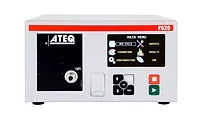
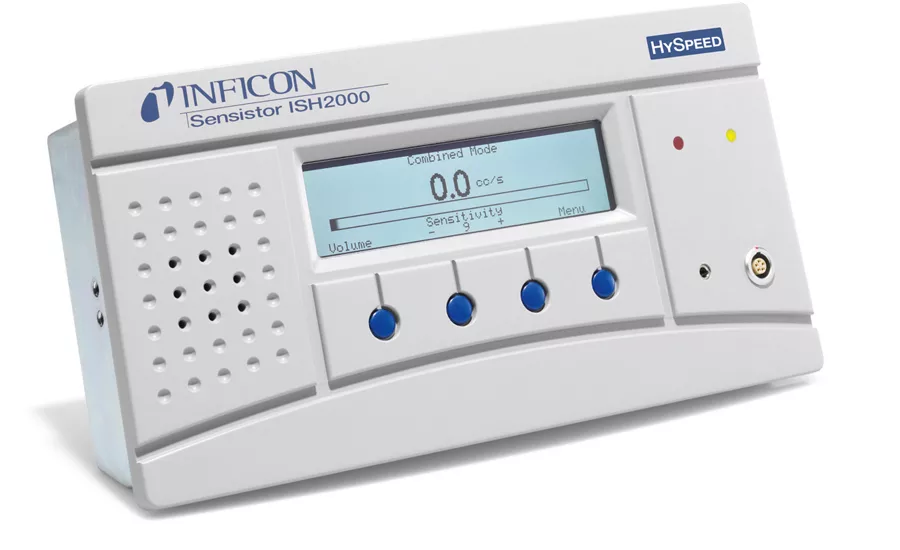
Hydrogen detectors cost much less than most mass spectrometers. Equipped with microelectronic sensors, hydrogen detectors have a high sensitivity and selectivity to hydrogen. They are robust enough for industrial use and can detect leaks as small as 5 x 10⁻⁷ cubic centimeters per second, or approximately 1 gram per year.
Hydrogen leak detectors are easy to operate. The test gas is injected into the test object, and a hand probe connected to the hydrogen detector is used to search for leaks. The probe does not use suction, so it can be used without worrying about dust. In addition, the probe can be equipped with a protective cover that allows it to be used on wet objects.
The detector indicates leaks with an audio signal. The signal increases in pitch the closer the probe gets to the leak location. There is no need to create a vacuum, which saves testing time and maintenance costs.
Hydrogen leak testing can also be automated with a stationary sampling probe. The probe can be used in two ways: an accumulation chamber test or a clamp-shell test.
In the accumulation chamber test, the test object is pressurized with the hydrogen-nitrogen mixture and placed in a chamber in which the air is circulated by a fan. Any hydrogen leaking from the object will stay within the chamber, and the concentration will build up in proportion to the leak rate. The fan ensures a homogeneous concentration of hydrogen, irrespective of the leak location. At a predetermined time, the probe draws a defined sample of air and passes it over the hydrogen sensor. Directly thereafter, it purges the sampling hose and is ready for a new test. If the concentration exceeds a set reject level, the tester signals an alarm.
In the clamp-shell test, the test object is pressurized with the hydrogen-nitrogen mixture and a test point on the object is enclosed in a clamp shell from which the probe draws an air sample. The shell should be designed so that air passing through it collects any gas that may leak out from the object. The gas concentration in the sample air is proportional to the leak rate.
For more information on leak testing with hydrogen, call 315-434-1100 or visit www.inficon.com.
Looking for a reprint of this article?
From high-res PDFs to custom plaques, order your copy today!