What’s New With Machine Vision Systems
New technology is making vision systems faster, more reliable and easier to use.
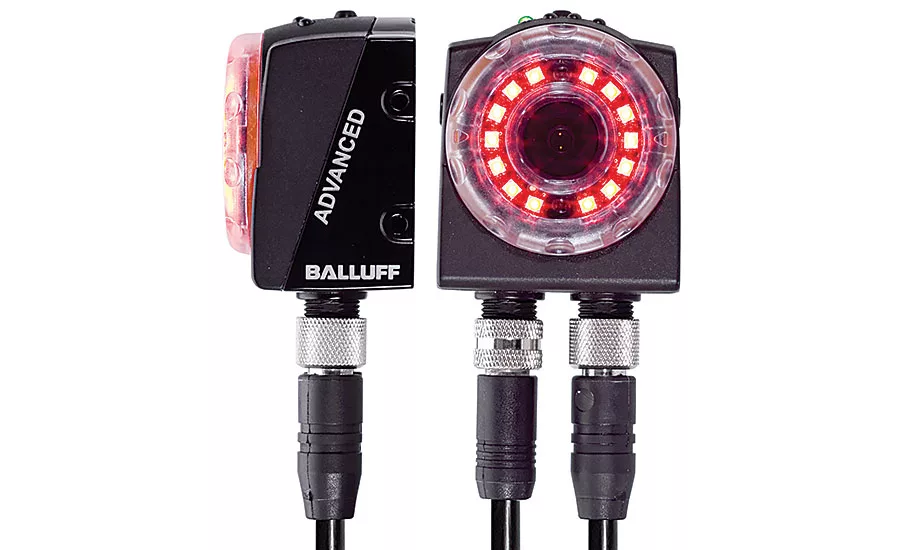
The BVS-E universal vision sensor can detect objects regardless of their location or position. Photo courtesy Balluff Inc.
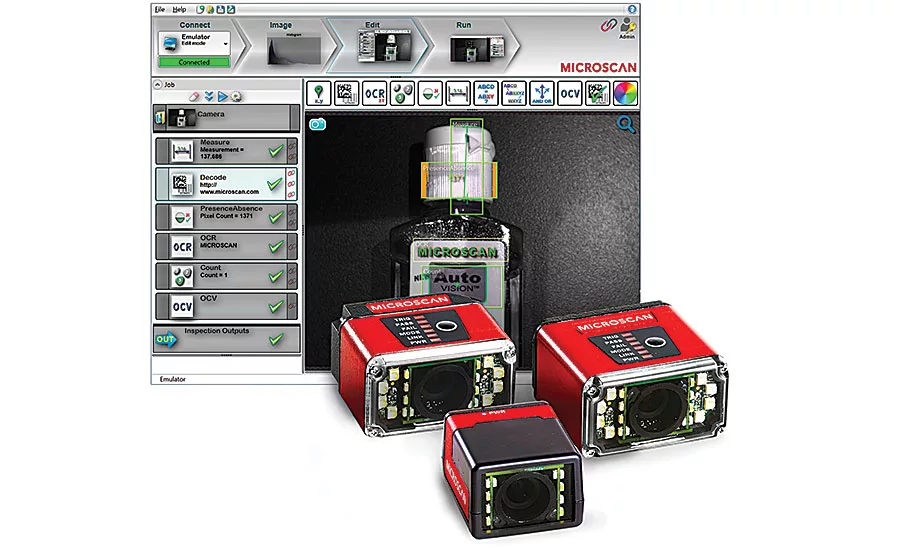
AutoVISION 4.0 allows engineers to easily implement machine vision jobs for item tracking, traceability, defect detection, guidance and monitoring. Photo courtesy Microscan Systems Inc.
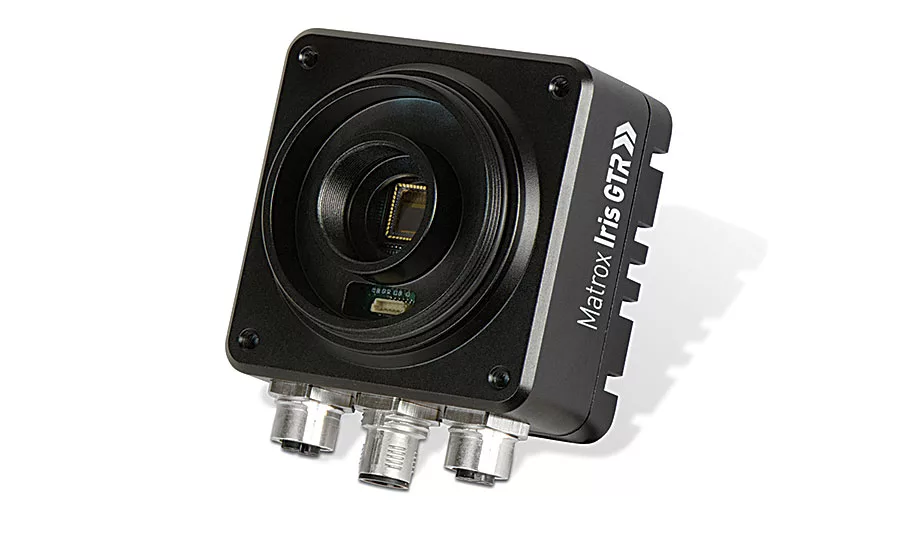
The Iris GTR smart camera measures just 75 by 75 by 54 millimeters, allowing it to fit into tight spaces. Photo courtesy Matrox Imaging
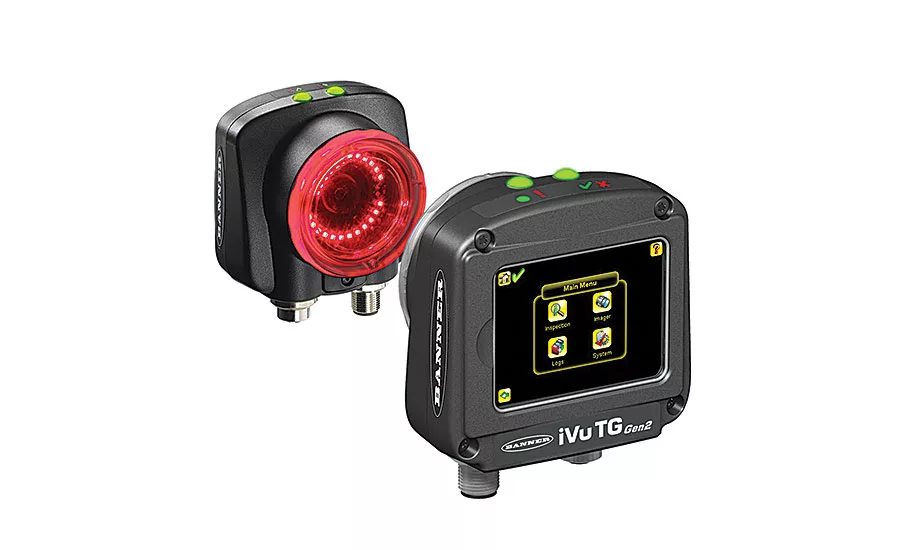
The iVu Plus Gen2 vision sensors have touch screen interfaces for easy setup and monitoring. Photo courtesy Banner Engineering
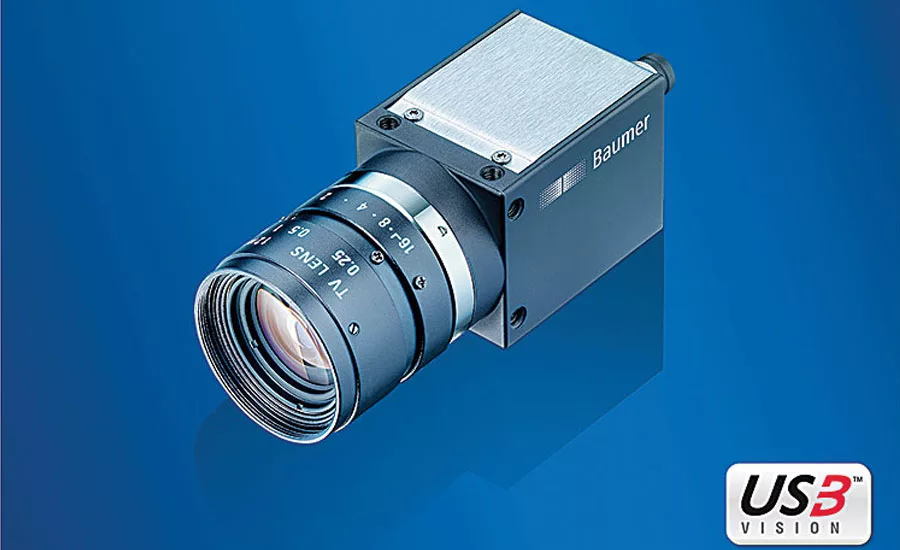
Compact 12-Megapixel Camera from Baumer Ltd.
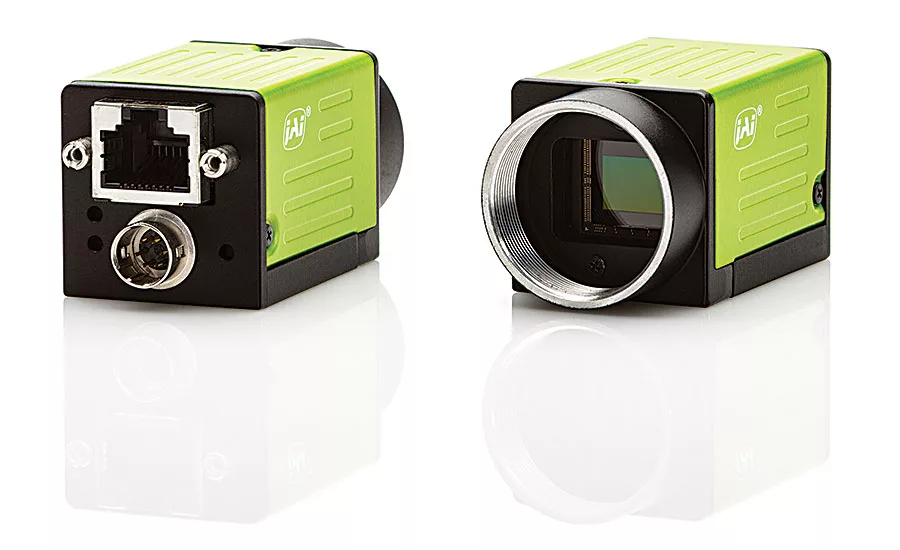
Five-Megapixel CMOS Camera from JAI Inc.
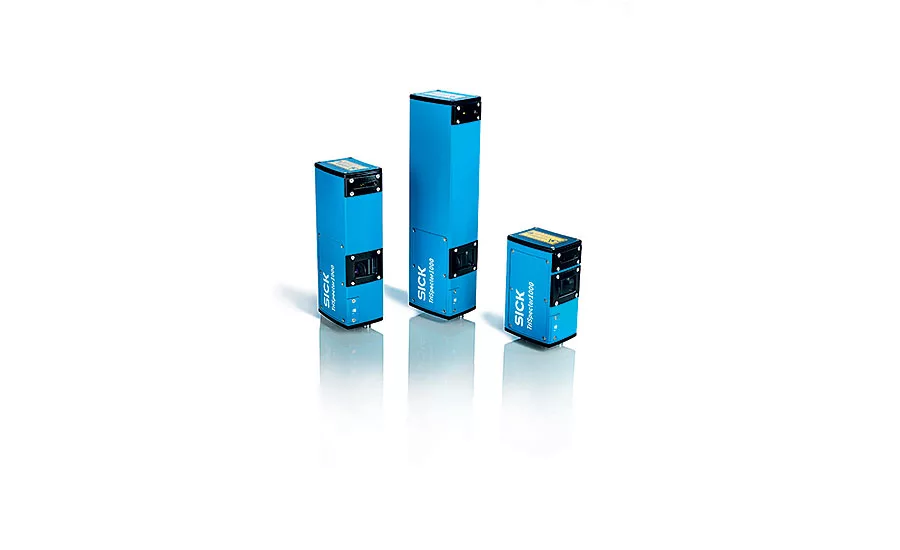
SICK Inc. has introduced the TriSpector1000 vision sensor for costefficient and reliable 3D inspection.
Vision systems play a vital role in automated assembly systems. They can check for the presence or absence of parts or materials. They can measure key dimensions of assemblies. They can tell robots the precise location of parts. They can even read 1D and 2D codes.
North American sales of machine vision components and systems grew to $2.3 billion in 2015, the highest annual total on record, according to the AIA, the industry’s trade group. And why not? New technology is making vision systems faster, more reliable and easier to use.
The following is a sampling of some of the latest innovations.
High-Speed Vision Sensor
The BVS-E universal vision sensor from Balluff Inc. can detect objects regardless of their location or position. Production can be monitored more efficiently because of shorter process times and the option of using logical functions to combine individual checks.
The application range of the vision sensor includes assembly and presence control; reading and verification of text, numbers and 1D and 2D bar codes; and advance part position detection. Up to 40 codes per second can be located, read and verified in any orientation.
Powerful contour-based image processing tools can compensate for parts in any orientation and can check for defects or count all contours with similarity. It is also possible to transmit the position and orientation of the parts via Ethernet TCP/IP.
For more information, call Balluff at 800-543-8390 or visit www.balluff.us.
Looking for quick answers on assembly and manufacturing topics? Try Ask ASM, our new smart AI search tool. Ask ASM
User-Friendly Vision Software
Microscan Systems Inc. has released a new version of its simplified AutoVISION machine vision software.
Featuring an intuitive user interface for basic and mid-range applications, AutoVISION 4.0 allows any user—regardless of experience level—to easily implement practical machine vision jobs for item tracking, traceability, defect detection, automated guidance, and monitoring.
Inspection jobs are set up using step-by-step controls in the interface that guide users to connect to a camera, capture an image, add tools, and run the applied inspections. Graphical drag-and-drop machine vision tools allow users to add inspections to a saved image or live image feed from a connected camera to see real-time results and understand how a particular tool will affect the inspection output.
Software tools include the decode tool (decode any linear or 2D symbol to identify, log, track and trace products); the measure tool (ensure accurate parts and assemblies, as well as enable guidance operations); and the optical character recognition and verification tools. The software is scalable and backward-compatible with Microscan’s advanced Visionscape machine vision software for access to programmer-level machine vision settings, enabling users to migrate jobs from one software environment to another on a single vision system. This allows users to meet changing demands without increasing time or cost to implement new capability.
The software offers an expanded toolset for additional inspection capability. Among the new tools is a circle measure tool for measuring the radius of a circle when inspecting features like drill holes and apertures. New color tools have also been added for detecting, identifying and matching colored objects, such as test tube caps, PCB components, or features in automotive dashboard displays.
All measurements are available in real-world units, such as millimeters and inches, for intuitive application by operators. In addition, the software adds a setting for FTP image output, enabling users to store pass-fail images taken by the connected camera to a local file location for documentation and audit purposes.
AutoVISION 4.0 is fully scalable to Microscan’s comprehensive machine vision software, Visionscape, for advanced inspection tasks and custom machine vision programming.
Optionally, an AutoVISION sensor interface is also available for inspection applications that do not require code reading or verification. This option can save engineers money if bar codes are not a factor in their inspection applications.
AutoVISION 4.0 now supports the company’s new MicroHAWK MV smart cameras. Available in three compact models (MV-20, MV-30, and MV-40), each camera features selectable options for the sensor (WVGA, SXGA, or QSXGA), lens (standard and high-density), and integrated lighting (red or white internal and add-on LEDs). AutoVISION 4.0 also supports the integrated liquid-lens autofocus capability of the new MV-30 and MV-40 models for inspecting parts at various positions, distances or sizes.
Industrial, high-speed EtherNet/IP and Profinet communication is supported in applications utilizing the MV-40 model, and the software’s new advanced communication capabilities allow MicroHAWK cameras and PCs to exchange data across different subnets. This enables engineers to connect to MicroHAWK cameras from anywhere in a factory or connect a camera from a local factory to a satellite facility.
For more information, call Microscan at 425-226-5700 or visit www.microscan.com/microhawk.
Fast, Compact Smart Camera
The Iris GTR smart camera from Matrox Imaging measures just 75 by 75 by 54 millimeters, allowing it to fit into tight spaces. Equipped with an On Semiconductor Python CMOS image sensor with high readout rates and an Intel Celeron dual-core embedded processor, the smart camera can handle fast-moving lines or perform more inspections in an allotted time.
With an IP67-rated housing and M12 connectors, the camera is dust-proof and immersion-resistant. It comes pre-installed with Linux or Microsoft Windows Embedded Standard 7, giving developers the choice between the two prominent environments for running their vision application software.
The camera line offers a choice of monochrome and color image sensors with resolutions from VGA to 5 megapixels. A dedicated LED intensity-control interface simplifies setup and use of the overall machine vision system by enabling engineers to regulate integrated illumination via an application’s user interface. A dedicated interface for controlling a Varioptic Caspian auto focus lens also facilitates setup, use and maintenance. Focus position adjustments can be made via an application’s user interface.
Eight real-time general-purpose I/O with rotary encoder support give the camera the means to tightly follow and interact with fast-moving assembly lines. In addition, a Gigabit Ethernet interface allows the camera to efficiently output data, including images, over factory networks.
For more information, call Matrox at 800-804-6243 or visit www.matrox.com/imaging.
Fast, Flexible Vision Sensor
The iVu Plus TG Gen2 and iVu Plus BCR Gen2 vision sensors from Banner Engineering Corp. provide fast response times and multiple choices for inspection resolution.
Both sensors have integrated touch screen interfaces for easy setup and monitoring. A PC is not required to configure, change or monitor the devices. A software emulator lets engineers perfect their applications offline. Additionally, the vision sensors offer Ethernet connectivity, which enables them to share inspection data directly with PLCs, PCs or other factory devices. This simplifies communications and control on the plant floor.
For optimal detection of small parts and features, the iVu Plus TG Gen2 vision sensor offers the option for full 752 by 480 pixel resolution. The sensor can also be configured to operate using four different sensor types:
“Area,” which verifies the presence of a feature or features of interest.
“Blemish,” which identifies flaws on a part, such as scratches on a disc.
“Match,” which verifies that a pattern, shape or part in any orientation matches a reference pattern.
“Sort,” which recognizes and sorts as many as 10 different patterns of parts, such as nuts, bolts and washers.
The iVu Plus BCR Gen2 is for code-reading applications. Featuring a new coarse-mode option, the sensor allows for faster bar code read rates, especially for 2D codes.
Both the TG and BCR sensors have IP67-rated housing for rugged industrial environments. The housing is available with or without a variety of integrated ring lights (red, blue, green and infrared).
For more information, call Banner at 763-544-3164 or visit www.bannerengineering.com.
Compact 12-Megapixel Camera
Baumer Ltd. has expanded its CX series of vision system cameras to include a model equipped with the Sony Pregius IMX253 CMOS sensor with a global shutter.
With a high resolution of 4,096 by 3,000 pixels and a high frame rate of 31 images per second, the cameras are intended for applications requiring high-definition image acquisition at high throughput speeds.
To provide maximum flexibility and easy installation, the camera measures just 29 by 29 millimeters and has M3 mounting holes on each side of the housing.
Camera events and the integrated image memory ensure synchronized process control for long-term stability in image evaluation. The camera can endure a temperature up to 65 C. To ensure process safety and prevent damage to the camera, an integrated temperature sensor provides the current operating temperature at all times.
The USB cameras require only a single cable for high data transmission rates and easy integration through plug-and-play functionality. Optically isolated I/O ensure reliable operation.
For more information, call Baumer at 860-621-2121 or visit www.baumer.com/cameras/CX.
Five-Megapixel CMOS Camera
JAI Inc. has added a new model to its Go Series of small industrial cameras. The GO-5100-PGE is a new 5-megapixel camera built around the Sony Pregius IMX250 CMOS sensor.
Available in monochrome and Bayer color models, the camera features small, 3.45-micron square pixels, enabling the full resolution (2,464 by 2,056 pixels) to fit within a standard 0.67-inch C-mount optical format. This gives users a wider range of lens options than 5-megapixel cameras with typical 1-inch optical formats.
The camera runs at 22.7 frames per second in full, eight-bit resolution over a standard GigE Vision interface. Ten-bit and 12-bit modes are selectable at reduced frame rates. Power can be provided via the GigE Vision interface, or using a separate power supply.
The cameras let users define a region-of-interest from within the full resolution, which can then be output at a faster frame rate. Similarly, on monochrome models, 1 by 2, 2 by 1, and 2 by 2 binning is available for both added sensitivity and faster frame rates at reduced overall resolution.
The camera has a small form factor (29 by 29 by 41.5 millimeters, excluding lens mount) and weighs only 46 grams. Despite its small size and light weight, the camera can withstand factory environments. It has an 80G shock rating, 10G vibration rating, a standard operating temperature range of -5 to 45 C, and an overall mean-time-between-failures rating of more than 200,000 hours.
Standard features include a high-performance global shutter with speeds as fast as 14 microseconds (in 8-bit mode); pixel blemish compensation and shading correction functions; a built-in 256-point look-up table for gamma customization; and an “Auto Level Control” feature that combines auto gain and auto shutter capabilities into an integrated function to let users optimize auto exposure control for lowest noise, fastest shutter, or other priorities.
For more information, call JAI at 800-445-5444 or visit www.jai.com.
Vision Sensor for 3D Inspection
SICK Inc. has introduced the TriSpector1000 vision sensor for cost-efficient and reliable 3D inspection.
The sensor is a stand-alone, configurable 3D vision sensor that reliably inspects objects regardless of variations in color, shape or position. In addition, intensity data enhances 3D navigation and allows the sensor to check for object rotation or the presence of a label or printed pattern.
The sensor is especially suited for solving quality control applications in the consumer goods and packaging industry. It can be used for volume and thickness measurement and inspection of box integrity, including content verification, completeness and emptiness checks.
The sensor features an IP67 metal housing with plastic windows durable enough to withstand harsh environments.
For more information,call SICK at 800-325-7425 or visit www.sickusa.com.
Looking for a reprint of this article?
From high-res PDFs to custom plaques, order your copy today!