Metal Vs. Plastic
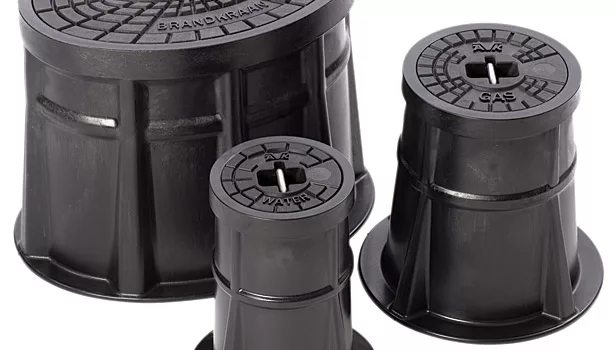

Plastic cover for external valves: weight reduction as compared with cast iron facilitates assembly and annual maintenance and provides protection from theft or corrosion. The color helps clearer identification of functions and, if necessary, permits signal transmission. Clips prevent the cover being removed too easily and the use of plastic makes it simple to apply a logo.
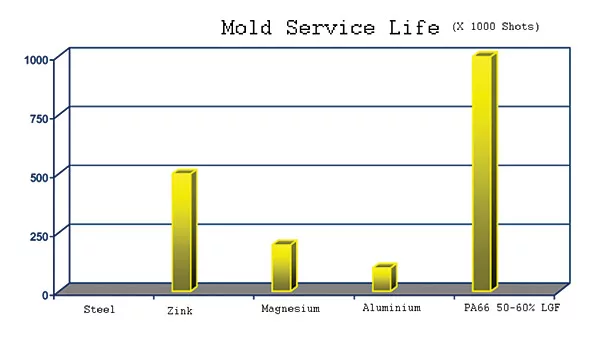
Figure 1. Comparison of injection mold service life: metal pressure diecasting versus plastic injection molding.
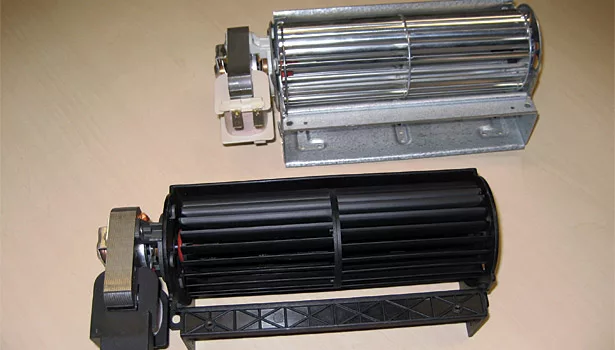
Figure 2. In the plastic version of the fan, thirty components became three. Operations such as stamping, bending, welding and counterbalancing were no longer necessary, while weight was reduced, tolerances improved, and corrosion and noise generation minimized.
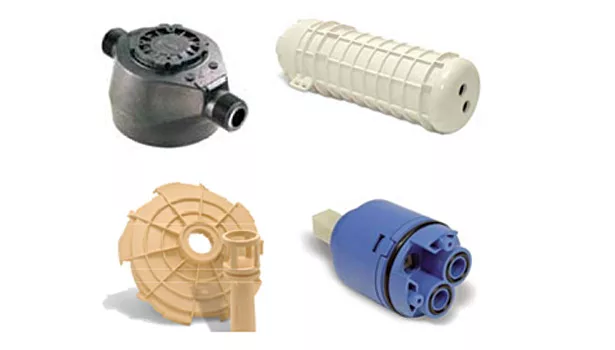
Figure 3. In the throttle body made from reinforced polyetherimide, weight was halved and thermal conductivity reduced compared with the original aluminum pressure diecast version. Post-machining was eliminated and the service life of the injection mold extended.
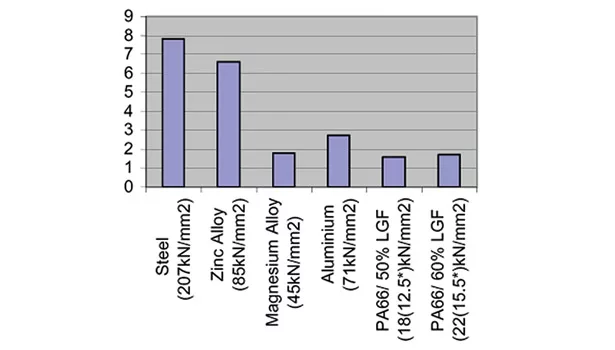
Figure 4. Material comparison: metals have both a higher material density and higher elastic modulus. To achieve the required tensile strength despite this, it is important to follow the principles of correct plastics design.
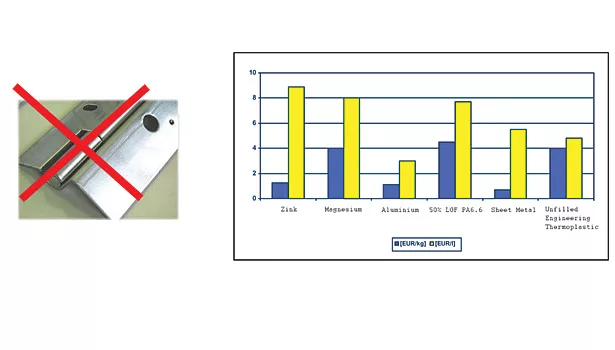
Figure 5. Metal replacement only pays if thermoplastic advantages such as component integration, design freedom, and weight reduction canât be exploited, or if assembly and finishing operations can be saved.
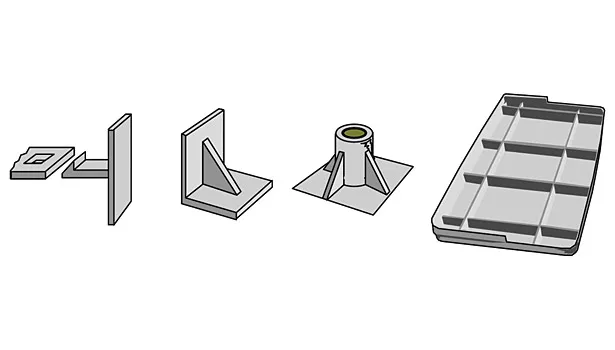
Figure 6. Snapfit joints, domes and inserts, along with radiusing instead of sharp edges and the avoidance of material accumulation, are typical elements of correct plastic design. Ribs are employed to increase component stiffness.
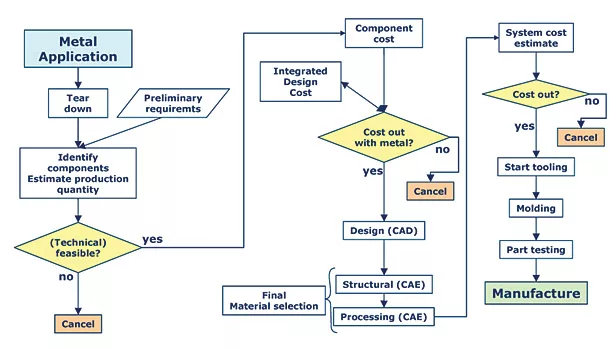
Figure 7. Influence of material selection on factors in the product development process.
When is it time to redesign with plastics instead of metal? A discussion of the factors that could swing component designs on the material fence.
In the product development process, designers and developers usually choose plastics over metal when plastics offers lower system and follow-up costs through productivity gains and/or weight reduction. Opportunities for plastics further increase when the greater design freedom achieved by system simplification leads to product differentiation.
For a product to be competitive in the global marketplace, high-performance materials, optimized components and cost-efficient production methods are required. Standards and legislation tighten up product safety and environmental standards in global markets.
The minimization of system costs is increasingly important in competitive markets. Instead of the usual price comparison between materials, savings can often be achieved if the entire product manufacturing process is placed under systematic scrutiny. The result of such an analysis can show that more expensive materials ultimately leads to higher cost reductions due to higher versatility. Weight or material savings through metal replacement, component integration and the elimination of costly finishing or assembly are then the goal.
Function and design are necessary for product differentiation in saturated markets and call for innovative material solutions and production methods. A good example of this can be seen in the miniaturization of mobile consumer electronics products. Despite thin-walled design, plastics housings must have good impact strength over a wide temperature range combined with enhanced material stiffness to ensure protection of the electronics inside. Additional requirements often include good surface appearance and effects, adequate hydrolytic and chemical resistance, compliance with regulatory requirements, improved environmental compatibility through the use of halogen-free flame retardants, and system cost minimization.
Advantages and Disadvantages of Metals
Metals have traditionally been used in many markets, which means there is a rich fund of experience in handling this material and data on its long-term use. This also means suitable production facilities and equipment are available. Arguments in favor of using metals include their material properties, such as high mechanical strength, dimensional accuracy, heat and UV resistance, perceived high quality, low thermal expansion, and good thermal and electrical conductivity. Metals suggest quality and durability, and meet consumer expectations for high-end, traditional appliances.
In semi-finished product machining, components are produced in short runs to high dimensional accuracy by turning and milling—more complex shapes generate higher costs, while theses processes are unsuitable for longer runs because of their low productivity.
Pressure diecasting is used to manufacture more complex components, often with very thick walls, in medium to large production volumes. In comparison with plastics injection molding, however, the short mold service life (see Figure 1) and additional finishing often required may be considered disadvantages.
In metal stamping, sheet metal is shaped by bending and stamping. This method is primarily suitable for low-cost parts with simple geometry that have no need for finishing or to look attractive, offer high stiffness in a small space, and can be manufactured in large numbers. More complex components must be produced by additional assembly steps, which often restrict freedom of design.
Reasons for Metal Replacement
Metal replacement almost always lies in the savings in system and follow-up costs achieved through productivity gains and/or weight reduction. As a rough rule of thumb, components up to 2kg in weight produced in runs greater than 150,000 with costly assembly and finishing steps offer particularly high savings potential. System simplification through integration of functional parts and modular construction saves time-consuming assembly steps such as screw fastening or welding by reducing the number of components and connecting components together. It also increases freedom of design for product differentiation (see Figure 2).
Weight savings can be achieved through lower material density and thinner-walled design. In the automotive and aerospace sectors, in particular, this aspect is becoming increasingly important, since weight reduction has a positive effect on fuel consumption (see Figure 3).
Production from plastics also makes post-machining unnecessary. The use of colored or conductive pellets often saves painting. In addition, problems with metals such as corrosion, low-temperature embrittlement, high material density, and fluctuating market prices and material availability are further reasons why the use of reinforced plastics comes into consideration as an alternative for metal (see Figure 4).
Limitations of Plastics
Metal replacement projects must take account of the following facts:
One-for-one material exchange without component integration or elimination of assembly steps is only rarely economically sensible. In pressure diecasting, it is most likely to be feasible if minor design changes are undertaken. Simple stamped sheet metal parts or extruded profiles, on the other hand, tend not to lead to the desired success and therefore saving potentials cannot be fully exploited (see Figure 5).
Conversion to plastics requires an exact knowledge of the actual mechanical short- and long-terms stresses to which the component will be exposed over its lifetime and can only be successfully achieved through a combination of material stiffness, additional ribs and the application of correct plastics design principles (see Figure 6).
Unlike metals, plastics are insulators but can be modified with fillers to make them thermally and electrically conductive or electromagnetically shielded. The thermal expansion, water absorption and shrinkage of engineering thermoplastics are greater than for metals—in product design, especially when metal and plastic components are to be combined this must also be considered.
Product Concept and Customers
Metal replacement projects should pass through the following phases in the product development process: definition of primary aims, product conceptualization, analysis of feasibility and potential savings, material selection, consideration of requirements and application of correct plastics design principles, design optimization through theoretical and practical mold filling studies, and evaluation of material suitability through test specimen and component testing.
Definition of customer requirements: A market trend analysis, comparison with the competition and step-by-step dismantling of an existing product can help to formulate primary objectives. In this process, it is important that a team of product developers and material and product specialists analyze the function of the individual parts and their present design, manufacture, assembly and finishing with a view to cost reduction.
Product conceptualization: Ideas for design alternatives, metal replacement, component integration and function combination or simplification of finishing and assembly operations for the components can be generated in a brainstorming session and evaluated with respect to their feasibility and the amount of potential savings.
Material selection: Once the decision about a certain component has been taken, it is time to select the plastic. In the case of metal replacement, this in itself severely limits the number of possible material options because of strength requirements, glass- or carbon-fiber-filled engineering thermoplastics are generally chosen instead of unfilled resins. Modification with steel fibers improves shielding against electromagnetic radiation. Assuming correct plastics processing, long glass or carbon fibers increase material stiffness and strength in comparison with standard fibers, which makes them of interest for components subject to very high long-term mechanical loads. To ensure that important material requirements are not overlooked, it is advised to determine requirements systematically with a checklist, and then carefully take them into account.
In practice, it seems that the benefit of early material selection in terms of system costs is often underestimated, if product design, mold construction, and production and finishing processes would have been adapted to the material.
Design & engineering: When materials have been identified as candidates for the design concept of the component, a computer model can be generated using computer-animated design and engineering. The mold design is developed according to correct plastics design principles to ensure material flow into the mold takes place with the least possible stress. Measures such as suitable location and dimensioning of the gate, radiusing in preference to sharp edges, the avoidance of abrupt wall thickness transitions and material accumulation to minimize sink marks and warpage, and the use of snapfit joints, clips or ultrasonically placed inserts instead of screws can help achieve this aim.
Component optimization: Material behavior during processing and in service can be predicted by computer simulation, if suitable material data is available on viscosity, thermal stability, and strength and processing. By this means, the suitability of the thermoplastics in question can be assessed and the position of weld lines and possible air entrapment can be optimized by modifying gate position and wall thickness geometries. Short material residence times in the screw, moderate injection rates and low pressures reduce material degradation during processing help extend component service life. In addition mold filling and demolding behavior due to optimized design and skilled material selection can lead to faster cycles and increased productivity in the production process.
Tests and End Product
Product & Part Testing: To confirm the suitability of the plastic, its mechanical behavior and esthetic properties must be tested on specimens, prototypes and components under environmental influences such as UV, temperature, moisture and chemicals. The challenge for the manufacturer lies in finding accelerated test conditions, which—despite the shorter time—correctly describe material behavior over the entire product lifecycle. Material data determined on test specimens can be used as a guide during the material selection phase but can in no way replace testing on the actual component.
Industrialization: After production start-up, it is ultimately only possible to determine on the finished end product whether all objectives have been met, all requirements taken into account, and the identified saving potentials successfully realized. To safeguard cost reduction longterm, careful documentation and regular quality control are recommended so that rejects and complaints can be kept to a minimum.
A typical area of application for plastics is in fluid handling products such as mixer faucets, water meters, water pumps and valves, and water softener tanks, where the advantages of metal replacement such as design freedom and system cost reduction can be fully exploited.
Source: appliance DESIGN
Looking for a reprint of this article?
From high-res PDFs to custom plaques, order your copy today!