Assembly Magazine logo
search
Ask ASSEMBLY AI
cart
facebook twitter linkedin youtube
  • Sign In
  • Create Account
  • Sign Out
  • My Account
Assembly Magazine logo
  • TRENDS
    • Ask ASSEMBLY AI
    • Trends
    • News
    • New Products
  • INDUSTRIES
    • Aerospace
    • Appliance
    • DFMA Assembly
    • Medical Devices
    • Green Manufacturing
    • Lean Manufacturing
    • Machinery Assembly
    • Electronics Assembly
    • Automotive
  • TECHNOLOGIES
    • Adhesives & Dispensing
    • Assembly Presses
    • Automated Assembly Systems
    • Manufacturing Management
    • Manufacturing Software
    • Motion Control
    • Screwdriving & Riveting
    • Robotics
    • Test & Inspection
    • Plastics & Metal Welding
    • Wire Processing
    • Workstations
  • AUTONOMOUS & ELECTRIC MOBILITY
    • AEM Magazine Archives
    • Autonomy
    • Electrification
    • Mobility Services
    • Assembly & Testing
    • AV/EM News
  • MEDIA
    • Ask ASSEMBLY AI
    • Podcasts
    • Assembly News Now
    • Assembly TV
    • Webinars
    • eBooks
  • EVENTS
    • Calendar
    • The ASSEMBLY Show
  • MORE
    • Exclusives >
      • Plant of the Year
      • Capital Spending
    • Buyers Guide >
      • Supplier Insights
    • Classifieds
    • Featured Products
    • Newsletters
    • Store
    • White Papers
    • Columns
    • Sponsor Insights
  • INFOCENTER
    • Assembly & Test Solutions
  • EMAGAZINE
    • eMagazine
    • Archive Issues
    • Advertise
    • Contact Us
    • Sign Up
Autonomous & Electric MobilityAssembly and TestingAV/EM NewsAutonomyConnectivity

Cutting-Edge R&D Project Aims to Optimize AV Connectivity
SWRI.jpg
March 19, 2021
SAN ANTONIO—The U.S. Department of Energy has awarded a three-year, $5.25 million contract to the Southwest Research Institute (SwRI) to develop connected and automated vehicle (CAV) technologies to help reduce energy consumption and carbon emissions. The project is the second phase of the Advanced Research Projects Agency-Energy's (ARPA-E's) Next-Generation Energy Technologies for Connected and Autonomous On-Road Vehicles (NEXTCAR) program.
Phase I focused on the development of CAV technologies for use in all vehicle classes, including cars, trucks and buses, with the goal of enabling a 20 percent reduction in energy consumption. The next goal is to achieve a 30 percent reduction. SwRI engineers will integrate test vehicles with Level 4 automation technology, which gives them the ability to perform all driving operations on their own with optional human override.
"We are excited to have the opportunity to continue developing this technology to optimize vehicle efficiency," says Scott Hotz, an assistant director in SwRI's Powertrain Engineering Division and leader of the NEXTCAR project through SwRI's Ann Arbor Technical Center in Michigan. "It will have enormous benefits, not only to the automotive industry, but more importantly, also to the public by reducing carbon emissions."
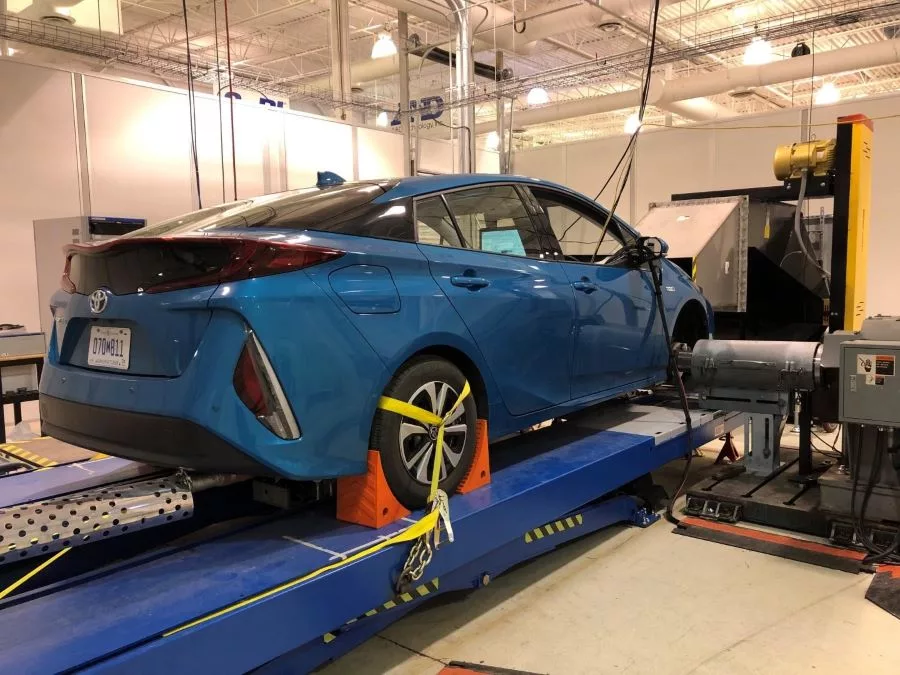
During the first phase, SwRI developed optimal control algorithms to leverage vehicle-to-vehicle (V2V), vehicle-to-infrastructure (V2I) and other vehicle-to-everything (V2X) technologies to simultaneously optimize route, speed profile and power flows from the hybrid system on a 2017 Toyota Prius Prime plug-in hybrid electric vehicle. Engineers demonstrated a more than 20 percent improvement in energy consumption in real-world driving conditions through a combination of vehicle dynamics and advanced power train control algorithms, including eco-routing, eco-driving and power-split optimization.
"Vehicle connectivity and automation are already being used to effectively improve safety and driver convenience," claims Sankar Rengarajan, manager of SwRI's Powertrain Controls Section. "We tapped into those existing data streams and put the information to use in a new way to help us achieve a 22 percent gain in fuel efficiency."
In the second phase, SwRI will build on those technologies and expand its predictive eco-routing, eco-driving and hybrid power control strategies. The eco-driving feature focused on longitudinal dynamics control and contributed about 10 percent of the energy savings.
“The algorithm helped the human driver make smarter decisions based on localized traffic knowledge through V2X connectivity and communication,” says Rengarajan. “Because of the advanced perception and actuation precision of a Level 4 autonomous vehicle over a human driver, [we] will expand the eco-driving framework to optimize for multilane dynamics and further reduce energy consumption.”
KEYWORDS: autonomous vehicles connected products

Share This Story

Looking for a reprint of this article?
From high-res PDFs to custom plaques, order your copy today!

Recommended Content

JOIN TODAY
To unlock your recommendations.

Already have an account? Sign In

  • Made in the U.S.A.

    Consumer Products Manufacturing: Made in the USA

    Supply chain lessons learned during the coronavirus...
    Automated Assembly Systems
    By: Austin Weber
  • Best Practices for Press-Fit Assembly

    Best Practices for Press-Fit Assembly

    In manufacturing, ironclad formulas for success are hard...
    Assembly Presses
    By: Jim Camillo
  • aem0523leader-tesla1.jpg

    Tesla Rethinks the Assembly Line

    Engineers at Tesla Inc. have developed a new process that...
    Assembly and Testing
    By: Austin Weber
Manage My Account
  • eMagazine Subscription
  • Assembly Newsletters
  • Online Registration
  • Subscription Customer Service
  • Manage My Preferences

More Videos

Sponsored Content

Sponsored Content is a special paid section where industry companies provide high quality, objective, non-commercial content around topics of interest to the ASSEMBLY audience. All Sponsored Content is supplied by the advertising company and any opinions expressed in this article are those of the author and not necessarily reflect the views of ASSEMBLY or its parent company, BNP Media. Interested in participating in our Sponsored Content section? Contact your local rep!

close
  • ultrasonic welding
    Sponsored bySonobond Ultrasonics

    Engineering Efficiency in High-Performance Assembly: How Ultrasonic Welding Enhances Throughput, Reliability and Quality

  • UV curing system
    Sponsored byDymax

    Why UV Intensity Alone Doesn’t Define Curing Performance

  • wooden pallets
    Sponsored byLEAN Manufacturing Products

    Eliminating Waste on the Shop Floor: Applying Lean Principles to Improve Manufacturing Efficiency

Popular Stories

ASSEMBLY News Now, episode-30: Volvo Redesigns EV Manufacturing

Volvo Redesigns EV Manufacturing

Boeing CEO Kelly Ortberg announces 1 billion investment

Boeing Plans $1 Billion Wichita Investment, Workforce Training Center

GE Appliances Worker on Line

GE Appliances Expands Factory AI With 800 Gemini Enterprise Agents

Watch the latest episode of ANN now!

Events

July 24, 2025

From Shop Floor to CFO: How Manufacturers Are Closing the Loop Between Operations and Finance

On Demand Learn how manufacturers are bridging the gap between the shop floor and ERP systems to gain real-time visibility, streamline operations, and kick-start digital transformation—without waiting years.

Sponsored by:

PicoStratusGreen
July 30, 2025

Buffer Analysis and Design Fundamentals for Manufacturing Excellence

On Demand In this presentation, Dr. Herman Tang shares practical insights from his industry experience and research on buffer management in manufacturing operations.

View All Submit An Event

Poll

Difficult Assembly Processes

Which assembly process gives you the most difficulty?
View Results Poll Archive

Products

Manufacturing Cost Policy Deployment (MCPD) Profitability Scenarios: Systematic and Systemic Improvement of Manufacturing Costs

Manufacturing Cost Policy Deployment (MCPD) Profitability Scenarios: Systematic and Systemic Improvement of Manufacturing Costs

See More Products
Register for webinar - Modernizing Automotive Assembly: Why Upgrading Legacy MES is a Business Imperative

Related Articles

  • JLR lightweight.png

    Lightweight Composite R&D Project Aims to Reduce EV Weight

    See More
  • RWTH Aachen University have launched a three-year R&D project to develop sustainable components for electric vehicle traction motors.

    New Project Aims to Develop Sustainable E-Motors

    See More
  • IMA Automation laser

    European Research Project Aims to Revolutionize Laser-Based Production

    See More

Related Products

See More Products
  • project management.jpg

    Project Management of Complex and Embedded Systems

  • total quality.jpg

    Total Quality Management for Project Management

  • scrum.jpg

    Scrum Project Management

See More Products
×

Never miss the latest news and trends driving the manufacturing industry

Stay in the know on the latest assembly trends.

JOIN TODAY!
  • RESOURCES
    • Advertise
    • Contact Us
    • Directories
    • Manufacturing Division
    • Store
    • Want More?
  • SIGN UP TODAY
    • Create Account
    • eMagazine
    • Newsletters
    • Customer Service
    • Manage Preferences
  • SERVICES
    • Marketing Services
    • Reprints
    • Market Research
    • List Rental
    • Survey/Respondent Access
  • STAY CONNECTED
    • LinkedIn
    • Facebook
    • Instagram
    • YouTube
    • X (Twitter)
  • PRIVACY
    • PRIVACY POLICY
    • TERMS & CONDITIONS
    • DO NOT SELL MY PERSONAL INFORMATION
    • PRIVACY REQUEST
    • ACCESSIBILITY

Copyright ©2026. All Rights Reserved BNP Media, Inc. and BNP Media II, LLC.

Design, CMS, Hosting & Web Development :: ePublishing