Assembly Magazine logo
search
Ask ASSEMBLY AI
cart
facebook twitter linkedin youtube
  • Sign In
  • Create Account
  • Sign Out
  • My Account
Assembly Magazine logo
  • TRENDS
    • Ask ASSEMBLY AI
    • Trends
    • News
    • New Products
  • INDUSTRIES
    • Aerospace
    • Appliance
    • DFMA Assembly
    • Medical Devices
    • Green Manufacturing
    • Lean Manufacturing
    • Machinery Assembly
    • Electronics Assembly
    • Automotive
  • TECHNOLOGIES
    • Adhesives & Dispensing
    • Assembly Presses
    • Automated Assembly Systems
    • Manufacturing Management
    • Manufacturing Software
    • Motion Control
    • Screwdriving & Riveting
    • Robotics
    • Test & Inspection
    • Plastics & Metal Welding
    • Wire Processing
    • Workstations
  • AUTONOMOUS & ELECTRIC MOBILITY
    • AEM Magazine Archives
    • Autonomy
    • Electrification
    • Mobility Services
    • Assembly & Testing
    • AV/EM News
  • MEDIA
    • Ask ASSEMBLY AI
    • Podcasts
    • Assembly News Now
    • Assembly TV
    • Webinars
    • eBooks
  • EVENTS
    • Calendar
    • The ASSEMBLY Show
  • MORE
    • Exclusives >
      • Plant of the Year
      • Capital Spending
    • Buyers Guide >
      • Supplier Insights
    • Classifieds
    • Featured Products
    • Newsletters
    • Store
    • White Papers
    • Columns
    • Sponsor Insights
  • INFOCENTER
    • Assembly & Test Solutions
  • EMAGAZINE
    • eMagazine
    • Archive Issues
    • Advertise
    • Contact Us
    • Sign Up
Autonomous & Electric MobilityAssembly and TestingAV/EM NewsElectrification

Structural Batteries Could Reduce Electric Vehicle Weight
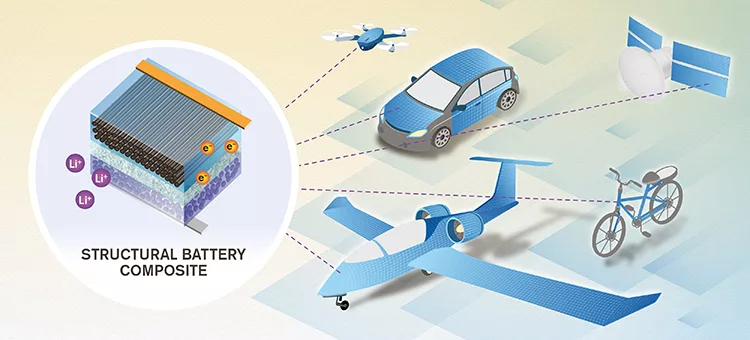
Chalmers 1.jpg
March 30, 2021
GOTHENBURG, Sweden—Engineers at Chalmers University of Technology have developed a structural battery that performs 10 times better than all previous versions. It contains carbon fiber that serves simultaneously as an electrode, conductor and load-bearing material. The breakthrough paves the way for “’massless” energy storage in electric vehicles.
Although engineers have been working on structural batteries for more than 10 years, it has been difficult to manufacture them with both good electrical and mechanical properties. The new battery has properties that far exceed anything yet seen in terms of electrical energy storage, stiffness and strength.
The battery has a negative electrode made of carbon fiber and a positive electrode made of a lithium iron phosphate-coated aluminum foil. They are separated by a fiberglass fabric in an electrolyte matrix.
“The carbon fiber acts as a host for the lithium and thus stores the energy,” says Leif Asp, a professor of material and computational mechanics who is heading up the R&D project. “Since the carbon fiber also conducts electrons, the need for copper and silver conductors is also avoided, reducing the weight even further.
“Both the carbon fiber and the aluminum foil contribute to the mechanical properties of the structural battery,” explains Asp. “The task of the electrolyte is to transport the lithium ions between the two electrodes of the battery, but also to transfer mechanical loads between carbon fibers and other parts.
“The batteries in today's electric cars constitute a large part of the vehicles' weight, without fulfilling any load-bearing function,” Asp points out. “A structural battery, on the other hand, is one that works as both a power source and as part of the structure, such as a car body.
“This is termed massless energy storage, because in essence the battery’s weight vanishes when it becomes part of the load-bearing structure,” says Asp. “Calculations show that this type of multifunctional battery could greatly reduce the weight of an electric vehicle.
“It is absolutely conceivable that [future] electric cars, electric planes and satellites will be powered by structural batteries,” claims Asp.
The battery has an energy density of 24 watt-hours per kilogram (Wh/kg), meaning approximately 20 percent capacity compared to comparable lithium-ion batteries currently available. But, since the weight of vehicles can be greatly reduced, less energy will be required to drive an electric car, and lower energy density also results in increased safety. And, with a stiffness of 25 gigapascals (GPa), Asp believes the structural battery can compete with many other commonly used construction materials.
A new project, financed by the Swedish National Space Agency, now underway aims to increase the performance of the structural battery even further. According to Asp, the aluminum foil will be replaced with carbon fiber as a load-bearing material in the positive electrode, providing both increased stiffness and energy density. In addition, the fiberglass separator will be replaced with an ultra-thin variant, which will provide faster charging cycles.
Asp estimates that such a battery could reach an energy density of 75 Wh/kg and a stiffness of 75 GPa. “This would make the battery about as strong as aluminum, but with a comparatively much lower weight,” he claims.
KEYWORDS: battery design electric vehicle battery electric vehicles lightweighting

Share This Story

Looking for a reprint of this article?
From high-res PDFs to custom plaques, order your copy today!

Recommended Content

JOIN TODAY
To unlock your recommendations.

Already have an account? Sign In

  • Made in the U.S.A.

    Consumer Products Manufacturing: Made in the USA

    Supply chain lessons learned during the coronavirus...
    Automated Assembly Systems
    By: Austin Weber
  • Best Practices for Press-Fit Assembly

    Best Practices for Press-Fit Assembly

    In manufacturing, ironclad formulas for success are hard...
    Assembly Presses
    By: Jim Camillo
  • aem0523leader-tesla1.jpg

    Tesla Rethinks the Assembly Line

    Engineers at Tesla Inc. have developed a new process that...
    Assembly and Testing
    By: Austin Weber
Manage My Account
  • eMagazine Subscription
  • Assembly Newsletters
  • Online Registration
  • Subscription Customer Service
  • Manage My Preferences

More Videos

Sponsored Content

Sponsored Content is a special paid section where industry companies provide high quality, objective, non-commercial content around topics of interest to the ASSEMBLY audience. All Sponsored Content is supplied by the advertising company and any opinions expressed in this article are those of the author and not necessarily reflect the views of ASSEMBLY or its parent company, BNP Media. Interested in participating in our Sponsored Content section? Contact your local rep!

close
  • ultrasonic welding
    Sponsored bySonobond Ultrasonics

    Engineering Efficiency in High-Performance Assembly: How Ultrasonic Welding Enhances Throughput, Reliability and Quality

  • UV curing system
    Sponsored byDymax

    Why UV Intensity Alone Doesn’t Define Curing Performance

  • wooden pallets
    Sponsored byLEAN Manufacturing Products

    Eliminating Waste on the Shop Floor: Applying Lean Principles to Improve Manufacturing Efficiency

Popular Stories

Ferrari

Ferrari Unveils Four-Door EV

ASSEMBLY News Now, episode-30: Volvo Redesigns EV Manufacturing

Volvo Redesigns EV Manufacturing

Robots working at Toyota Plant in Japan

Toyota Deploys Geekplus Robots for Factory Material Handling

Watch the latest episode of ANN now!

Events

July 24, 2025

From Shop Floor to CFO: How Manufacturers Are Closing the Loop Between Operations and Finance

On Demand Learn how manufacturers are bridging the gap between the shop floor and ERP systems to gain real-time visibility, streamline operations, and kick-start digital transformation—without waiting years.

Sponsored by:

PicoStratusGreen
July 30, 2025

Buffer Analysis and Design Fundamentals for Manufacturing Excellence

On Demand In this presentation, Dr. Herman Tang shares practical insights from his industry experience and research on buffer management in manufacturing operations.

View All Submit An Event

Poll

Difficult Assembly Processes

Which assembly process gives you the most difficulty?
View Results Poll Archive

Products

Manufacturing Cost Policy Deployment (MCPD) Profitability Scenarios: Systematic and Systemic Improvement of Manufacturing Costs

Manufacturing Cost Policy Deployment (MCPD) Profitability Scenarios: Systematic and Systemic Improvement of Manufacturing Costs

See More Products
ebook

Related Articles

  • aem1222insight1.jpg

    Structural Batteries Could Make EVs Lighter

    See More
  • GM Taps AI and 3D Printing to Reduce Vehicle Weight

    GM Taps AI and 3D Printing to Reduce Vehicle Weight

    See More

Related Products

See More Products
  • assembly march 2020

    ASSEMBLY March 2020 Issue

  • assembly august 2019

    ASSEMBLY August 2019 Issue

See More Products

Related Directories

  • Bendix Commercial Vehicle Systems LLC

×

Never miss the latest news and trends driving the manufacturing industry

Stay in the know on the latest assembly trends.

JOIN TODAY!
  • RESOURCES
    • Advertise
    • Contact Us
    • Directories
    • Manufacturing Division
    • Store
    • Want More?
  • SIGN UP TODAY
    • Create Account
    • eMagazine
    • Newsletters
    • Customer Service
    • Manage Preferences
  • SERVICES
    • Marketing Services
    • Reprints
    • Market Research
    • List Rental
    • Survey/Respondent Access
  • STAY CONNECTED
    • LinkedIn
    • Facebook
    • Instagram
    • YouTube
    • X (Twitter)
  • PRIVACY
    • PRIVACY POLICY
    • TERMS & CONDITIONS
    • DO NOT SELL MY PERSONAL INFORMATION
    • PRIVACY REQUEST
    • ACCESSIBILITY

Copyright ©2026. All Rights Reserved BNP Media, Inc. and BNP Media II, LLC.

Design, CMS, Hosting & Web Development :: ePublishing