Assembly Magazine logo
search
Ask ASSEMBLY AI
cart
facebook twitter linkedin youtube
  • Sign In
  • Create Account
  • Sign Out
  • My Account
Assembly Magazine logo
  • TRENDS
    • Ask ASSEMBLY AI
    • Trends
    • News
    • New Products
  • INDUSTRIES
    • Aerospace
    • Appliance
    • DFMA Assembly
    • Medical Devices
    • Green Manufacturing
    • Lean Manufacturing
    • Machinery Assembly
    • Electronics Assembly
    • Automotive
  • TECHNOLOGIES
    • Adhesives & Dispensing
    • Assembly Presses
    • Automated Assembly Systems
    • Manufacturing Management
    • Manufacturing Software
    • Motion Control
    • Screwdriving & Riveting
    • Robotics
    • Test & Inspection
    • Plastics & Metal Welding
    • Wire Processing
    • Workstations
  • AUTONOMOUS & ELECTRIC MOBILITY
    • AEM Magazine Archives
    • Autonomy
    • Electrification
    • Mobility Services
    • Assembly & Testing
    • AV/EM News
  • MEDIA
    • Ask ASSEMBLY AI
    • Podcasts
    • Assembly News Now
    • Assembly TV
    • Webinars
    • eBooks
  • EVENTS
    • Calendar
    • The ASSEMBLY Show
  • MORE
    • Exclusives >
      • Plant of the Year
      • Capital Spending
    • Buyers Guide >
      • Supplier Insights
    • Classifieds
    • Featured Products
    • Newsletters
    • Store
    • White Papers
    • Columns
    • Sponsor Insights
  • INFOCENTER
    • Assembly & Test Solutions
  • EMAGAZINE
    • eMagazine
    • Archive Issues
    • Advertise
    • Contact Us
    • Sign Up
IndustriesColumnsMedical Devices AssemblyTest and Inspection Assembly

Cavity Pressure Is the Key to Molding Consistent, Quality Parts

Pressure conditions in certain phases of the molding process correlate to specific attributes of the part.

By Suzanne Graeser Bieri
Cavity Pressure Is the Key to Molding Consistent, Quality Parts
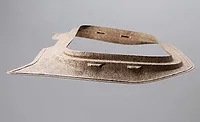
When molding plastic parts for medical devices, the objective is to find a process window that produces parts of consistently high quality. Photo courtesy Kistler Group
Cavity Pressure Is the Key to Molding Consistent, Quality Parts
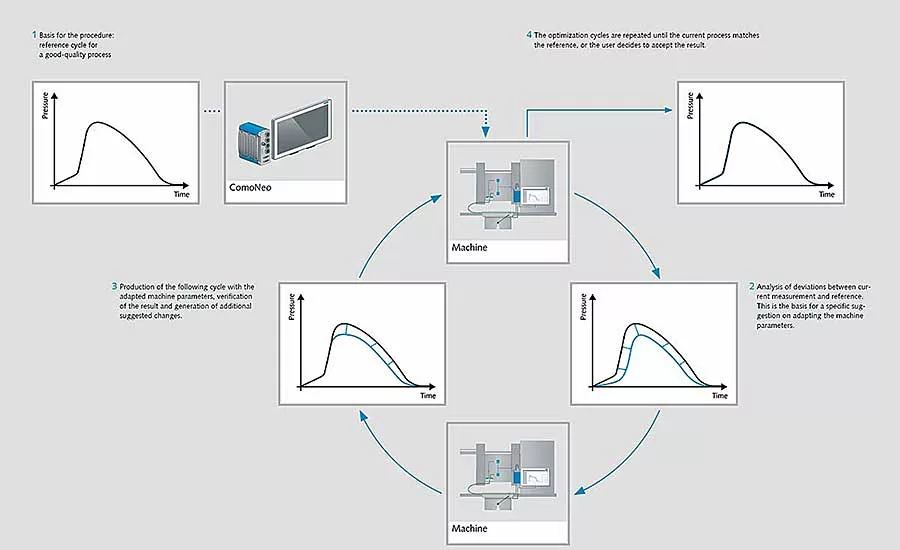
To validate the process for molding plastic parts for medical devices, a stable curve is used as process baseline. The settings on a new machine can then be optimized in a multistep process. Illustration courtesy Kistler Group
Cavity Pressure Is the Key to Molding Consistent, Quality Parts
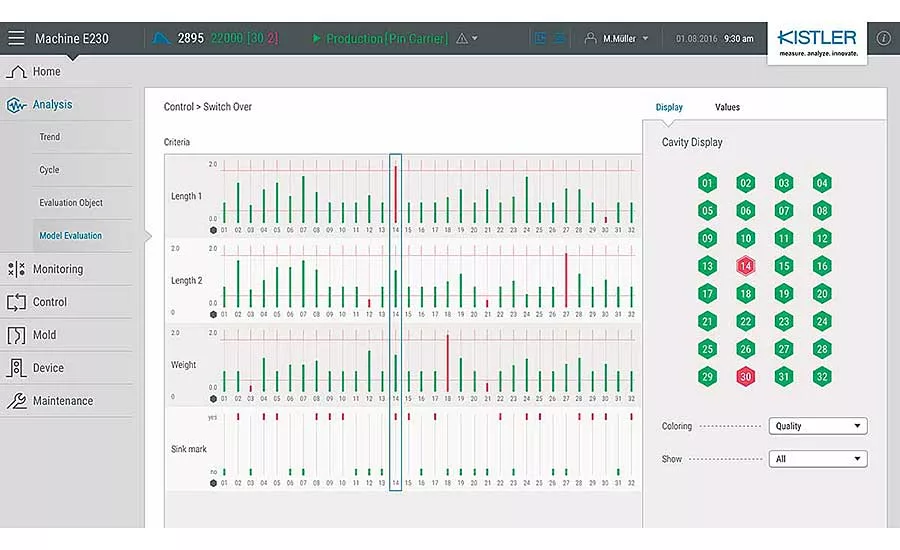
Thanks to ComoNeo’s Predict functionality, the quality of a molded part can be predicted even before it has actually been produced. Illustration courtesy Kistler Group
Cavity Pressure Is the Key to Molding Consistent, Quality Parts
June 9, 2021

Validation causes more headaches for medical device manufacturers than almost any other stage of the production process. For companies certified to ISO 13485, validation is always a costly and time-consuming undertaking—regardless of whether a new process is being set up or an existing process is being transferred. To add to the challenges, manufacturers are confronted with new and stricter regulatory requirements, such as the European Medical Device Regulation, which comes into force this year.

These regulations aim to guarantee product quality based on process quality—in other words, by ensuring that processes are controlled and stable. Consistent process analysis and end-to-end proof of the quality of every step in the process are therefore essential.

However, it can take months to validate machinery and the process, and it’s not always clear how to proceed. This is because the regulations do not specify exactly how validation should be performed. Nevertheless, medical device manufacturers must make sure that quality requirements are met, and they must provide complete transparency and documentation throughout the entire value chain. These requirements apply to material suppliers, parts manufacturers and OEMs.

In the absence of clearly specified requirements, engineers must answer two questions: Is the data adequately documented for all parties involved? And, will the various measures, when viewed together, be able to pass an audit?

For suppliers of plastic parts for medical devices, conventional process validation methods focus on investigating the injection-molding machinery. The objective is to find a process window that allows a stable molding process so that parts are made in line with specifications. Machine-specific settings are defined with the help of downstream tests that investigate the influence of individual machine settings on the test material and the specific attributes of the components. The drawback of this approach is that the knowledge gained is only valid for the machine that is to be qualified. In addition, mapping of conditions inside the mold cavity is usually inadequate.

This shortcoming has an unfortunate consequence: When an existing process is transferred to a new machine, it is usually impossible to reproduce part quality identically. Even though the machine settings are the same, deviations occur in the molded part that will then lead to inconsistent part quality. The result is that every change of machine or location confronts manufacturers with the question of revalidation.

A sensible way to reduce outlay and effort on revalidations is to apply a machine-independent approach that allows end-to-end monitoring in the mold—including the manifold and the cavities. Monitoring of this type requires sensors in all the cavities. The most informative process variable here is cavity pressure. It describes the conditions under which the plastic parts are formed throughout all phases of the process. It also provides insights into the mold where the plastic part is gradually taking shape. Pressure conditions in certain phases of the molding process correlate to specific attributes of the part. For instance, during the injection phase, it is mainly the surface characteristics that are influenced. Similarly, the progression of the compression phase determines factors such as flash and possible damage to the mold. And the holding pressure phase has the most critical influence on the part’s dimension and weight.
Looking for quick answers on assembly and manufacturing topics? Try Ask ASM, our new smart AI search tool. Ask ASM →

Inline process monitoring systems, such as ComoNeo from Kistler, capture the pressure in the cavity throughout the entire molding process. They document the values measured by piezoelectric sensors in the form of a time-pressure curve. Besides ensuring transparency, this approach plays a key part in process baselining. Once a stable process has been defined, its profile can be used as a reference. This is a major factor in ensuring that quality parts can quickly be produced even after a change of machine or location.

To achieve this, ComoNeo’s Recover Restart Assistant accesses the reference curve for an existing optimal process that is already producing a quality part. It compares this curve to the curve for the new process, so any deviations in the characteristic process phases become clearly visible. On this basis, the system suggests that the operator should change specific machine settings to approach the ideal profile for the baseline curve.

Part quality is determined by a number of parameters, such as injection speed, holding pressure time and temperature, so the curves are compared in a series of consecutive adaptation steps. As this sequential process proceeds, the operator can see whether and how individual machine setting values affect the cavity pressure. Process optimization continues until the new operating point precisely matches the reference cavity pressure, or until the user personally judges the result to be satisfactory.

Once the process has been tracked back to the right machine, the search for a stable process window can be launched on the qualified machine. Finding a suitable window is the starting point for the final stage of process development. This is a time-consuming part of the validation process.

The first step is to generate extensive test plans (known as design of experiments, or DoE), which are worked through to determine how various machine settings influence conditions in the mold cavity—as expressed by the cavity pressure profiles. A vast amount of data must be recorded and statistically evaluated to identify the relationships between machine settings and part characteristics. Together with Stasa QC software, technology from Kistler makes it possible to examine these process windows efficiently at shop-floor level. DoEs are then generated and transferred into the Stasa QC software. Automatic recording of the cavity pressure curves is handled by ComoNeo’s Predict functionality.

The data is then fed back into the Stasa QC software, which uses it to generate a statistical quality prediction model. The completed model simulates the relationships between machine parameters and expected part attributes. In conjunction with ComoNeo Predict, engineers can then have these expected quality characteristics specified directly on the machine without actually measuring them. Due to this approach, the part’s quality can be predicted even before it has been manufactured. Besides improving validation, this method yields a major advantage during production. With the help of the quality prediction model, automatic separation of good and bad parts can be implemented directly on the machine—together with all the documentation that is required.

KEYWORDS: factory automation injection molding process monitoring sensors for automation

Share This Story

Looking for a reprint of this article?
From high-res PDFs to custom plaques, order your copy today!

Suzanne Graeser Bieri // Head of Marketing // Kistler Group // Winterthur, Switzerland

Recommended Content

JOIN TODAY
To unlock your recommendations.

Already have an account? Sign In

  • Made in the U.S.A.

    Consumer Products Manufacturing: Made in the USA

    Supply chain lessons learned during the coronavirus...
    Automated Assembly Systems
    By: Austin Weber
  • Best Practices for Press-Fit Assembly

    Best Practices for Press-Fit Assembly

    In manufacturing, ironclad formulas for success are hard...
    Assembly Presses
    By: Jim Camillo
  • aem0523leader-tesla1.jpg

    Tesla Rethinks the Assembly Line

    Engineers at Tesla Inc. have developed a new process that...
    Assembly and Testing
    By: Austin Weber
Manage My Account
  • eMagazine Subscription
  • Assembly Newsletters
  • Online Registration
  • Subscription Customer Service
  • Manage My Preferences

More Videos

Sponsored Content

Sponsored Content is a special paid section where industry companies provide high quality, objective, non-commercial content around topics of interest to the ASSEMBLY audience. All Sponsored Content is supplied by the advertising company and any opinions expressed in this article are those of the author and not necessarily reflect the views of ASSEMBLY or its parent company, BNP Media. Interested in participating in our Sponsored Content section? Contact your local rep!

close
  • ultrasonic welding
    Sponsored bySonobond Ultrasonics

    Engineering Efficiency in High-Performance Assembly: How Ultrasonic Welding Enhances Throughput, Reliability and Quality

  • UV curing system
    Sponsored byDymax

    Why UV Intensity Alone Doesn’t Define Curing Performance

  • wooden pallets
    Sponsored byLEAN Manufacturing Products

    Eliminating Waste on the Shop Floor: Applying Lean Principles to Improve Manufacturing Efficiency

Popular Stories

ASSEMBLY News Now, episode-30: Volvo Redesigns EV Manufacturing

Volvo Redesigns EV Manufacturing

Boeing CEO Kelly Ortberg announces 1 billion investment

Boeing Plans $1 Billion Wichita Investment, Workforce Training Center

automated consumer goods assembly system

Best Practices for Cycle Time Optimization

Watch the latest episode of ANN now!

Events

July 24, 2025

From Shop Floor to CFO: How Manufacturers Are Closing the Loop Between Operations and Finance

On Demand Learn how manufacturers are bridging the gap between the shop floor and ERP systems to gain real-time visibility, streamline operations, and kick-start digital transformation—without waiting years.

Sponsored by:

PicoStratusGreen
July 30, 2025

Buffer Analysis and Design Fundamentals for Manufacturing Excellence

On Demand In this presentation, Dr. Herman Tang shares practical insights from his industry experience and research on buffer management in manufacturing operations.

View All Submit An Event

Poll

Difficult Assembly Processes

Which assembly process gives you the most difficulty?
View Results Poll Archive

Products

Manufacturing Cost Policy Deployment (MCPD) Profitability Scenarios: Systematic and Systemic Improvement of Manufacturing Costs

Manufacturing Cost Policy Deployment (MCPD) Profitability Scenarios: Systematic and Systemic Improvement of Manufacturing Costs

See More Products
Register for webinar - Modernizing Automotive Assembly: Why Upgrading Legacy MES is a Business Imperative

Related Articles

  • Natural fibers may hold the key to lightweighting

    Natural Fibers May Hold the Key to Lightweighting

    See More
  • Education: The Key to Profits

    See More

Related Products

See More Products
  • OIP.jpg

    Is Quality Just a Word We Use?

  • The First Snap-Fit Handbook 2e: Creating and Managing Attachments for Plastics Parts

  • history.jpg

    Faster, Better, Cheaper in the History of Manufacturing: From the Stone Age to Lean Manufacturing and Beyond

See More Products

Related Directories

  • ZeroKey

  • Graphic Parts International

    Graphic Parts International (G.P.I.),a division of The A.W.T. World Trade Group, is the world's premier manufacturer of replacement parts and provider of remanufacturing services for the screen printing industry. G.P.I. maintains a giant inventory of parts, accessories, and supplies for screen printers.
×

Never miss the latest news and trends driving the manufacturing industry

Stay in the know on the latest assembly trends.

JOIN TODAY!
  • RESOURCES
    • Advertise
    • Contact Us
    • Directories
    • Manufacturing Division
    • Store
    • Want More?
  • SIGN UP TODAY
    • Create Account
    • eMagazine
    • Newsletters
    • Customer Service
    • Manage Preferences
  • SERVICES
    • Marketing Services
    • Reprints
    • Market Research
    • List Rental
    • Survey/Respondent Access
  • STAY CONNECTED
    • LinkedIn
    • Facebook
    • Instagram
    • YouTube
    • X (Twitter)
  • PRIVACY
    • PRIVACY POLICY
    • TERMS & CONDITIONS
    • DO NOT SELL MY PERSONAL INFORMATION
    • PRIVACY REQUEST
    • ACCESSIBILITY

Copyright ©2026. All Rights Reserved BNP Media, Inc. and BNP Media II, LLC.

Design, CMS, Hosting & Web Development :: ePublishing