3D Printing and Wire Harness Assembly
Harness assemblers are using additive manufacturing to make custom connectors and assembly fixtures.
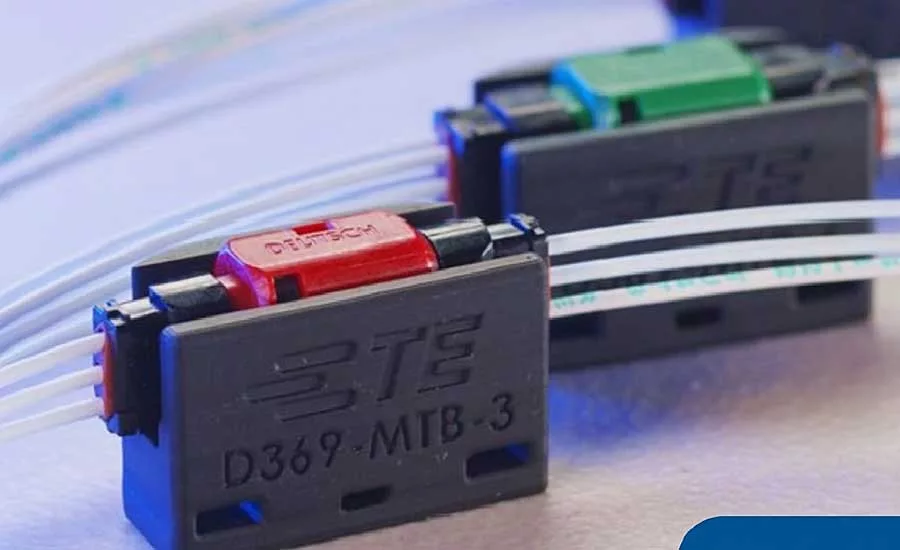
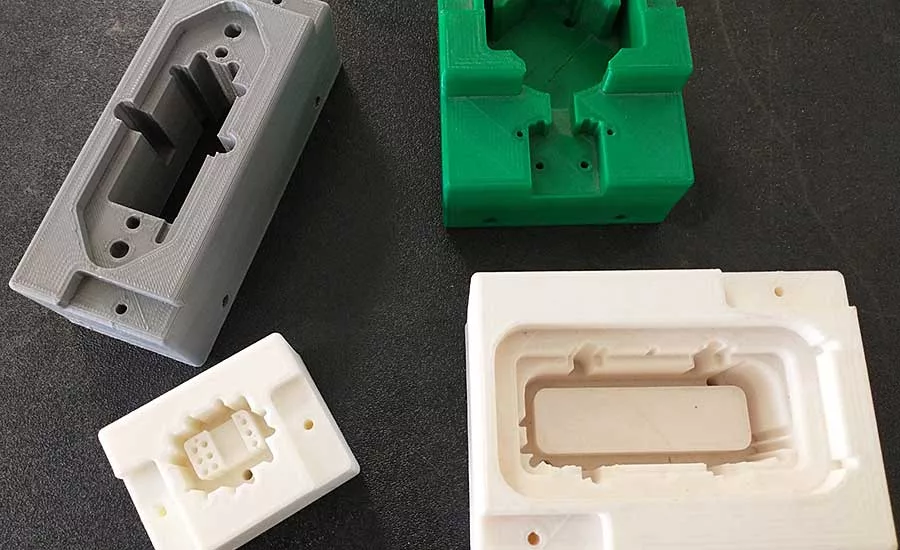
TE Connectivity designed and 3D printed this mounting holder for its D369 connectors at the request of an aerospace manufacturer. Photo courtesy Stratasys Ltd.
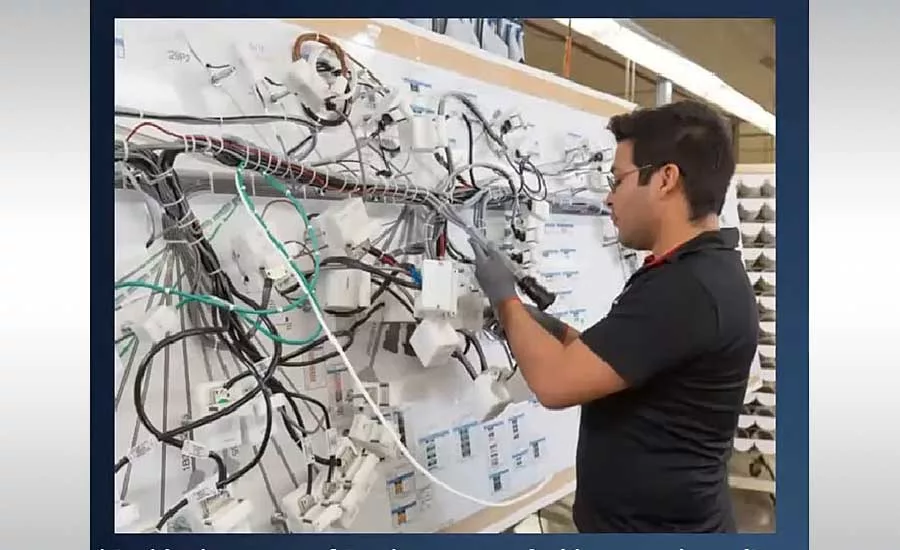
Wire harness manufacturer Cesar-Scott Inc. 3D prints connector holders, switches, jigs, fixtures, and machine safety guards and spare parts. Photo courtesy Cesar-Scott Inc.
Made of plastic, these white blocks are holders that keep connectors in position during harness assembly. Photo courtesy HP Inc.
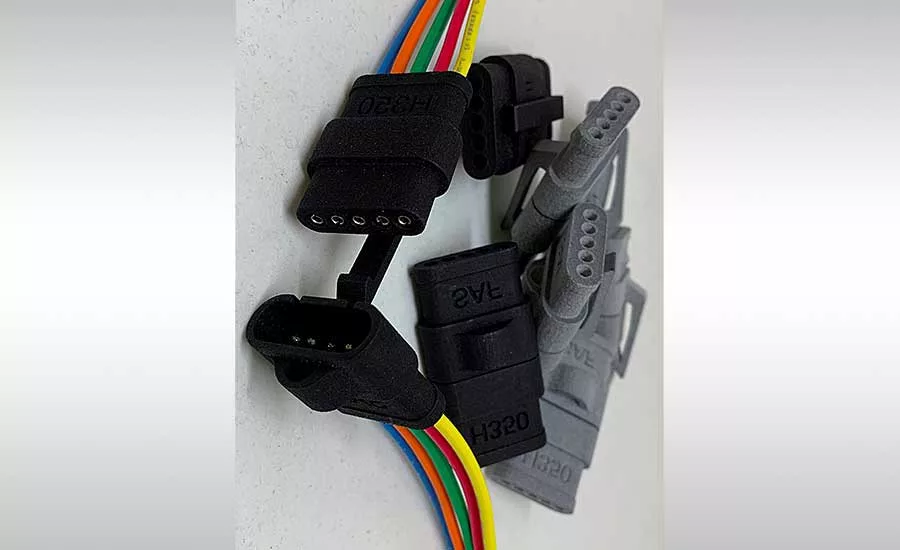
Harness manufacturers can 3D print high-quality connectors at production levels on demand with the H350 machine. Photo courtesy Stratasys Ltd.
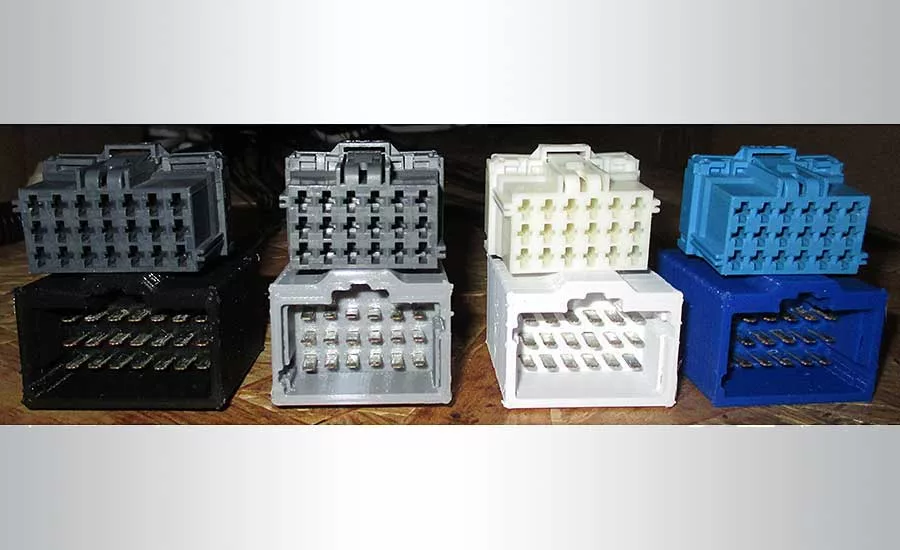
In this photo, CNC-machined harness connectors sit on top of their 3D-printed mating connecters, which are used for conductivity testing. Photo courtesy Electrex Inc.
For years, harness manufacturers only used 3D printing for basic jigs and tooling, prototyping applications or the connectors needed to perform continuity testing of finished harnesses. Now, though, 3D printer suppliers have introduced machines that enable companies to economically print a wide range of connectors and fixtures.
“Being able to customize the harness components we 3D print is a great benefit, but there are others as well, such as correcting defects and finishing projects quicker,” acknowledges Tim Buhler, director of engineering services at Electrex Inc., which has made wire harnesses for off-road vehicles and on-road specialty trucks since the late 1970s. “The need to enhance our harness quality was the main reason we began 3D printing parts, including test fixtures, clamps to secure wires to boards, and holders that help assemblers locate, orient and identify connectors on the harness.”
3D printing has also enabled Electrex to help its customers. Last year, for example, the company printed a unique connector that performs functional and continuity testing of harnesses for a priority customer that manufactures tractors. This increased the quality of the harnesses.
Until recently, only manufacturers in established industries like automotive and aerospace used 3D printing to their advantage. Now, harness makers are doing likewise, and the timing couldn’t be better, in light of the supply chain problems affecting manufacturing.
The traditional benefits of 3D printing—such as saving money and time, and enjoying greater design freedom and material flexibility—appeal to harness assemblers as much as other manufacturers. But, additive manufacturing is also enabling harness assemblers to be less reliant on third-party component suppliers on a daily basis.
Production-Level Connectors
To hear Allen Kreemer, commercial applications engineer at Stratasys Ltd., tell it, the days of using 3D printing solely to make prototype connectors are gone. He says harness manufacturers can now produce high-quality connectors at production levels on demand, thanks to the Stratasys H350 machine, which was introduced in July 2021.
“The advanced technology used by the H350 has been in the works for nearly 15 years, beginning with research work done back at the University of Loughborough earlier in the century,” explains Kreemer. “But, it’s only within the last few years that it became ready for use in the wire harness and other markets. These include the automotive, white goods, electronics, heavy equipment and recreational vehicle industries.”
Looking for quick answers on assembly and manufacturing topics? Try Ask ASM, our new smart AI search tool. Ask ASM
The key to the H350 is its Selective Absorption Fusion (SAF) technology, notes Alec Logeman, commercial applications engineer at Stratasys. SAF uses a counter-rotating roller to coat powder layers onto a print bed before applying absorber fluid to image the part layers. The layers are then melted and fused by passing an infrared lamp over the entire span of the print bed.
Fluid is applied by industrial-grade piezoelectric print heads to prescribed areas to create each part cross section. The process is always performed in the same direction across the print bed to provide a uniform thermal experience and part consistency, regardless of their placement in the build.
“Manufacturers can custom print connectors of any shape with any pin count they want,” says Logeman. “The printed connector body replaces that which usually gets injection molded, and the pins get inserted in a separate process.
“On the H350, its large work envelope (315 by 208 by 293 millimeters) enables a company to 3D print up to 200 standard three-pin Molex-type connectors in just 13 hours,” continues Logeman. “Nearly 400 smaller connectors can be printed in the same space. Production volume will vary by end-user, but the printer is cost-effective, regardless of whether the company prints thousands of connectors per week or year.”
With the H350, Stratasys uses a third-party-certified powder material, PA11, rather than a resin or filament. PA11 is a bio-based plastic made of renewable raw materials derived from sustainable castor oil.
“To get the best production parts when switching over to 3D printing, consider using design for additive manufacturing practices,” recommends Kreemer. “Implementing these strategies when adjusting existing designs can result in making parts faster, cheaper and better.”
Pick (and Print) Your Fixture
Assemblers use various types of fixtures to mount a wire harness to a board during assembly. One type is a plastic holder or cover that each connector is inserted into.
Isabel Sanz, business development manager for the AMS region for HP Inc., says the Jet Fusion 5200 and 5210 models from HP are perfect for 3D printing connector holders. Both machines use Multi-Jet Fusion (MJF) technology for high-volume production.
MJF features a removable build unit with a print head that sprays a fusing agent in one pass onto a powder (PA11 or PA12) surface in the shape of a two-dimensional layer (0.003 inch thick). Infrared lamps then heat and fuse the powder, before another layer of powder is deposited, and the process is repeated.
Each printer features a work envelope of 15 by 11 by 15 inches, and a jetting system that precisely deposits 30 million drops of fusing agent per second per inch. As needed, the print head can apply a detailing agent onto areas next to the intended fusing area to prevent thermal bleed and enhance part performance. This agent also produces features such as rounded edges to prevent wire and connector damage during harness assembly.
“Either model can print up to 184 holders in one print job cycle, which involves 11 hours of printing, followed by 36 hours of cooling,” explains Sanz. “Our testing and research show that holders printed on the 5200 series reduce lead time from two to six weeks, down to one day. The holders cost from $6 to $7 per part when made at a rate of 250 to 300 per day. This represents a savings of up to 75 percent when compared to CNC-machined holders.”
Electrex operates a dozen 2D and 3D printers at its North America locations (three in Kansas, nine in Mexico) to produce a wide range of fixturing clamps and connector holders. Its main printers are Creality Ender 5 Plus models made by Comgrow that use the fused deposition modeling (FDM) process. The printer deposits melted filament material (in this case, polylactic acid, or PLA, a natural thermoplastic polyester) over a build platform layer by layer until the part is complete.
“We use standard off-the-shelf printers for the majority of our parts,” notes Buhler. “They range up to 12 inches square, with most parts measuring less than six inches square and as small as one inch square.”
Wire harness manufacturer Cesar-Scott Inc. (CSI) also relies on FDM-based 3D printers to produce connector holders. Their Atom Industrial Printers (from TCC Print) make PLA or acrylonitrile butadiene styrene (ABS) parts within a 12-inch-square working envelope.
Founded in 1988, CSI has made wire harnesses since 1994 and switch harnesses since 2012. This type of harness energizes the electronic spark module on gas stoves, barbeque and gas grills, and other appliances.
“We’ve been 3D printing most of our prototype switches, along with connector holders, jigs, fixtures, and machine safety guards and spare parts, since 2015,” explains owner and co-founder C. Gustavo Farell. “Last year, we built nearly 500,000 harnesses, each of which features four or five switches and two to 10 wires.
“The main benefit of using 3D printing, for us, is that it quickens the speed to failure,” Farell continues. “What I mean by that is, the faster we can print the wrong part, the more efficient and cost-effectively we can create a mold for the right part to use in production. On average, it takes about three tries to get it right.”
Farell says CSI prints the holders in multiple colors to match those of the connectors. This helps ensure that the assembler places the correct connector in the holder and the correct wires in the connector. Colors include white, transparent white, black, red, blue and green. Most holders are one or two square inches, but can be as large as eight square inches.
Some switches that CSI uses in its harnesses are printed by a third party and sent back. According to Farell, these switches need to be mounted to a PCB via the stereolithography (SLA) printing process.
This process, and its equipment, ensures that the switches meet the higher temperature and resolution requirements for agency approvals. Lower-end equipment may not always meet these requirements. The work is done by multiple companies, as well as at the University of Texas at El Paso’s 3D Engineering and Additive Manufacturing Technology Center.
Both the H350 and Origin One printers from Stratasys can 3D print connector holders. The latter model supports part dimensions up to 192 by 108 by 370 millimeters and prints details less than 50 microns in size.
Certified third-party materials include industrial resins, as well as high-temperature, durable-elastomer, general purpose and medical-grade materials. The Origin One’s Programmable PhotoPolymerization P3 software precisely orchestrates light, temperature, pull forces and pneumatics to optimize part quality.
Installation Helpers
Accessories that help wire harness installation can also be 3D printed. These include clamps, brackets, mounting holders and routing aids.
Recently, cable management specialist HellermannTyton (HT) hired Fast Radius Inc. to 3D print custom routing aids that HT workers attach to finished wire harnesses for easy installation in vehicles. The aids’ large size and complexity forced HT engineers to split the design into multiple smaller sections, which are then printed on HP Jet Fusion machines.
Ethan Fish, product designer at HT, says Fast Radius provided more than 3,000 sections for the first run, in just six weeks. HT workers then assembled these parts into 1,235 parts. Each printed section measures nearly 13 inches long, with the final assembly coming out at nearly 46 inches long.
Hiring Fast Radius for the project helped HT eliminate the upfront cost of injection molding tooling and trials for its automotive customer. HT also saved nearly two months in project lead time and nearly $1 million in total project costs.
Some component suppliers prefer doing their own 3D printing. TE Connectivity, for example, recently designed and 3D printed a prototype mounting holder for its D369 connectors at the request of an aerospace manufacturer. The holder correctly and securely mates connectors that are mounted inside aircraft enclosures.
Besides needing the holder quickly, the manufacturer required that it be made of aerospace-grade material to an accuracy of ±0.002 inch. The holder also had to pass industry-standard airworthiness and environmental tests to prevent failure during various operating conditions.
Engineers at TE Connectivity used the Stratasys Origin One for the project because of past experience with it. Experts at Stratasys, meanwhile, worked with Henkel Loctite to develop a flame-retardant photopolymer for the application.
Looking for a reprint of this article?
From high-res PDFs to custom plaques, order your copy today!