Manufacturing Software
An IIoT Roadmap for Driving Productivity and Efficiency in Automotive Assembly Plants
A three-tiered approach is needed to connect, collect and analyze production data.
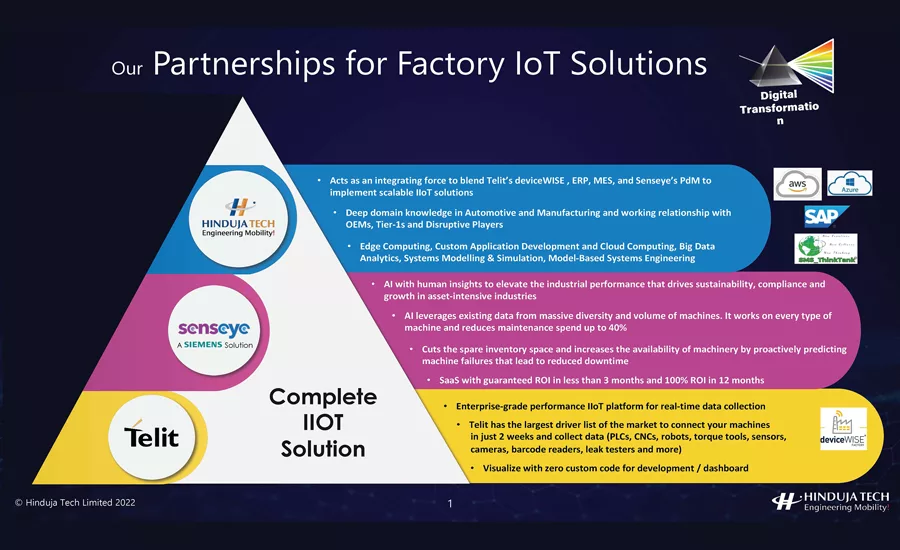
The strategic partnership between Hinduja Tech, Telit and Senseye provides a holistic, end-to-end approach to implementing IIoT technology. Telit offers an easy-to-deploy IIoT platform for connecting machines and visualizing real-time data. Senseye leverages AI to enable predictive analytics and actionable insights. Hinduja Tech acts as the binding force between these technologies.
Photo courtesy Hinduja Tech
The strategic partnership between Hinduja Tech, Telit and Senseye provides a holistic, end-to-end approach to implementing IIoT technology. Telit offers an easy-to-deploy IIoT platform for connecting machines and visualizing real-time data. Senseye leverages AI to enable predictive analytics and actionable insights. Hinduja Tech acts as the binding force between these technologies.
Photo courtesy Hinduja Tech
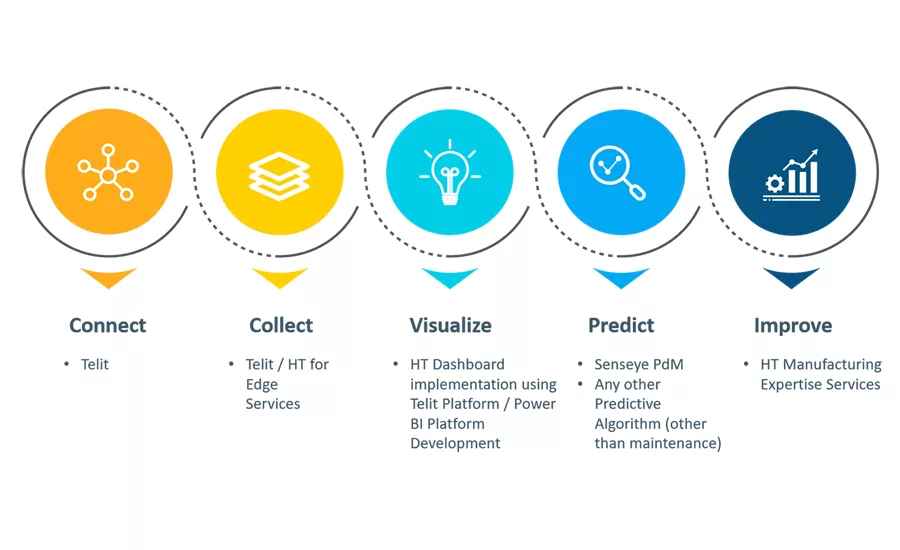
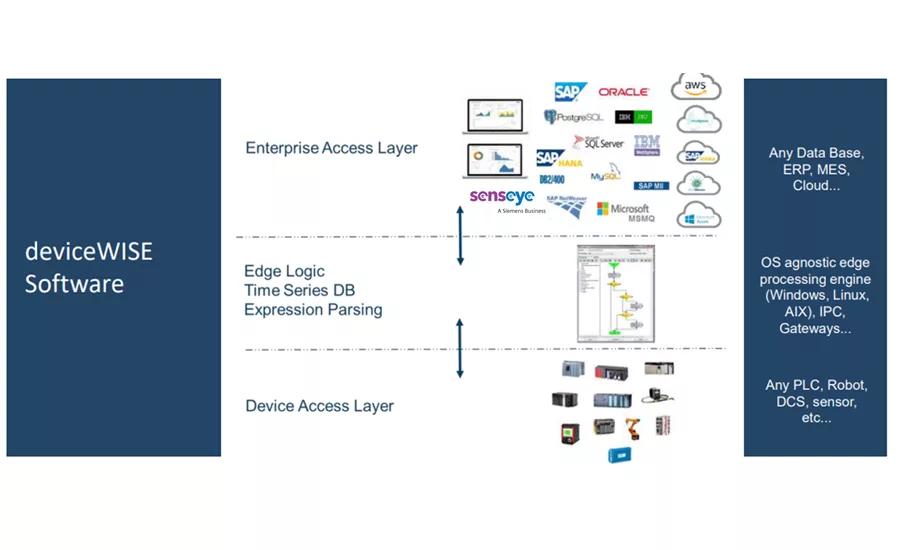
Telit’s deviceWISE EDGE platform enables machines to communicate in a standardized way.
Photo courtesy Hinduja Tech
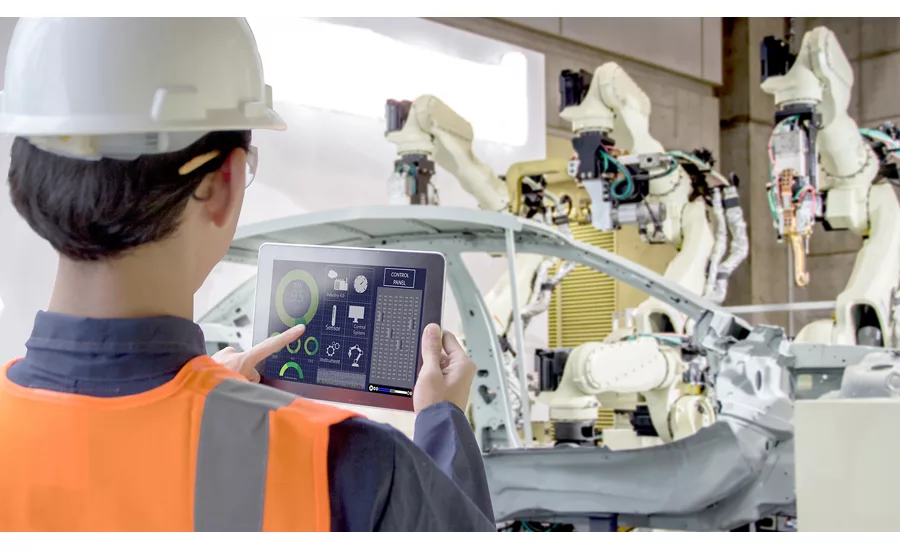
If a user knows a group of robots should behave in more or less the same way, then any outlier—a robot that runs a few degrees hotter or draws more motor current—might indicate a larger issue that needs attention.
Photo courtesy Hinduja Tech
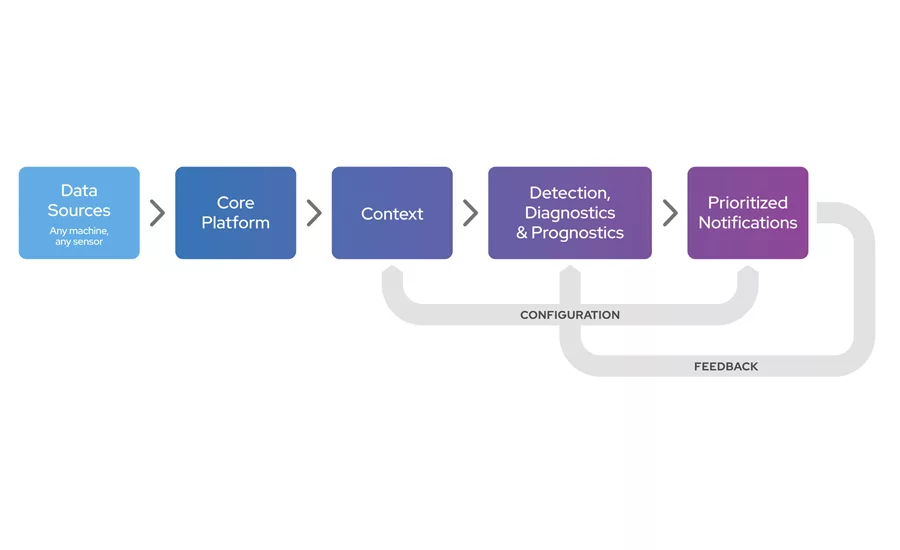
To direct maintenance efforts to where they are needed the most, Senseye deploys a proprietary algorithm called an Attention Engine. This tool uses neural networks to estimate an Attention Index for each machine based on historic patterns, user feedback, maintenance schedules and other contextual information.
Photo courtesy Hinduja Tech
With the explosion of smart factories, automotive manufacturers are increasingly looking for new ways to use the data provided by sensors, machine controllers and other devices to improve productivity and efficiency. When unlocked properly, the insights embedded in the data paint a detailed picture of the factory floor, including the health of each machine, providing manufacturers with greater process visibility. These insights also serve as the starting point for many new or improved operational processes—from quickly identifying and rectifying bottlenecks, to proactively addressing maintenance needs ahead of equipment failure.
Together, these Industrial Internet of Things (IIoT) capabilities can help manufacturers optimize efficiency—often measured as overall equipment effectiveness (OEE)—and maintain an edge in an increasingly competitive, consumer-driven market.
The first step on the road to creating a smart factor is gathering operational data. Unfortunately, for many manufacturers, the road ends there. Roughly 80 percent of IIoT projects fail, according to Gartner. While there is no shortage of incoming data, the decision of what to do with it leaves many automotive manufacturers scratching their heads.
How can manufacturers make the critical transition from data to action? How do they effectively navigate the overabundance of data to pick out what’s meaningful? How do they use these insights to drive overall productivity and efficiency in an automotive context?
The answer to these questions involves deploying a three-tiered IIoT approach that provides automotive OEMs and suppliers with a comprehensive digital roadmap for their operations. The steps of this approach include:
- Connecting the shop floor to the enterprise using an easy-to-use IIoT platform.
- Deploying predictive maintenance tools with advanced analytics to unlock actionable insights. This step includes working with a vendor with a proven solution, domain expedience and methodology to ensure success.
The strategic partnership between Hinduja Tech, Telit and Senseye embodies this holistic, end-to-end approach. Telit offers an easy-to-deploy IIoT platform for connecting machines and visualizing real-time data and Senseye leverages artificial intelligence (AI) to enable predictive analytics and actionable insights. And, thanks to its expertise in the automotive and manufacturing sectors, Hinduja Tech acts as the binding force between these technologies, culminating in scalable, data-driven IIoT technology for automotive manufacturers.
Connecting the Shop Floor to the Top Floor
To build, manage and deploy comprehensive IIoT technology, automotive manufacturers first need a communication platform for their industrial devices and applications, including relational and non-relational databases, operating systems and cloud platforms. One example is Telit’s deviceWISE EDGE platform, which enables machines to communicate in a standardized way so that manufacturers can collect, process and visualize real-time data via dashboards without writing any custom code. User-friendly drag-and-drop features simplify the process of building dashboards. With out-of-the-box integration, this IIoT platform can connect more than 100 types of machines, including PLCs, robots, fastening tools, sensors and vision systems. It only takes two weeks to get up and running, ensuring manufacturers can quickly begin to base their decisions on the most accurate, up-to-date information.
Looking for quick answers on assembly and manufacturing topics? Try Ask ASM, our new smart AI search tool. Ask ASM
DeviceWISE EDGE offers the speed and power of advanced edge logic while offering easy-to-use drag-and-drop tools for defining alarms and alerts, monitoring data, creating logic algorithms and performing calculations. It also seamlessly integrates with existing legacy, modern, proprietary or open-source architectures. It can even connect multiple facilities, enabling companies to compare data across their entire enterprise.
Empowered with incoming IIoT data, manufacturers can begin to shift their focus to improving their productivity. At the same time, they no longer have to worry about creating custom code or one-off software to connect their equipment—activities that are time-consuming and labor-intensive.
Deploy Predictive Models to Stay Ahead of Maintenance Needs
Once automotive manufactures have enabled real-time data collection via an IIoT platform, the next step is to leverage the power of AI to transform the information into actionable insights. AI-powered tools—such as those provided by Senseye—are improving machine reliability across the whole plant, rather than on a small number of machines or production lines.
The company’s cloud-based predictive maintenance software can automatically monitor thousands of machines. Common examples in an automotive plant include compressors; motors; gearboxes; paint, welding and parts-handling robots; conveyors; and automated guided vehicles (AGVs).
As the platform learns each machine’s behavior, it creates a unique digital fingerprint that the software continuously improves upon via user feedback. Because it constructs these models automatically, users can begin to apply predictive maintenance to all their machines—not just the most critical ones—without requiring extensive condition monitoring or data science expertise.
Using this data-driven approach, Senseye’s predictive maintenance software is scalable and applies contextual data—such as maintenance schedules, machine types or asset criticality—to improve each machine’s output. In terms of how it generates the analytics, the software utilizes both unsupervised and user-dependent processes. It automatically calculates each baseline digital fingerprint and then detects isolated or ongoing deviations from this baseline. Using additional data provided by maintenance personnel, it also builds a “failure fingerprint” for any historic functional failures and then analyzes the condition monitoring data to see if it matches a known fingerprint.
To direct maintenance efforts to where they are needed the most, Senseye deploys a proprietary algorithm called an Attention Engine. This tool uses neural networks to estimate an Attention Index for each machine based on historic patterns, user feedback, maintenance schedules and other contextual information. If the index is high enough, the engine will direct the user’s attention to the machine in question. The system continues to learn, adapt and refine the index according to user feedback, generating and prioritizing notifications while avoiding the “notification overload” that is typical of many condition monitoring systems. Using the system’s open architecture, users can even integrate the notifications into their normal workflows—Microsoft Team channels, for instance—enabling personnel to see and respond to issues in a more organic way.
In addition to individual machines, Senseye can even look at entire fleets to compare one machine against the group. For example, if a user knows a group of AGVs should behave in more or less the same way, then any outlier—an AGV that runs a few degrees hotter or draws more motor current—might indicate a larger issue that needs attention. In cases like this, a parameter might not be unusual on its own, but having a basis for comparison yields additional insights about the health of the machine.
Using Senseye’s data-driven approach, automotive manufacturers can begin to reap the benefits of the data they are collecting from their manufacturing assets—sometimes in nonobvious ways. One example is the hidden time savings contained in the system’s logs—specifically, in the time difference between when a machine is given a command and when the log marks the command as completed. A longer-than-usual interval might indicate a mechanical change in the machine—a motor struggling due to increased wear, for example.
Other benefits of this AI-powered system include:
- Manufacturers can take more targeted preventative maintenance activities, improving the efficiency of these processes by up to 55 percent.
- Preventative maintenance schedules, based on Senseye’s condition monitoring analysis, can extend machine lifetime and reduce unplanned downtime by up to 50 percent.
- The amount of labor required to diagnose, document and solve issues is reduced.
- The platform’s open APIs can integrate with any type of hardware and leverage existing data from multiple sources, such as coordinate measuring machines or manufacturing execution systems. The Attention Index, based on Senseye’s pool of user feedback, can help to fill in the knowledge gap for organizations as their workers leave or change jobs.
Customize Your IIoT Technology
Once systems for data collection, analysis and predictive maintenance have been deployed, the final piece to the IIoT puzzle is to work with an integrator to combine these technologies. This integrator should have expertise in automotive enterprise systems, which—when put into practice with today’s OEMs and suppliers—encompasses SAP. Using its extensive domain knowledge, the provider can create complete, scalable IIoT technology that meets the needs of a particular manufacturing operation.
These needs typically fall into one of three categories:
- No data collection capabilities. The machines in an automotive plant are not capable of collecting or sending data because the operation is not outfitted with the proper sensors.
- No data sending capabilities. Machines can collect data, but they cannot send the data to higher-level enterprise systems, necessitating device drivers to connect, collect and visualize the information.
- Laying the groundwork. Machines can capture and send data, but someone must physically configure the machines and software on the plant floor.
One example of an integrator that can do all that is Hinduja Tech. As a one-stop shop for automotive OEMs and suppliers, the company offers both engineering and digital technology services, enabling its customers to make data-driven decisions that drive productivity and efficiency. Understanding three generations of machines and their useful life, as well as the operating conditions of the typical machines used on the shop floor, are critical assets that enable Hinduja Tech to implement technology for automotive plants quickly and easily.
Once up and running with IIoT technology in place, automotive manufacturers will begin to benefit from the richer data streams, shedding light on machines and processes in ways that are both obvious and nonobvious. For example, Hinduja Tech has been able to predict equipment failures with an accuracy of more than 85 percent in a manufacturing assembly line. The company was also able to correlate failures and identify the cascading failures that might occur as a result of a particular failure.
To learn more about this three-tiered approach to connecting, collecting and analyzing production data, please visit hindujatech.com.
Looking for a reprint of this article?
From high-res PDFs to custom plaques, order your copy today!