Is Inflation Hurting Investment in Capital Equipment?
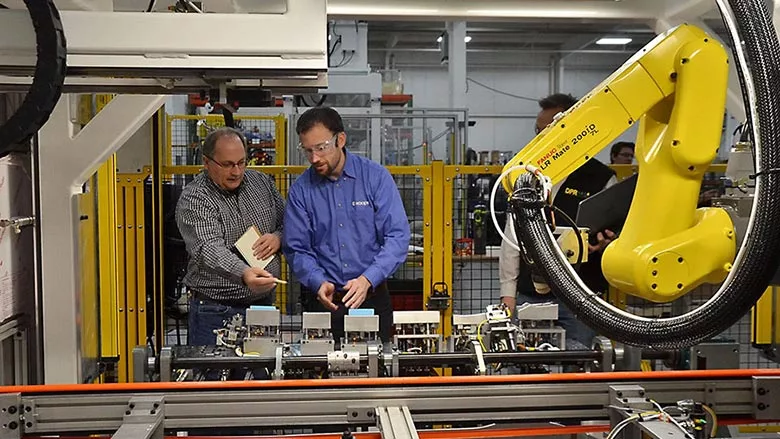
Machine builders are coping with higher prices for automation components and raw materials.
Photo courtesy Koops Automation Systems
Inflation is affecting manufacturers in myriad ways, including higher costs for raw materials, energy and transportation; reduced profit margins; and upward wage pressure. One way to combat these issues is to produce more with less, and one way to do that is with automation.
Ironically, however, the tool used to reduce inflation—higher interest rates—has also made investing in automation more expensive. And, that is affecting systems integrators and other automation providers.

Interest rates on business equipment loans of up to $5 million range from 4.99 to 7.99 percent. Photo courtesy Edgewater Automation
In the aftermath of the post-coronavirus pandemic inflation surge, the Federal Reserve raised interest rates 11 times in the span of about a year and a half, bringing the federal funds rate to a 23-year high of 5.33 percent. Those rate hikes exerted upward pressure on interest rates for all kinds of loans. The Fed’s goal is to make borrowing harder and discourage spending in an effort to bring supply and demand more into balance.
If manufacturers need large or expensive machinery, they will likely need a business equipment loan. Heavy machinery and specialized equipment can cost far more than most businesses have in liquid funds. At press time, interest rates on equipment loans of up to $5 million range from 4.99 to 7.99 percent, depending on the lender, terms and amounts, according to the financial information website, Bankrate.com.
How have interest rates changed? Historical data on the U.S. Small Business Administration’s SBA 504 loan program provide some insight. SBA 504 loans provide financing for the purchase of fixed assets, such as real estate, buildings and machinery, at below market rates. The loans are intended to help for-profit businesses that can’t get financing elsewhere, and are designed to promote job creation and business growth.
In May 2019, the interest rate for a 10-year SBA 504 loan was 4.35 percent, or about the same as it was just five years earlier, in May 2014, 4.5 percent. Then the pandemic hit. With the government desperate to spur any kind of economic growth, the interest rate for a 10-year SBA 504 loan fell to 2.64 percent in May 2020. Today, with the government trying, instead, to curb inflation, the interest rate for the same loan is 6.89 percent.

According to the Atlanta Fed’s Business Inflation Expectations survey, 80 percent of businesses reported that interest rates were having some effect on capital expenditures. Photo courtesy Edgewater Automation
Those higher interest rates are affecting capital spending. According to the Atlanta Fed’s Business Inflation Expectations survey, 80 percent of businesses reported that interest rates were having some effect on capital expenditures. Of those impacted, 43 percent said they stopped or decreased capital expenditures and 30 percent said they were accessing credit less frequently. Another 13 percent said they stopped or lowered levels of research and development.
Looking for quick answers on assembly and manufacturing topics? Try Ask ASM, our new smart AI search tool. Ask ASM
“We’ve seen quotes sit on the shelf for longer,” observes Scott McNabb, project manager for Edgewater Automation, a systems integrator in St. Joseph, MI. “Manufacturers have been hesitant to pull the trigger.”
Rick Blake, founder and CEO of Edgewater, agrees that high interest rates and inflation have changed the landscape for manufacturers. But, he says those are not the only factors slowing the automation market.
“Coming out of the pandemic, manufacturers had a lot of pressure to purchase tools and equipment, and they may have overbought due to labor shortages and material availability,” explains Blake, who has more than 30 years of experience in the automation business. “We have been in the custom automation world for a long time, and there are cycles of capital equipment purchases that can create a high demand followed by a valley.”
At the same time, Blake believes there will be more opportunities for automation business in the near term. “Manufacturers are more willing to make their products closer to where they sell them,” he says. “So, we might see some pick up in the back half of 2024 and first quarter of 2025.”

Some systems integrators say that higher interest rates have made their customers hesitant to invest in automation. Photo courtesy Edgewater Automation
Thomas LaNigra, vice president of applications engineering and project management at Lanco Integrated, a systems integrator in Westbrook, ME, says interest rates are an issue not just for business loans, but consumer loans, as well. “If fewer people are buying houses and cars, then there’s less demand for the things that go into houses and cars,” he points out.
Brian Romano, Ph.D., director of technology development at Arthur G. Russell Co. Inc., a machine builder in Bristol, CT, says that high interest rates have limited the prospects for multimillion-dollar automation projects—at least in the near term. Rather, he says, integrators are focusing on customer service, improving the overall equipment effectiveness of existing systems, and developing incremental automation projects.
Romano says manufacturers currently want to automate “in bite-sized chunks” and are looking for machine builders that are willing to partner with them on process development. Given the current economic climate, manufacturers are more willing to pay for semiautomatic systems and eventually transition to full automation.
Keith P. Stout, president of Genesis Automation, a systems integrator in St. Charles, IL, is more upbeat regarding higher interest rates. Companies that need to automate are going to automate, regardless of the costs. “The case for automation is always going to be there,” he says. “Lower interest rates just make the return-on-investment calculations easier.”

For some manufacturers, the labor shortage is a bigger issue than interest rates. For them, production wouldn’t happen without automation. They just can’t get people. Photo courtesy Edgewater Automation
Mike Stell, account manager at Koops Automation Systems, is also more optimistic. “We’re starting to see a lot more projects released,” he says. “There was some hesitation early, because people thought interest rates might go down, but now companies are moving ahead with their plans.
“The labor shortage is a bigger issue. Our customers have assembly plants that would go dark without automation. They just can’t get people.”
Higher interest rates are also changing how manufacturers pay for automation systems. Ideally, an automated assembly system should be paid for in installments based on milestones. For example, engineers should expect to provide approximately 30 percent of the total cost as a down payment; 30 percent upon completion of engineering; 30 percent after initial run-off; and 10 percent after final installation and acceptance.
Now, manufacturers are delaying invoicing milestones, pushing for lower percentages up front and greater percentages at the end of the project. Such terms place the financial burden of an automation project solely on the machine builder. This is particularly bad for small automation firms, which will be unable to compete for the contract.
“We just lost a major project solely on financing terms,” laments the business development manager at a systems integrator who requested anonymity when discussing money matters.

Due to higher interest rates, some manufacturers are delaying invoicing milestones for automation projects, pushing for lower percentages up front and greater percentages at the end. Photo courtesy Koops Automation Systems
Rising Prices for Automation
To complicate matters, machine builders are themselves coping with higher prices for automation components and raw materials. For example, according to producer price index (PPI) data from the U.S. Bureau of Labor Statistics, the price of extruded aluminum in May 2024 was 33 percent higher than in May 2019 and 60 percent higher than in December 2004, the base year for the index. Extruded aluminum is often used for framing automated assembly systems and cells.
The PPI is a family of indexes that measures the average change over time in the selling prices received by domestic producers of goods and services. PPIs measure price change from the perspective of the seller. This contrasts with other measures, such as the consumer price index, that measure price change from the purchasers’ perspective. Sellers’ and purchasers’ prices may differ due to government subsidies, sales and excise taxes, and distribution costs.
The bureau compiles more than 10,000 PPIs for individual products and groups of products each month. Bureau data reveal that prices for most components in assembly systems have risen sharply during the past five years. For example, from May 2019 to May 2024, the price of controls has increased by 34 percent, pneumatic cylinders by 20 percent, unit-handling conveyors by 30 percent, electric screwdrivers by 38 percent, resistance welders by 26 percent, and electrical connectors by 33 percent. (On the bright side, the price of sensors has actually decreased by 4 percent during that same time period.)
“The prices for technology items—things like PLCs and controllers—have gone up 5 to 10 percent per year for the past three years,” says Romano. “The price of a connector assembly we use for bowl feeders has increased from $79 to $200. On the other hand, prices for some commodity items have actually gone down.”
Such steep and rapid inflation has made the process of quoting on automated assembly projects more difficult. “We’re often asked to provide a budgetary quotes on assembly systems, but a year later, that quote to be 30 percent off,” says Romano.
Lanco’s LaNigra agrees. “Prices have gone up in just the past six months,” he says. “You can’t depend on prices in your data base that are two years old.”
“Inflation is affecting us, especially on the control side,” adds Stout. “Companies are requiring more testing on their machines today, and anything with a microchip in it is more expensive today. A machine that used to cost $500,000 now costs $650,000.”

Rapid inflation has made the process of quoting on automated assembly projects more difficult. Photo courtesy Lanco Integrated
Integrators can pass some price increases onto their customers, but many times, they simply eat into the profit margin on the system.
“Systems integrators are caught in the middle between our suppliers raising prices and our customers, who are squeezing us on cost,” says McNabb.
Stell says inflation is less of an issue for his company. “Integrators are all in the same boat,” he points out. “If we have to buy a robot, we have to buy a robot.”
Long Leads Less Problematic
Five years ago, the problem with automation components was not so much their price, but their lead times. Due to rising demand and other issues, lead times for indexers, actuators, robots and other components increased dramatically. Depending on the size and complexity of the part, delivery times for linear slides ranged from 20 to 26 weeks; robots ranged from 14 to 20 weeks; and indexers took eight to 12 weeks. Then came the COVID-related shutdowns, and delivery times really soared.
Thankfully, integrators say that lead times are mostly back to normal. “Post-pandemic, lead times have moderated,” says Romano. “Many suppliers have reshored production, and companies have become much better at supply chain management. One controller we use still has a 40- to 50-week delivery time.”
Nevertheless, the lead-time issues of the past few years have changed how integrators manage projects. “When we start a project, we meet right away to talk about long-lead-time items, so we can get those on order immediately,” Romano explains.
ASSEMBLY ONLINE
For more information on automated assembly, read these articles:
Yamaha Smart Factory Features AGV Bypass System
Update Report: 2013 Assembly Plant of the Year — Northrop Grumman Corp.
Robots Automate Assembly of Battery Packs for Electric Buses
Looking for a reprint of this article?
From high-res PDFs to custom plaques, order your copy today!