Assembly Magazine logo
search
Ask ASSEMBLY AI
cart
facebook twitter linkedin youtube
  • Sign In
  • Create Account
  • Sign Out
  • My Account
Assembly Magazine logo
  • TRENDS
    • Ask ASSEMBLY AI
    • Trends
    • News
    • New Products
  • INDUSTRIES
    • Aerospace
    • Appliance
    • DFMA Assembly
    • Medical Devices
    • Green Manufacturing
    • Lean Manufacturing
    • Machinery Assembly
    • Electronics Assembly
    • Automotive
  • TECHNOLOGIES
    • Adhesives & Dispensing
    • Assembly Presses
    • Automated Assembly Systems
    • Manufacturing Management
    • Manufacturing Software
    • Motion Control
    • Screwdriving & Riveting
    • Robotics
    • Test & Inspection
    • Plastics & Metal Welding
    • Wire Processing
    • Workstations
  • AUTONOMOUS & ELECTRIC MOBILITY
    • AEM Magazine Archives
    • Autonomy
    • Electrification
    • Mobility Services
    • Assembly & Testing
    • AV/EM News
  • MEDIA
    • Ask ASSEMBLY AI
    • Podcasts
    • Assembly News Now
    • Assembly TV
    • Webinars
    • eBooks
  • EVENTS
    • Calendar
    • The ASSEMBLY Show
  • MORE
    • Exclusives >
      • Plant of the Year
      • Capital Spending
    • Buyers Guide >
      • Supplier Insights
    • Classifieds
    • Featured Products
    • Newsletters
    • Store
    • White Papers
    • Columns
    • Sponsor Insights
  • INFOCENTER
    • Assembly & Test Solutions
  • EMAGAZINE
    • eMagazine
    • Archive Issues
    • Advertise
    • Contact Us
    • Sign Up
IndustriesTechnologiesAutomotive AssemblyWorkstations Assembly

Evaluating Fatigue on the Assembly Line
By Xiaonan Yang
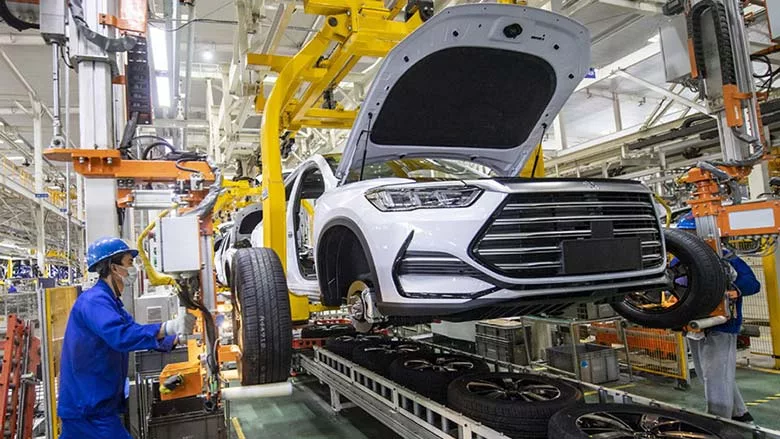
Chinese automotive assembly plant

Like their counterparts in Europe and North America, Chinese automakers are concerned about ergonomics and safety.

Photo courtesy BYD

July 8, 2024

Long hours on the assembly line can easily lead to fatigue. Tired workers are less efficient and more prone to errors. These problems can be avoided if assemblers are able to work within their physical capabilities, so it’s important to accurately assess fatigue on the line.

Software can help. For example, Tecnomatix Jack 8.0 modeling and simulation software from Siemens is a powerful tool for human-centric design and ergonomic analysis. It aids in creating work environments that are efficient, productive, ergonomic and safe.

As good as these tools are, however, they are not great at assessing physical fatigue or predicting energy expenditure. They don’t account for the influence of external environmental factors or differences between individual workers.

wireless blood oxygen sensors attached to a headband

To measure cerebral oxygen levels, the researchers used wireless blood oxygen sensors attached to a headband. A motion capture system collected data for the ergonomic indexes. Photo courtesy Beijing Institute of Technology

wireless blood oxygen sensors attached to a headband

The car seat assembly process involves lifting, carrying and static assembly. Photo courtesy Beijing Institute of Technology

wireless blood oxygen sensors attached to a headband

While wearing augmented reality goggles, workers had to pick up a weight, move it 3 meters, and “install” it in a virtual vehicle body. Photo courtesy Beijing Institute of Technology

We wanted to develop a more accurate and objective method of assessing fatigue by measuring oxygen saturation levels in the brain. Although the brain represents just 2 percent of body weight, it consumes 20 percent of the body’s energy. Rapid consumption of energy by the brain during exercise can lead to changes in cerebral oxygen saturation. As a result, oxygen levels in the brain can be used to evaluate physical fatigue.

To test our idea, we conducted a field investigation at a Chinese automaker. Specifically, we looked at three actions on the line: lifting, carrying, and static assembly. The first two are self-explanatory. A worker picks up a part or subassembly—a door, a wheel, a seat—in one spot and carries it to another. In static assembly, the worker stays in one spot performing various tasks. He may or may not need to bend at the waist.

We hoped to answer three questions:

  •   Can oxygen saturation in the brain assess the degree of fatigue in the human body?
  •   Do different weights and carrying heights affect the degree of fatigue?
  •   Could our system be more accurate than Tecnomatix Jack at measuring fatigue and energy expenditure?


Experimental Design

To assess the effectiveness of our system, we needed way to quantify physical exertion. For lifting, we used the Lifting Index from the National Institute for Occupational Safety and Health (NIOSH). For carrying, we used the Ovako Working Posture Analysis System (OWAS), which was developed by Ovako OY, a European steel producer. For static assembly, we used the Rapid Upper Limb Assessment (RULA) from the University of Nottingham in England.

Looking for quick answers on assembly and manufacturing topics? Try Ask ASM, our new smart AI search tool. Ask ASM →

Each assessment score was weighted for statistical purposes. Because fatigue is a dynamic and cumulative process over time, a time-weighted method was used to weigh the actual duration of lifting, carrying, and static assembly.

All experiments were done in the morning to ensure consistency of the participants’ physical condition, and each experiment was only performed once a day for each participant. 

wireless blood oxygen sensors attached to a headband

The researchers found that cerebral oxygen levels (the blue line) had a stronger correlation to physical fatigue (the orange line) than the energy expenditure model in Tecnomatix Jack software. Photo courtesy Beijing Institute of Technology

The participants—men aged 23 to 24—were divided into six groups, with three workers in each group. Workers were asked to lift weights of 8, 14 or 20 kilograms to a height of 15 or 45 centimeters from the ground. While wearing augmented reality goggles, workers had to pick up a weight, move it 3 meters, and “install” it in a virtual vehicle body. The latter process required bending over to attach the seat to the vehicle, during which time their bodies remain relatively static and only their hands perform the task.

The level of physical fatigue was represented by three indicators: cerebral oxygen saturation, physical fatigue evaluation, and metabolic energy expenditure. Our hypothesis was that fatigue would vary depending on the task. For example, lifting a 20-kilogram weight to a height of 45 centimeters would be more fatiguing than lifting a 8-kilogram weight to a height of 15 centimeters.

To measure cerebral oxygen levels, we used wireless blood oxygen sensors attached to a headband. The Augmented Reality-based Ergonomic Platform (ARE Platform) was used to create a consistent virtual assembly application. The platform puts virtual manufacturing models in a physical environment, providing participants with a semi-immersive working experience and retaining the constraints of the physical environment. A motion capture system collected data for the ergonomic indexes (RULA, OWAS, and NIOSH).


Results

Our results showed that when the lifting height was 15 centimeters and the weight was 20 kilograms, the fatigue level was the highest. On the contrary, when the height was 45 centimeters and the weight was 8 kilograms, the fatigue level was the lowest. 

The correlation between the physical fatigue evaluation method and cerebral oxygen levels was slightly higher than that between the metabolic energy expenditure estimates in Tecnomatix Jack and cerebral oxygen levels. In other words, our proposed cerebral oxygen method is more accurate than Tecnomatix Jack at predicting physical fatigue in workers.

Our results point to a new way to measure fatigue using wearable blood oxygen sensors. In recent years, there have been many cases of using wearable devices for fatigue evaluation, and most of them have also achieved good results. The use of wearable devices has the advantages of high precision, high flexibility and high adaptability. In the future it may become the primary means of accurately assessing physical fatigue.

Editor’s note: This article is a summary of a research paper co-authored by Chaoran Wang, Yaoguang Hu and Tianxin Gao of the Beijing Institute of Technology, and Wanting Mao of the Imperial College of London. To read the entire paper, click here.

See more articles from our July 2024 issue!


ASSEMBLY ONLINE

For more information on ergonomics, read these articles:
Anti-Fatigue Mats Keep Workers on Their Feet
Exoskeletons Aid Assemblers at Truck Plant
Accommodating Older Workers

KEYWORDS: ergonomics industrial health and safety manual assembly

Share This Story

Looking for a reprint of this article?
From high-res PDFs to custom plaques, order your copy today!

Xiaonan Yang, Ph.D. // Professor of Mechanical Engineering // Beijing Institute of Technology // Beijing, China

Recommended Content

JOIN TODAY
To unlock your recommendations.

Already have an account? Sign In

  • Made in the U.S.A.

    Consumer Products Manufacturing: Made in the USA

    Supply chain lessons learned during the coronavirus...
    Automated Assembly Systems
    By: Austin Weber
  • Best Practices for Press-Fit Assembly

    Best Practices for Press-Fit Assembly

    In manufacturing, ironclad formulas for success are hard...
    Assembly Presses
    By: Jim Camillo
  • aem0523leader-tesla1.jpg

    Tesla Rethinks the Assembly Line

    Engineers at Tesla Inc. have developed a new process that...
    Assembly and Testing
    By: Austin Weber
Manage My Account
  • eMagazine Subscription
  • Assembly Newsletters
  • Online Registration
  • Subscription Customer Service
  • Manage My Preferences

More Videos

Sponsored Content

Sponsored Content is a special paid section where industry companies provide high quality, objective, non-commercial content around topics of interest to the ASSEMBLY audience. All Sponsored Content is supplied by the advertising company and any opinions expressed in this article are those of the author and not necessarily reflect the views of ASSEMBLY or its parent company, BNP Media. Interested in participating in our Sponsored Content section? Contact your local rep!

close
  • ultrasonic welding
    Sponsored bySonobond Ultrasonics

    Engineering Efficiency in High-Performance Assembly: How Ultrasonic Welding Enhances Throughput, Reliability and Quality

  • UV curing system
    Sponsored byDymax

    Why UV Intensity Alone Doesn’t Define Curing Performance

  • wooden pallets
    Sponsored byLEAN Manufacturing Products

    Eliminating Waste on the Shop Floor: Applying Lean Principles to Improve Manufacturing Efficiency

Popular Stories

ASSEMBLY News Now, episode-30: Volvo Redesigns EV Manufacturing

Volvo Redesigns EV Manufacturing

Boeing CEO Kelly Ortberg announces 1 billion investment

Boeing Plans $1 Billion Wichita Investment, Workforce Training Center

GE Appliances Worker on Line

GE Appliances Expands Factory AI With 800 Gemini Enterprise Agents

Watch the latest episode of ANN now!

Events

July 24, 2025

From Shop Floor to CFO: How Manufacturers Are Closing the Loop Between Operations and Finance

On Demand Learn how manufacturers are bridging the gap between the shop floor and ERP systems to gain real-time visibility, streamline operations, and kick-start digital transformation—without waiting years.

Sponsored by:

PicoStratusGreen
July 30, 2025

Buffer Analysis and Design Fundamentals for Manufacturing Excellence

On Demand In this presentation, Dr. Herman Tang shares practical insights from his industry experience and research on buffer management in manufacturing operations.

View All Submit An Event

Poll

Difficult Assembly Processes

Which assembly process gives you the most difficulty?
View Results Poll Archive

Products

Manufacturing Cost Policy Deployment (MCPD) Profitability Scenarios: Systematic and Systemic Improvement of Manufacturing Costs

Manufacturing Cost Policy Deployment (MCPD) Profitability Scenarios: Systematic and Systemic Improvement of Manufacturing Costs

See More Products
Register for webinar - Modernizing Automotive Assembly: Why Upgrading Legacy MES is a Business Imperative

Related Articles

  • employee working on an assembly line

    How to Evaluate Cardiovascular Health on the Assembly Line

    See More
  • Be Safe on the Assembly Line

    Be Safe on the Assembly Line

    See More
  • aerospace metal work

    Aerospace Company Improves Safety on the Assembly Line

    See More

Related Products

See More Products
  • foreman.jpg

    The Foreman on the Assembly Line

  • Kaizen Assembly: Designing, Constructing, and Managing a Lean Assembly Line

  • lean.jpg

    Lean Manufacturing: Business Bottom-Line Based

See More Products

Events

View AllSubmit An Event
  • October 27, 2026

    The ASSEMBLY Show

    The ASSEMBLY Show provides face-to-face access to the equipment, technologies, and experts driving today’s production manufacturing environments. Designed to help manufacturing professionals solve real operational challenges, this event helps attendees identify and implement technologies and processes that improve throughput, reduce costs, and support upcoming production goals.
View AllSubmit An Event
×

Never miss the latest news and trends driving the manufacturing industry

Stay in the know on the latest assembly trends.

JOIN TODAY!
  • RESOURCES
    • Advertise
    • Contact Us
    • Directories
    • Manufacturing Division
    • Store
    • Want More?
  • SIGN UP TODAY
    • Create Account
    • eMagazine
    • Newsletters
    • Customer Service
    • Manage Preferences
  • SERVICES
    • Marketing Services
    • Reprints
    • Market Research
    • List Rental
    • Survey/Respondent Access
  • STAY CONNECTED
    • LinkedIn
    • Facebook
    • Instagram
    • YouTube
    • X (Twitter)
  • PRIVACY
    • PRIVACY POLICY
    • TERMS & CONDITIONS
    • DO NOT SELL MY PERSONAL INFORMATION
    • PRIVACY REQUEST
    • ACCESSIBILITY

Copyright ©2026. All Rights Reserved BNP Media, Inc. and BNP Media II, LLC.

Design, CMS, Hosting & Web Development :: ePublishing