Assembly Magazine logo
search
Ask ASSEMBLY AI
cart
facebook twitter linkedin youtube
  • Sign In
  • Create Account
  • Sign Out
  • My Account
Assembly Magazine logo
  • TRENDS
    • Ask ASSEMBLY AI
    • Trends
    • News
    • New Products
  • INDUSTRIES
    • Aerospace
    • Appliance
    • DFMA Assembly
    • Medical Devices
    • Green Manufacturing
    • Lean Manufacturing
    • Machinery Assembly
    • Electronics Assembly
    • Automotive
  • TECHNOLOGIES
    • Adhesives & Dispensing
    • Assembly Presses
    • Automated Assembly Systems
    • Manufacturing Management
    • Manufacturing Software
    • Motion Control
    • Screwdriving & Riveting
    • Robotics
    • Test & Inspection
    • Plastics & Metal Welding
    • Wire Processing
    • Workstations
  • AUTONOMOUS & ELECTRIC MOBILITY
    • AEM Magazine Archives
    • Autonomy
    • Electrification
    • Mobility Services
    • Assembly & Testing
    • AV/EM News
  • MEDIA
    • Ask ASSEMBLY AI
    • Podcasts
    • Assembly News Now
    • Assembly TV
    • Webinars
    • eBooks
  • EVENTS
    • Calendar
    • The ASSEMBLY Show
  • MORE
    • Exclusives >
      • Plant of the Year
      • Capital Spending
    • Buyers Guide >
      • Supplier Insights
    • Classifieds
    • Featured Products
    • Newsletters
    • Store
    • White Papers
    • Columns
    • Sponsor Insights
  • INFOCENTER
    • Assembly & Test Solutions
  • EMAGAZINE
    • eMagazine
    • Archive Issues
    • Advertise
    • Contact Us
    • Sign Up
IndustriesColumnsMedical Devices AssemblyGreen Manufacturing AssemblyElectronics AssemblyOn Campus

University of Missouri Develops New Assembly Process
By Austin Weber
Freeform Multi-material Assembly Process

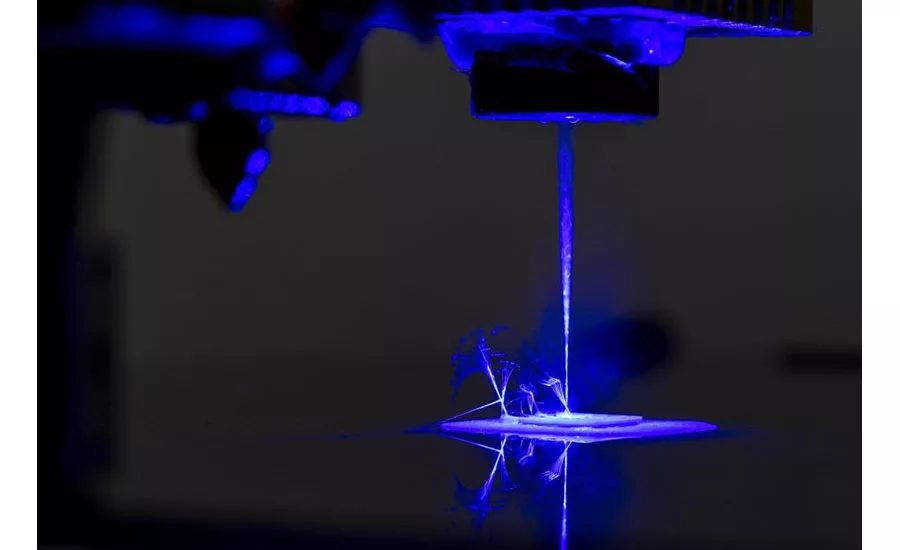
A new production process combines elements of traditional 3D printing with laser technology to develop multimaterial, multifunctional products. Photo courtesy University of Missouri
Freeform Multi-material Assembly Process

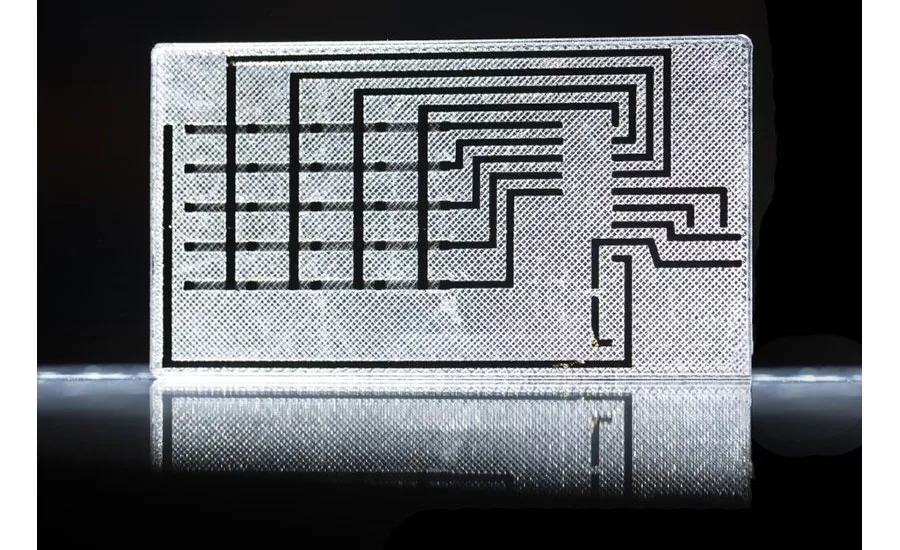
The new process can be used to create a variety of products, including multi-layered sensors, printed circuit boards and textiles embedded with electronic components. Photo courtesy University of Missouri

electrodes printed inside of a plastic material

These electrodes were printed inside of a plastic material. Photo courtesy University of Missouri
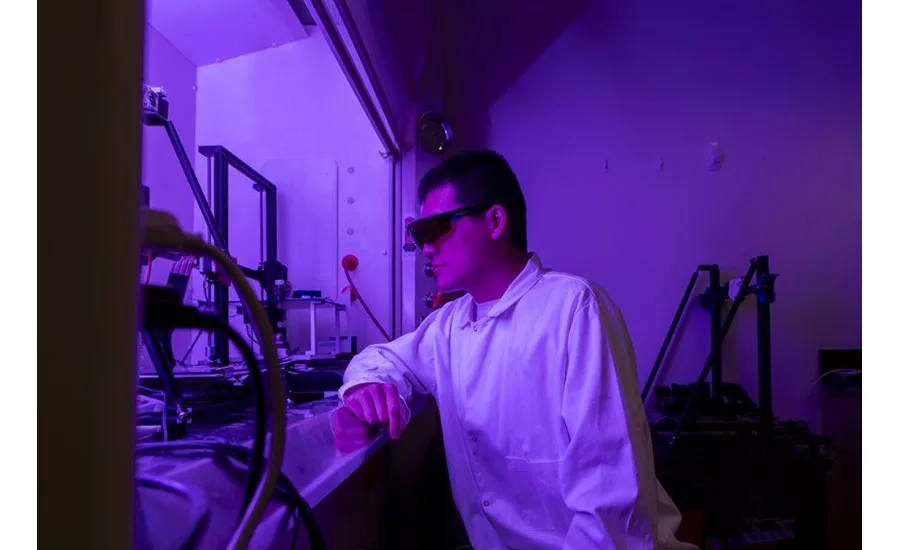
Freeform Multi-material Assembly Process
electrodes printed inside of a plastic material
September 23, 2024

Assembling products that contain dissimilar materials has challenged engineers for decades. However, a new production process developed at the University of Missouri may change that.

The Freeform Multi-material Assembly Process can create complex devices with a single machine that combines additive manufacturing and laser technology.

According to Jian “Javen” Lin, Ph.D., an associate professor of mechanical and aerospace engineering at Mizzou, the new process can be used to mass-produce a variety of products, including multilayered sensors, printed circuit boards (PCBs) and textiles embedded with electronic components.

The process could also be used to produce different types of medical devices. Since it can use all thermoplastic materials as structure and carbon as conductive traces, it can create biocompatible products for task-specific applications.

“One of the main benefits is that innovators can focus on designing new products without worrying about how to prototype them,” explains Lin. “It will shorten fabrication time for device prototyping by allowing [engineers] to make prototypes in-house.

“This opens the possibility for entirely new markets,” claims Lin. “It will have broad impacts on wearable sensors, customizable robots, medical devices and [other products].”

“The advancement of 3D printing has already made it possible for designers to create products themselves at a significantly lower cost than outsourcing to a manufacturing company,” adds Bujingda Zheng, a doctoral student in mechanical engineering at Mizzou who worked on the project. “This democratization of manufacturing means that as long as you have the design, a printer can produce it for you.

Looking for quick answers on assembly and manufacturing topics? Try Ask ASM, our new smart AI search tool. Ask ASM →

“However, desktop 3D printers are currently limited in their ability to fabricate products that require multiple materials,” notes Zheng. “Our new process addresses this limitation by enabling low-cost, multimaterial 3D printing, thus expanding the capabilities and applications of additive manufacturing technology.

“This advancement not only reduces production costs, but also opens up new possibilities for complex, multifunctional product designs,” claims Zheng..

“By printing sensors embedded within a structure, [our] machine can make things that can sense environmental conditions, including temperature and pressure,” says Zheng. “That could lead to natural-looking objects such as a rock or seashell that could measure the movement of ocean water. Other potential applications include wearable devices that monitor vital signs such as blood pressure.

“The greatest benefit would be a reduction in the time required to create PCBs,” explains Zheng. “The existing process for producing PCBs is totally different from ours. It involves chemical etching and other complicated [steps].

“Currently, manufacturing a multilayered structure such as a PCB can be a cumbersome process that involves numerous steps and materials,” Zheng points out. “Those processes are costly, time consuming and can generate waste that harms the environment.

“[Our] new process is simple,” claims Zheng. “It produces PCBs on one station without any waste. So, it will replace the traditional PCB manufacturing process. And, it can be fully automated.”

Zheng and his colleagues built a machine that has three different nozzles. One adds ink-like material; another uses a laser to carve shapes and materials; and the third adds additional functional materials to enhance the product’s capabilities.

It starts by making a basic structure with a regular 3D printing filament, such as polycarbonate. Then, it switches to laser to convert some parts into a special material called laser-induced graphene, putting it exactly where it’s needed. Finally, more materials are added to enhance the functional abilities of the final product.

“Not only is the new technique better for the planet, [but] it’s inspired by systems found in nature,” says Zheng. “Everything in nature consists of structural and functional materials.

“For example, electrical eels have bones and muscles that enable them to move,” Zheng points out. “They also have specialized cells that can discharge up to 500 volts to deter predators. These biological observations inspired [us] to develop new methods for fabricating 3D structures with multifunctional applications.”

According to Zheng, other techniques fall short when it comes to how versatile the material can be and how precisely smaller components can be placed inside larger 3D structures.

“Previously, we developed a process called freeform laser induction (FLI), which enables the fabrication of 3D electronics on curved surfaces,” says Zheng. “However, this process is limited to the exterior of pre-existing objects.

“To enhance the capabilities of FLI, we integrated two additional processes: fused filament fabrication (FFF) and direct ink writing (DIW),” explains Zheng. “This integration is the rationale behind the project’s approach. This is the first time this type of process has been used, and it’s unlocking new possibilities.”

The new production process can use various types of thermoplastic filaments, such as polycarbonate, polylactic acid, polyethylene terephthalate glycol and thermoplastic polyurethane, as structural materials. Additionally, it employs laser-induced graphene, lignin, silver, zinc oxide and other extrudable materials as functional components.

“The laser converts the structural material into functional material and converts the precursor of extruded material into functional material, such as silver nitrate into silver,” says Zheng. “FFF constructs the structural material, while DIW deposits the precursor into the predesignated locations.”
KEYWORDS: additive manufacturing mixed-material assembly

Share This Story

Looking for a reprint of this article?
From high-res PDFs to custom plaques, order your copy today!

Austinweber headshot
Austin has been senior editor for ASSEMBLY Magazine since September 1999. He has more than 21 years of b-to-b publishing experience and has written about a wide variety of manufacturing and engineering topics. Austin is a graduate of the University of Michigan.

Recommended Content

JOIN TODAY
To unlock your recommendations.

Already have an account? Sign In

  • Made in the U.S.A.

    Consumer Products Manufacturing: Made in the USA

    Supply chain lessons learned during the coronavirus...
    Automated Assembly Systems
    By: Austin Weber
  • Best Practices for Press-Fit Assembly

    Best Practices for Press-Fit Assembly

    In manufacturing, ironclad formulas for success are hard...
    Assembly Presses
    By: Jim Camillo
  • aem0523leader-tesla1.jpg

    Tesla Rethinks the Assembly Line

    Engineers at Tesla Inc. have developed a new process that...
    Automotive Assembly
    By: Austin Weber
Manage My Account
  • eMagazine Subscription
  • Assembly Newsletters
  • Online Registration
  • Subscription Customer Service
  • Manage My Preferences

More Videos

Sponsored Content

Sponsored Content is a special paid section where industry companies provide high quality, objective, non-commercial content around topics of interest to the ASSEMBLY audience. All Sponsored Content is supplied by the advertising company and any opinions expressed in this article are those of the author and not necessarily reflect the views of ASSEMBLY or its parent company, BNP Media. Interested in participating in our Sponsored Content section? Contact your local rep!

close
  • ultrasonic welding
    Sponsored bySonobond Ultrasonics

    Engineering Efficiency in High-Performance Assembly: How Ultrasonic Welding Enhances Throughput, Reliability and Quality

  • UV curing system
    Sponsored byDymax

    Why UV Intensity Alone Doesn’t Define Curing Performance

  • wooden pallets
    Sponsored byLEAN Manufacturing Products

    Eliminating Waste on the Shop Floor: Applying Lean Principles to Improve Manufacturing Efficiency

Popular Stories

Ferrari

Ferrari Unveils Four-Door EV

ASSEMBLY News Now, episode-30: Volvo Redesigns EV Manufacturing

Volvo Redesigns EV Manufacturing

Robots working at Toyota Plant in Japan

Toyota Deploys Geekplus Robots for Factory Material Handling

Watch the latest episode of ANN now!

Events

July 24, 2025

From Shop Floor to CFO: How Manufacturers Are Closing the Loop Between Operations and Finance

On Demand Learn how manufacturers are bridging the gap between the shop floor and ERP systems to gain real-time visibility, streamline operations, and kick-start digital transformation—without waiting years.

Sponsored by:

PicoStratusGreen
July 30, 2025

Buffer Analysis and Design Fundamentals for Manufacturing Excellence

On Demand In this presentation, Dr. Herman Tang shares practical insights from his industry experience and research on buffer management in manufacturing operations.

View All Submit An Event

Poll

Difficult Assembly Processes

Which assembly process gives you the most difficulty?
View Results Poll Archive

Products

Manufacturing Cost Policy Deployment (MCPD) Profitability Scenarios: Systematic and Systemic Improvement of Manufacturing Costs

Manufacturing Cost Policy Deployment (MCPD) Profitability Scenarios: Systematic and Systemic Improvement of Manufacturing Costs

See More Products
ebook

Related Articles

  • Honda Develops New Assembly Line Concept

    See More
  • Ford Motor Co.'s new Universal EV Production System

    Ford to Build Mass-Market EV Using a New Assembly Process

    See More
  • Toyota to Adopt New Assembly Process

    See More

Related Products

See More Products
  • Joining and Assembly of Medical Materials and Devices, 1st Edition

  • leaner

    Leaner Manufacturing: How to Make the Lean Production Process Easier, Faster, and More Cost-Effective

  • Kaizen Assembly: Designing, Constructing, and Managing a Lean Assembly Line

See More Products

Related Directories

  • Virtual Process

×

Never miss the latest news and trends driving the manufacturing industry

Stay in the know on the latest assembly trends.

JOIN TODAY!
  • RESOURCES
    • Advertise
    • Contact Us
    • Directories
    • Manufacturing Division
    • Store
    • Want More?
  • SIGN UP TODAY
    • Create Account
    • eMagazine
    • Newsletters
    • Customer Service
    • Manage Preferences
  • SERVICES
    • Marketing Services
    • Reprints
    • Market Research
    • List Rental
    • Survey/Respondent Access
  • STAY CONNECTED
    • LinkedIn
    • Facebook
    • Instagram
    • YouTube
    • X (Twitter)
  • PRIVACY
    • PRIVACY POLICY
    • TERMS & CONDITIONS
    • DO NOT SELL MY PERSONAL INFORMATION
    • PRIVACY REQUEST
    • ACCESSIBILITY

Copyright ©2026. All Rights Reserved BNP Media, Inc. and BNP Media II, LLC.

Design, CMS, Hosting & Web Development :: ePublishing