Ford to Build Mass-Market EV Using a New Assembly Process

Ford Motor Co.'s new Universal EV Production System uses three subassembly lines to improve productivity. Illustration courtesy Ford Motor Co.
LOUISVILLE—Ford Motor Co. plans to build a midsized electric pick-up truck at its assembly plant here. The company says the $30,000 vehicle represents a “Model T Moment” that will make EVs available to more people, just like the Model T did when it was launched in 1908.
Ford claims that the new EV will be built much faster than existing production methods by using a new “assembly tree” process instead of a traditional linear line. As part of a $5 billion investment, the Louisville Assembly Plant will be retooled to mass-produce vehicles using the automaker’s Universal EV Platform, which features production processes pioneered by Tesla and other start-ups, such as a structural battery pack, gigacasting and a zonal wiring architecture.
“We took a radical approach to a very hard challenge: Create affordable vehicles that delight customers in every way that matters—design, innovation, flexibility, space, driving pleasure and cost of ownership, and do it with American workers,” says Jim Farley, president and CEO of Ford Motor Co. “We have all lived through far too many ‘good college tries’ by Detroit automakers to make affordable vehicles that end up with idled plants, layoffs and uncertainty.
"So, this had to be a strong, sustainable and profitable business," notes Farley. "From Day 1, we knew there was no incremental path to success. We empowered a tiny skunkworks team three time zones away from Detroit. We tore up the moving assembly line concept and designed a better one. And we found a path to be the first automaker to make prismatic lithium iron phosphate (LFP) batteries in the U.S.”
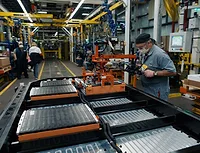
The 70-year-old factory currently builds the Ford Escape and Lincoln Corsair on traditional transfer lines where vehicles move from workstation to workstation. Ford’s new Universal EV Production System will consist of three parallel subassembly lines where operators will assemble the front structure, the rear structure, and the battery pack and interior. Seats and other interior components will be attached on top of a structural battery pack located in the floor of the vehicle.
"Instead of one long conveyor, three subassemblies run down their own lines simultaneously and then join together," explains Farley. "Large single-piece aluminum unicastings replace dozens of smaller parts, enabling the front and rear of the vehicle to be assembled separately.
"The front and rear are then combined with the third subassembly, the structural battery, which is independently assembled with seats, consoles and carpeting, to form the vehicle," Farley points out. "Parts travel down the assembly tree to operators in a kit. Within that kit, all fasteners, scanners and power tools required for the job are included, and in the correct orientation for use. The Ford Universal EV Production System dramatically improves ergonomics for employees by reducing twisting, reaching and bending, allowing them to focus on the job at hand."
Looking for quick answers on assembly and manufacturing topics? Try Ask ASM, our new smart AI search tool. Ask ASM
According to Farley, the new production system reduces parts by 20 percent vs. a typical vehicle, with 25 percent fewer fasteners, 40 percent fewer workstations dock-to-dock in the plant and 15 percent faster assembly time. Wiring harnesses will be more than 4,000 feet shorter and 10 kilograms lighter than the ones used in Ford's first-generation EVs.
"LFP prismatic batteries also enable space and weight savings, while delivering cost reduction and durability for customers," claims Farley. "The platform’s cobalt-free and nickel-free LFP battery pack is a structural subassembly that also serves as the vehicle’s floor. This low center of gravity improves handling, creates a quiet cabin and provides a surprising amount of interior space."
“We took inspiration from the Model T, the universal car that changed the world,” adds Doug Field, chief EV, digital and design officer at Ford. “We assembled a really brilliant collection of minds across Ford and unleashed them to find new solutions to old problems. We applied first‑principles engineering, pushing to the limits of physics to make it fun to drive and compete on affordability. Our new zonal electric architecture unlocks capabilities the industry has never seen. This isn’t a stripped‑down, old‑school vehicle.”
Learn more in our September 2025 episode of ASSEMBLY News Now.
Looking for a reprint of this article?
From high-res PDFs to custom plaques, order your copy today!


.webp?height=200&t=1758179318&width=200 "Assembly News Now, episode 21: Ford Invents a New Process to Assemble a Mass-Market EV")
.webp?height=200&t=1754669798&width=200 "Toyota logo.jpg")