Dow Tackles EV Thermal Management Challenges
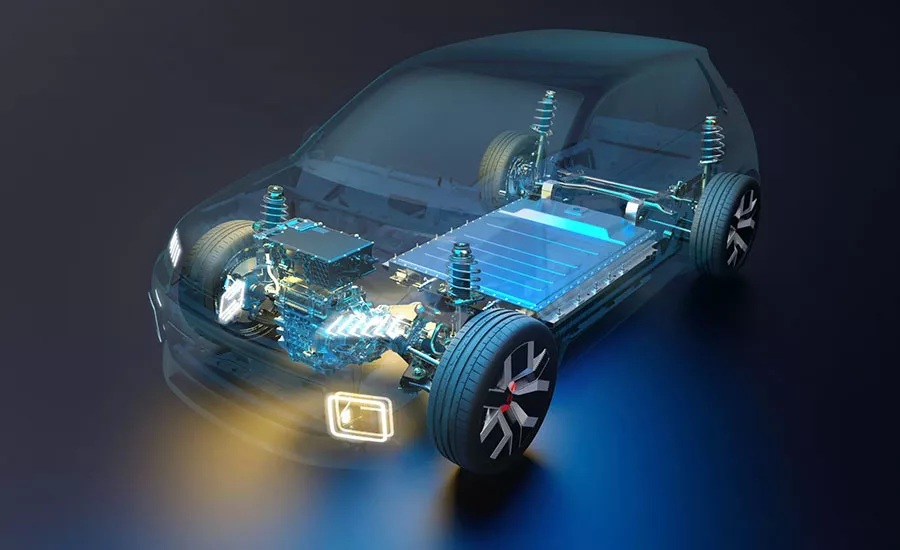
Electric vehicle batteries, traction motors and power electronics require a specific temperature range for optimal operation.
Illustration courtesy Renault Group
Electric vehicle batteries, traction motors and power electronics require a specific temperature range for optimal operation. To minimize elevated or unsafe temperatures, thermal management plays a critical role in performance, reliability and safety. Without it, thermal runaway is a constant threat.
Numerous EVs have been recalled recently due to the risk of high-voltage battery fires. Some motorists have even been warned not to park their vehicles near their house or in their garage for risk of fire. Serious fire-related incidents have been caused by everything from contaminants in battery cells to poor thermal designs that allow components to overheat.
Thermal interface materials are designed to dissipate heat efficiently and effectively to prevent overheating and ensure the reliable operation of electric vehicles. Several types of materials are available, including adhesives, encapsulants, gap fillers, gels, greases, foams and pads.
Dow MobilityScience, a division of Dow Inc., focuses on EV battery pack assembly, protection, thermal management and circularity. It has developed a variety of silicone materials, such as DOWSIL, that address thermal and electrical isolation, conformability and structure, while being lightweight, thin and low cost.
Last year, Dow launched a strategic initiative with Carbice Corp., a start-up company that specializes in carbon nanotube (CNT) technology for heat transfer applications. CNTs deliver predictable contact and reliable performance across any type of assembly application, allowing engineers to solve the interface problem, not just the material problem.
Materials can change shape under the stresses of assembly and exhibit uneven surfacing before, during or after temperature cycling. Nanotube arrays adapt like a memory foam mattress and flex to maintain connection.
“This collaboration will meet the rising demand for reliability in the expanding thermal interface market with innovative pad solutions for e-mobility and electronics applications,” says Jon Penrice, former president of Dow Mobility [Penrice recently retired and his role has been assumed by Jennifer Kempf]. “By leveraging our application know-how, our expertise in material science and collaborating with industry leaders like Carbice, we are committed to advancing the performance and reliability of EVs.
Looking for quick answers on assembly and manufacturing topics? Try Ask ASM, our new smart AI search tool. Ask ASM
“Silicone and CNTs individually offer thermal management benefits, but together they offer even more,” explains Penrice. “The exceptional wetting capabilities and precise dispensing of Dow silicones combined with the versatility and durability of Carbice CNTs creates an interface contact that lowers all modes of stress transfer for reliable solutions, allowing them to operate in a wide range of environments.
“By leveraging Carbice’s CNT technical and modeling expertise with [our] material science knowledge, customers can utilize thermal management materials tailored to their applications with the thinnest bond lines to reduce interface stress," notes Penrice.
Autonomous & Electric Mobility recently asked Luc Dusart, marketing manager; Pete Vert, director of technical service and development and associate director of R&D; and Danielle Berry, associate TS&D scientist, to explain how Dow MobilityScience is developing new thermal management technology for electric vehicles.
AEM: Why are thermally conductive materials important to electric vehicle performance, reliability and safety?
Vert: Heat is the enemy of reliable electronics, and it can reduce a battery’s performance. High heat can also increase the risk of thermal runaway in battery cells. Thermally conductive materials move, or transfer, heat from heat sources to heat sinks and are available in flame-rated formulations. They are used during the assembly of electric vehicle batteries, but they can also be used in many EV systems containing electronics that generate high levels of heat.
Without thermally conductive materials, air would fill the gaps between heat sources and heat sinks. Unfortunately, air has a relatively low thermal conductivity (TC) of 0.024 watts per meter kelvin, which means it is not especially efficient at moving heat away from electronics. Thermally conductive materials, on the other hand, have higher TC values and are available in a range of thermal conductivities for specific thermal management challenges.

Thermally conductive materials are used in the assembly of EV charging stations. Photo courtesy Dow MobilityScience
AEM: What type of EV components are typically assembled with thermally conductive materials?
Dusart: Thermally conductive materials are used in the assembly of power electronics modules, such as inverters, converters and on-board chargers. Battery packs are the key application, but thermally conductive materials are also used in the assembly of advanced driver assistance systems (ADAS), displays and communications, and EV charging stations.
AEM: What type of ADAS components are typically assembled with thermally conductive materials?
Berry: Within ADAS, thermally conductive materials are used in the assembly of cameras, radar, lidar and sensors. In cameras, thermally conductive silicones are used to dissipate heat from module assemblies. For lidar, radar and sensors, silicones dissipate heat from printed circuit board assemblies, many of which contain chips and other electronic components that generate significant heat.
As the demand for performance increases, components are increasing in size and power usage. For example, high-level autonomous driving systems will soon adopt new chips that improve computing performance significantly. Increasing chip power by a factor of two or three generates much more heat, so higher performing thermally conductive materials are needed to efficiently manage heat removal.
AEM: Why are silicones ideal for thermally conductive applications?
Berry: Automotive engineers have a choice of chemistries, but thermally conductive silicones have important advantages. For example, silicones can withstand wider temperature ranges than organic materials, such as acrylics, epoxies or urethanes. Silicones also provide longer-lasting heat resistance without a significant loss in performance properties.

Thermal management materials help prevent overheating and ensure the reliable operation of electric vehicles. Illustration courtesy Toyota Motor Corp.
Epoxies form stronger adhesive bonds, but they are more prone to cracking when changes in temperature cause components that are made of different materials to expand and contract at different rates. By contrast, silicones are stress-relieving. With their hydrolytic stability, they also maintain their properties when there is contact with moisture or humidity. Silicones can resist salt spray and many automotive chemicals, and they are available in UL 94 V0 flame-rated formulations.
In addition, silicones can support flexible and efficient product assembly. For example, there are silicone products that cure at room temperature, with added heat, with ultraviolet (UV) light or with a combination of curing mechanisms to meet the needs of manufacturers. Thermally conductive silicones also support automated mixing and dispensing.
AEM: What type of thermally conductive materials are automotive engineers looking for today?
Vert: The type of thermally conductive material that an automotive engineer selects is highly dependent upon the application. For systems that require bonding or fewer mechanical fasteners, a thermally conductive adhesive can be used. Gap fillers and dispensable thermal pads are used typically when there is a large gap between the heat source and the spreader. Battery assemblies are a common example.
Thermal gels, another type of thermally conductive material, can fill larger gaps and have the added benefit of supporting rework. Thermal compounds and thermal greases are non-curing and can achieve very thin bond lines for low thermal resistance. Often, these thermally conductive materials are used to fill thin gaps between chips and heat sinks. Encapsulants are usually self-leveling and have a low viscosity that allows them to flow into small areas between components.
Automotive engineers are also looking for thermally conductive materials that can support trends such as the growth of integrated modules (X in 1), module miniaturization, and the integration of high-performance computing and artificial intelligence. These trends are increasing power density, which increases the amount of heat and the need for greater thermal conductivity. The auto industry is also seeking cost-effective thermal interface materials that can support high-volume assembly.
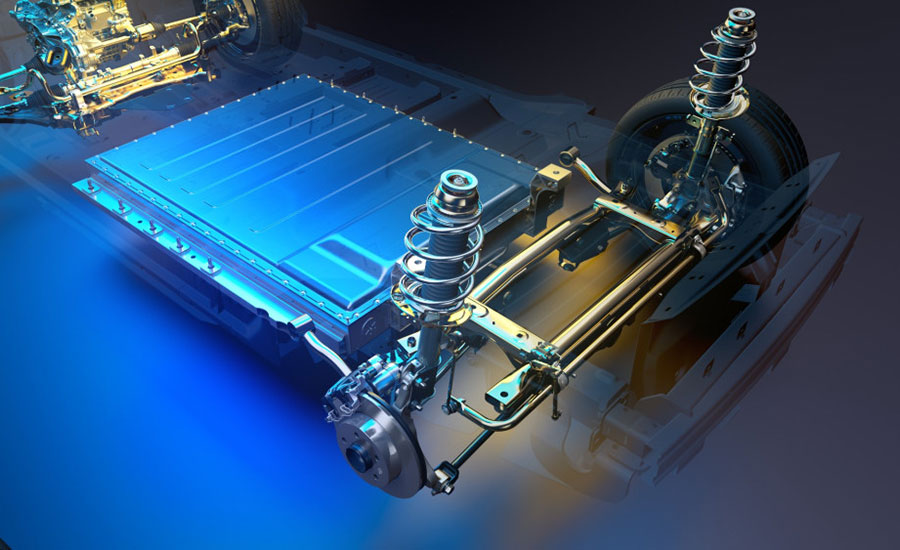
Numerous EVs have been recalled recently due to the risk of high-voltage battery fires. Illustration courtesy Renault Group
AEM: What is the biggest challenge to using thermally conductive adhesives? How is Dow addressing those challenges?
Vert: The biggest challenge is balancing thermal conductivity with mechanical properties and processability. For example, adhesives with higher thermal conductivities require greater amounts of specialized fillers. In turn, this higher filler loading can reduce adhesive strength. During mixing and dispensing, achieving uniform filler dispersion is critical to avoid inconsistent thermal performance. Additionally, some thermally conductive adhesives are challenging to dispense, because they have relatively high viscosities or lengthy cure times.
To address these challenges, [we] work closely with our partners to understand their needs and goals. That is why Dow has developed thermally conductive, silicone-based adhesives that maintain their mechanical properties, support automated mixing and dispensing, are available in a range of viscosities, and support faster curing. We have also developed thermally conductive adhesives that cure with UV light or that have a dual-cure mechanism, in case there are shadowed areas where the UV light does not reach.
AEM: What is Dow’s latest thermally conductive material for e-mobility applications? What makes it unique or different?
Dusart: DOWSIL TC-3080 Curable Thermal Gel recently earned a 2025 BIG Innovation Award in the Transformative Products category [from consulting firm Business Innovation Group]. Part of what makes this thermally conductive, silicone-based material different is that it has a low viscosity for easy dispensing. It can also be printed onto substrates. Compared to other materials, DOWSIL TC-3080 maintains lower and more consistent temperatures in e-mobility electronics. By reducing the risk of thermal failures and module shutdowns, this thermal management material helps drive performance, reliability and safety.
Looking for a reprint of this article?
From high-res PDFs to custom plaques, order your copy today!