Dispensing Thermally Conductive Fillers
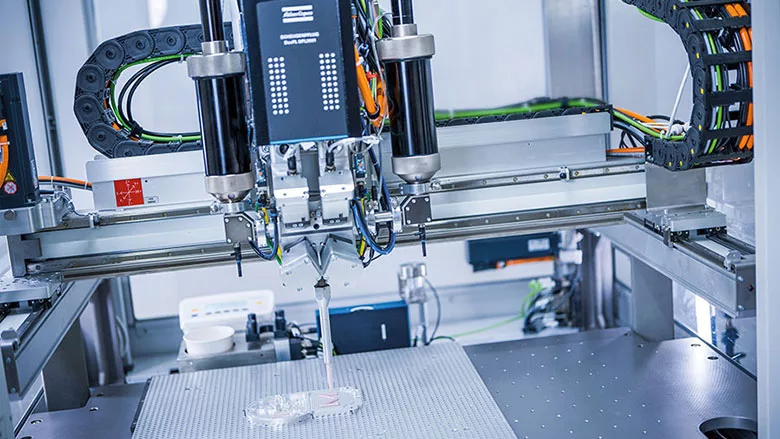
Thermal interface materials require dispensing equipment that can withstand abrasion.
Photo courtesy Atlas Copco IAS
Thermally conductive adhesives are designed for applications where heat needs to be dissipated. They’re widely used in the automotive industry, in addition to everything from consumer electronics to telecommunications equipment.
Thermal interface materials improve heat transfer between two surfaces, typically a heat source, such as a computer processor, and a heat sink or other cooling system. They fill the small gaps and imperfections between surfaces, reducing thermal resistance and increasing heat transfer efficiency.
In addition to cooling components that generate heat, thermally conductive adhesives help reduce weight by eliminating the need for space-restrictive mechanical fasteners such as screws or clips. They are available in many types of resins, including epoxies, polyurethanes and silicones. And, the adhesive come in various forms, including films, liquid metals, pads and pastes.
Material suppliers use a variety of fillers in their products. They are typically added to resins and binders to improve specific properties, make the product cheaper or achieve both benefits.
Some thermal interface materials contain resins and ceramic particles that are inherently electrically isolating. Their largest filler particles dictate the minimum gap that can be achieved to prevent direct contact of an electrical component to a heat spreader. Because of their high filler content, dispensing these materials requires special equipment that can withstand abrasion.
“In most cases, thermally conductive adhesives are high-end structural adhesives with thermal conductivity as an additional feature,” says Jürgen Bauer, director of product management, chemical formulations and new business at DELO Industrial Adhesives. “They efficiently transfer or dissipate heat, while reliably fixing components in place.
“As they are mostly used in high-demand applications, thermally conductive adhesives are often heat-curing epoxy resins,” explains Bauer. To achieve high thermal conductivity, fillers are included in their formulation.
Looking for quick answers on assembly and manufacturing topics? Try Ask ASM, our new smart AI search tool. Ask ASM
“Common types such as ceramic or mineral fillers additionally provide electrical insulation,” Bauer points out. “However, compared to metal fillers, these fillers have a lower thermal conductivity overall.”
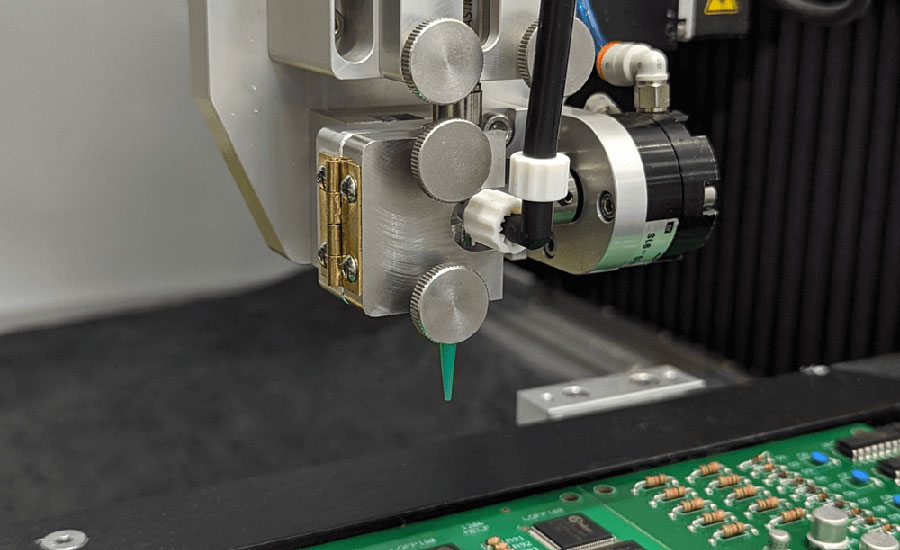
Components such as chips, printed circuit boards and power electronics require effective heat management. Photo courtesy Precision Valve & Automation
Increasing Demand
Market research firm IDTechEx predicts that the thermal interface material market will grow 14 percent annually over the next decade, exceeding $7 billion by 2034. Data centers and electric vehicles will account for a large chuck of that increased demand.
The rising power densities and high functional safety required for components such as chips, printed circuit boards and power electronics means they require effective heat management.Applications include everything from data center server boards to laptop computers, smart phones and wearable medical devices.
“Increasing demand for thermally conductive adhesives and dispensers is being driven by the growing use of high-voltage batteries, electric motors, inverters, power electronics and other devices in many types of automotive applications, such as electric vehicles,” says Jon Urquhart, director of applications engineering at Precision Valve & Automation (PVA).
Thermally conductive adhesives are used to bond battery cells to modules or packs. They’re also needed for LED lighting and advanced driver assistance system (ADAS) applications.
LEDs generate a considerable amount of heat relative to their size, making thermally conductive adhesives ideal for assembling them to heat sinks, which helps enhance their performance and service life. Cameras, lidar, radar and other ADAS components also require thermal interface materials to help dissipate heat.
“More and more electronics are used in everything from consumer goods to defense products,” explains Urquhart. “Anything that depends on or generates a lot of computing power produces heat, which has to be dissipated from the devices to ensure that they operate correctly.”
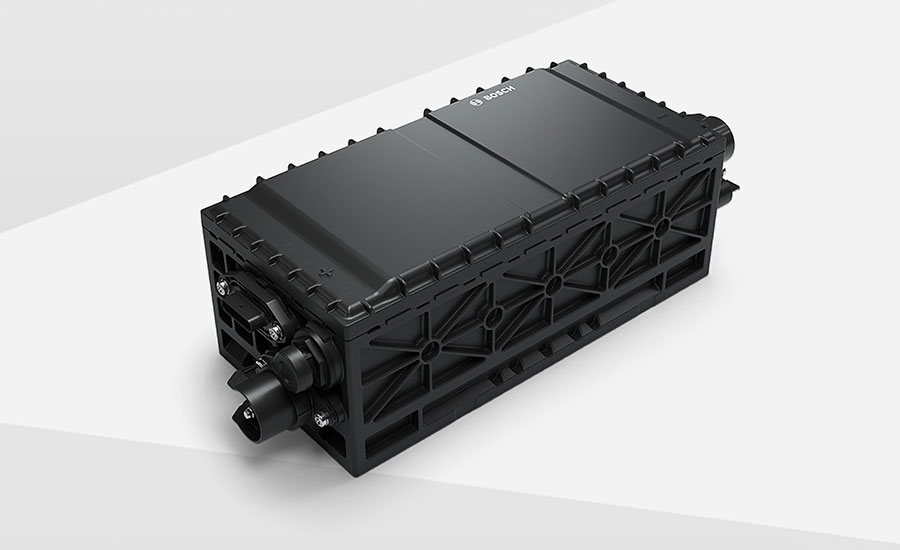
Thermally conductive adhesive is used to bond battery cells and also dissipate operational heat. Photo courtesy DELO Industrial Adhesives
“Efficient thermal management is also crucial in the field of renewable energy, such as solar power,” adds Bauer. “Proper heat dissipation is essential to ensure the optimal performance of these systems. Similarly, in data centers, the need for improved heat dissipation has become paramount as server densities continue to increase.”
Telecom is another big market for thermally conductive adhesives, with application such as 5G base stations. That’s because cell phone towers contain antennas, control modules, emitters, receivers and other sensitive electronic components that must be kept cool to maintain optimal performance and avoid disruptions.
“We’ve observed a growing demand for thermally conductive materials in recent years,” says Bauer. “As the trend toward miniaturization continues, electronics operate at the same levels of performance while taking less space, resulting in more trapped heat that must be efficiently dissipated. In addition, another trend toward improved performance leads to even more heat within the electronics as well.
“A major driver of this demand is the rapid advancement of e-mobility,” explains Bauer. “In electric vehicles, efficient thermal management is crucial for the performance and reliability of battery systems and power electronics. Since complex cooling systems require ample installation space, adhesives are often used as an efficient way to dissipate heat.
“Manufacturers today are seeking materials that offer easy and fast processing,” notes Bauer. “For smaller volumes, they often prefer one-component adhesives, while for higher volumes, two-component adhesives are [popular] for efficiency reasons. Furthermore, a one-step curing process can be highly desirable as it saves time and reduces complexity.
“In high-tech applications where a variety of adhesives are typically necessary, such as bonding heat sinks and housings, it is particularly advantageous if the same adhesive can be used for multiple bonding points,” claims Bauer. “These features collectively streamline production and enhance efficiency.”
Engineers at Robert Bosch GmbH recently decided to use thermally conductive adhesives when developing a 48-volt lithium-ion battery for mild hybrid applications. The compact battery is only 5.5 inches tall, which enables maximum flexibility during installation in vehicles. It can be placed in discreet places such as under the front passenger seat.
The key to the compact design lies in its thermal efficiency. DELO Duopox TC8686 thermally conductive adhesive not only bonds the battery cells within the housing, but also efficiently dissipates operational heat.
“This adhesive combines structural bonding and thermal conductivity in one step, eliminating the need for mechanical fixation and separate gap fillers,” explains Bauer. “By removing an entire step, thermally conductive adhesives streamline the manufacturing process.”
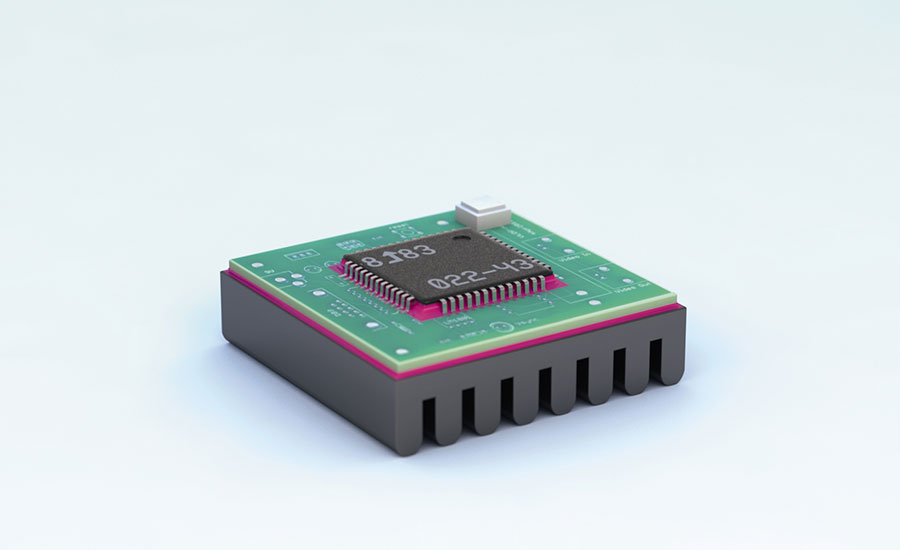
Thermally conductive adhesives are designed for applications where heat needs to be dissipated, such as electronics. Photo courtesy DELO Industrial Adhesives
Dispensing Methods
Thermally conductive materials contain fillers that are typically metals of some sort. Higher thermal conductivity leads to a higher percentage of fillers, which are abrasive. That can wreak havoc on a dispensing system if it’s not set up properly using the right type of components.
As with thick and thin materials, the need to automatically dispense filled materials depends on production volume and the need for accuracy.
Manual dispensing is most cost-effective for low-volume and wide-tolerance applications. Semiautomatic dispensing is fine for low- to medium-volume applications or applications with less strict tolerance requirements.
A fully automated setup incorporates a robot, automation equipment or conveyor to move each part to the nozzle for dispensing and then past it for further production work. Automated systems also include wired or wireless connections between the dispensing motor and pump, HMI and PLC.
“Different types of dispensing equipment are required for thermally conductive materials,” says PVA’s Urquhart. “For instance, everything has to be abrasion-resistant. A lot of components use carbide steel or ceramic-coated components to hold up to abrasive materials. Fittings such as needles, nozzles and valves have to enable optimum flow paths and withstand high wear.
“Today, we’re seeing more demand for materials such as thermal grease and liquid metal,” Urquhart points out. “They flow well and enable thin bond lines. We also see conductive encapsulants used for potting applications associated with control modules, power electronics and other enclosed devices.”
“Manufacturers are looking for reliable production equipment that is easy and inexpensive to operate,” adds Mike Gorman, senior applications engineer at Marco System Analysis & Development LLC. “[They want] equipment with advanced process controls that can monitor the dispensing process while producing parts at high production rates with high quality yields.
“Due to the high viscosity of the fluids involved, the best approach is process control and mechanical components designed for silicones and abrasive fillers such as alumina, silver and zinc oxide,” claims Gorman. “A mixing tank can be used to maintain fluid uniformity directly feeding the dispenser.
“Filled materials are abrasive, due to the conductive particles suspended in fluid,” says Gorman. “Challenges with getting material break-off from the nozzle require the capability to move the material from a container, and through fluid system components and a dispense valve and nozzle. The dispense mechanism can be a jetting or needle dispensing method, with linear piston pump or progressive cavity valves.”
Jetting material involves a piston contacting a surface opposite an orifice (nozzle). This mechanical interaction causes the piston and the contact surface to abrade more quickly. As such, the dispenser must be capable of generating high forces for closing the piston to achieve break-off of the fluid from the dispense nozzle.
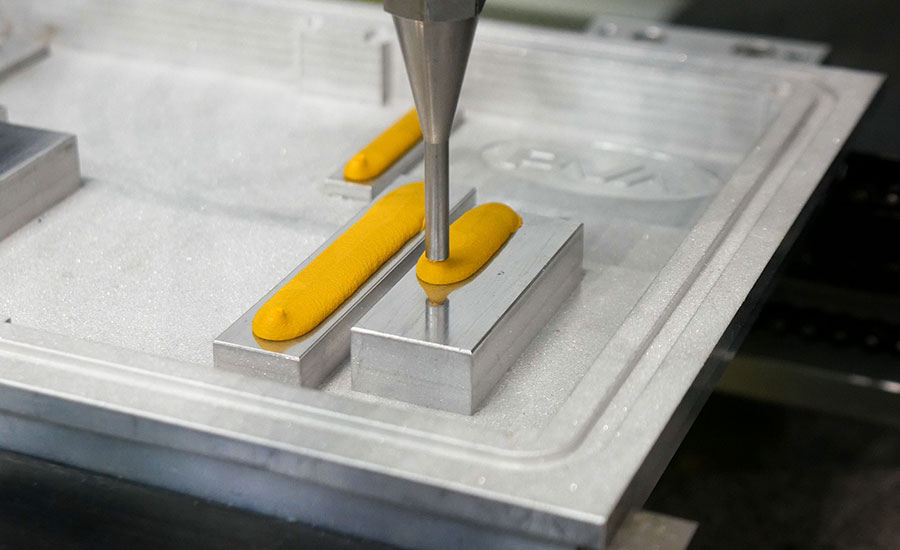
This dispensing system is designed for use with liquid metal products. Photo courtesy Precision Valve & Automation
“A piezoelectric valve drive can obtain the closing force necessary to jet many thermally conductive fluid formulations,” notes Gorman. “The design and the materials used for the piston, valve seat and nozzles are optimized for flow and hardened for longer lifetime. These parts will eventually wear out due to abrasion, but optimized design and material selection lowers the cost of ownership.”
Unlike standard adhesives, thermally conductive materials contain fillers such as aluminum oxide and boron nitride that enhance heat dissipation and prevent overheating. Due to their high viscosity, they require dispensing equipment that can withstand abrasive fillers.
“Piston pumps ensure precise flow control, while static mixers effectively blend two-part materials,” says Johannes Blaser, business line manager, ELD North America, at Atlas Copco IAS. “Cartridge ejection units and bulk feed systems maintain a steady material flow, reducing filler sedimentation.
“Manufacturers today are seeking advanced materials that offer high performance, sustainability and cost-efficiency,” explains Blaser. “To handle these materials, [we are] working very closely with material [suppliers] to ensure the best solutions for our customers. The need for precise, high-speed dispensing systems reflects the industry’s shift toward miniaturization, efficiency and greener manufacturing practices.
“A common myth about dispensing thermally conductive materials is that higher thermal conductivity always leads to better performance,” notes Blaser. “While thermal conductivity is important, it’s not the only factor that matters.
“Bonding strength can suffer with materials that have higher conductivity, and viscosity increases, making dispensing more challenging,” warns Blaser. “Additionally, thermal interface resistance and electrical conductivity play crucial roles. Focusing only on thermal conductivity without considering these factors can result in suboptimal performance in heat management applications.”
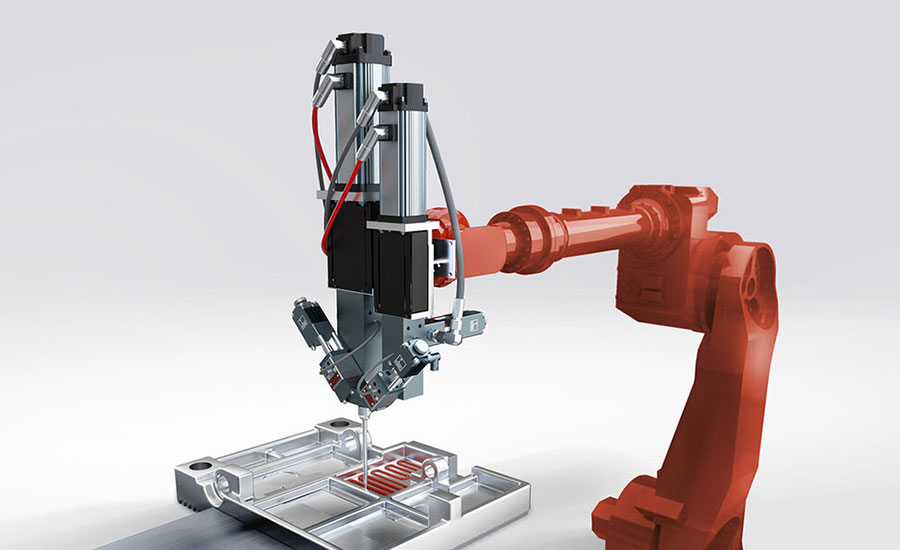
This machine is fitted with a static mixing system that includes a two-component valve combined with a disposable static mixer. Photo courtesy Dopag & Meter US
What’s New
Engineers have a variety of products available for dispensing thermally conductive adhesives, including state-of-the-art equipment such as the following options.
PVA’s newest product is the SP100 syringe pump dispenser. It features a metered syringe chamber that is designed for use with liquid metal products.
“These type of materials tend to be very expensive, so minimal waste is important,” says Urquhart. “The SP100 is ideal for linear positive displacement dispensing. It is optimal for encapsulant, adhesive and thermal grease applications. Tool-free disassembly and disposable wetted components also make the SP100 an ideal dispenser for materials with a short pot life or abrasive fluids.”
Marco offers a dispensing product called SuperiorJet. It can be configured across a wide variety of materials, including thermally conductive materials. Using a piezo-based dispenser offers the ability to apply higher forces vs. pneumatically actuated valve products, leading to better break-off.
“Additionally, our modular valve seat (nozzle) offers the ability to replace the seat piston—the source of highest wear—instead of needing to replace the entire seat, leading to lower cost of ownership,” says Gorman. “[Our] Follower Plate system allows high viscosity thermal materials to be moved mechanically rather than relying on compressed air to move.
“Reducing the air-gas content dissolved in materials leads to more predictable material compressibility, which leads to lower variance in dispensed volumes,” explains Gorman. “The S Jet Superior modular dispensing valve is versatile. The connection of the valve drive and the dosing needle via a ring spring limits the media contact to the dosing unit. This can be replaced quickly and at will.
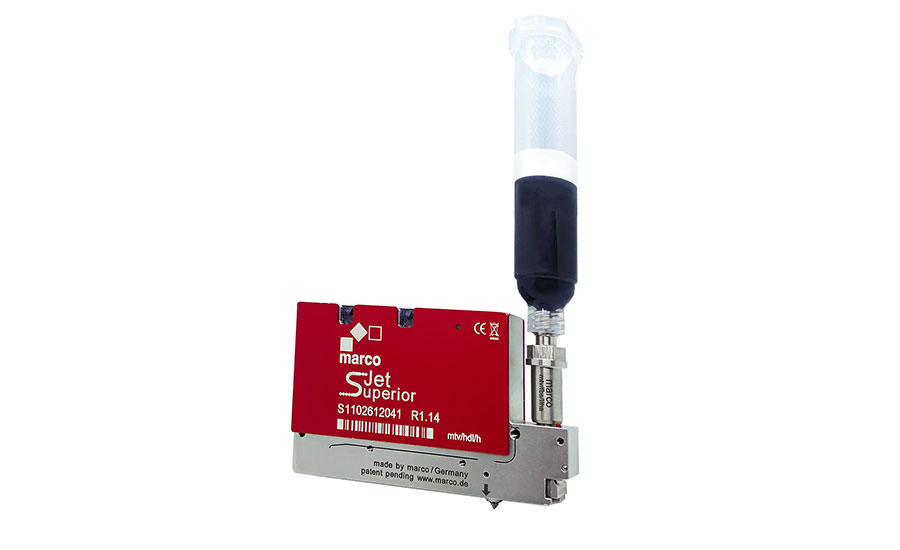
This modular valve is ideal for dispensing abrasive media with short processing times. Photo courtesy Marco System Analysis & Development LLC
“The modular valve is ideal for dispensing abrasive media with short processing times,” claims Gorman. “Frequencies of up to 1,000 hertz with a service life of more than 1 billion cycles are possible without maintenance thanks to the piezo drive. The exchangeable dosing units print dots or lines between 50 and 3,000 microns wide. In addition, heat-conducting plates can be attached to ensure temperature control of the media.”
Eldomix is a new programmable system for metering, mixing and dispensing two-component adhesives from Dopag & Meter US. Pressure vessels supply the materials to a pair of three-phase, asynchronous, motor-driven gear pumps, where they are proportioned at the preselected ratio.
Each gear pump is protected against over-pressure. Eldomix 100 is a benchtop model, while Eldomix 600 is a mobile system on castors.
“The machine is fitted with a metering computer with touchscreen terminal and a static mixing system that includes a two-component valve combined with a disposable static mixer,” says Leigh Thatcher, general manager of Dopag. “The mix ratio and output rate are programmable. It can dispense shots or continuous flow.”
The latest Atlas Copco product is a multiple dosing unit that reduces cycle time and increases efficiency. “In addition, we have developed a high-performance, small-volume dispenser to meet megatrends such as miniaturization and digitalization in the automotive and electronics sectors,” explains Blaser. “With the high-performance [unit], we can dispense up to 10 times faster than the conventional dispensing systems currently on the market.
“Our proven system for applying thermally conductive materials comprises the A280 material feed system, a DosP DP803 TCA dispenser and the DC803 DispensingCell,” says Blaser. “The material feed and dispenser are specially designed for processing highly abrasive materials.
“The extremely viscous thermally conductive material is fed from the material drum via material feed lines to the dispenser,” adds Blaser. “This then applies the material on the component in the form required. Precise material application in three dimensions is ensured by installing the dispenser on the CNC axis system of the dispensing cell.”
A special TCA (Thermally Conductive Adhesive) version of the DosP DP803 016 is available for thermal management applications. “This model has been optimized for the fast and precise application of thermally conductive materials with a viscosity of more than 150,000 million millipascal seconds (mPa-s),” claims Blaser.
“Thanks to design adaptations and the integration of new, particularly robust high-performance components, this version offers significantly improved wear resistance and an optimized material flow,” Blaser points out.
“The DosP DP803 also offers the well-known advantages of the proven volumetric Dos P piston dispensers from Scheugenpflug,” says Blaser. “Exactly dimensioned dispensing cylinders enable the application of precise, reproducible material volumes or, in the case of 2K media, a constant mixing ratio at all times.”
For more information on adhesive dispensing, read these articles:
Precision Fluid Dispensing for EV Batteries
Low-Cost Robotics for Adhesive Dispensing
Adhesive Dispensing Is Focus of New Program at Eastern Michigan University.
Looking for a reprint of this article?
From high-res PDFs to custom plaques, order your copy today!