Assembly Lines
Automotive Suppliers Facing Mounting Headwinds
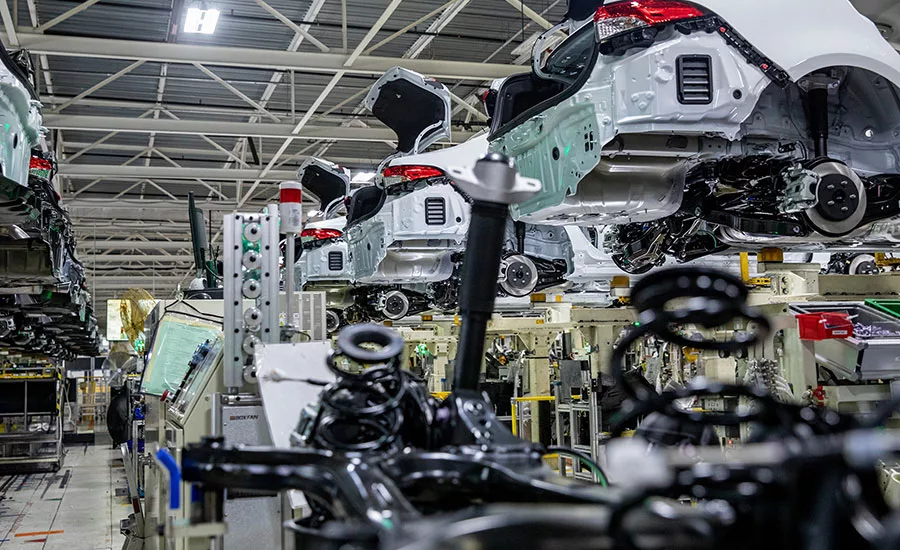
Stronger relationships can help automakers and suppliers better navigate industry uncertainty.
Photo courtesy Toyota Motor Corp.
MUNICH—Automotive suppliers are under increasing pressure as they continue to face challenging market conditions. According to a recently study conducted by Roland Berger and Lazard, stagnant production volumes, geopolitical uncertainty, increasing competition and rising cost pressures have driven average profitability down to just 4.7 percent.
Weak demand and challenging price negotiations with OEMs are placing additional strain on suppliers. While OEM profitability is still higher, it has also declined. That is predicted to put sustained pressure on supplier margins in the coming years.
“What we are currently observing in the European and North American automotive supplier industry can best be described as a phase of ‘stagformation,’” says Felix Mogge, a partner at Roland Berger. “On the one hand, suppliers are facing stagnant volume growth, while on the other, they are undergoing a fundamental transformation that requires them to urgently reshape their business models.
“While suppliers have slowly regained revenue growth since the Covid-19 pandemic, their profitability has structurally declined,” explains Mogge. “A significant portion of revenue growth has been driven by inflation, which has also increased costs.
“Overcapacity is putting pressure on the market, especially in Europe,” warns Mogge. “In contrast, China and South Asia are the primary drivers of modest global automotive growth. Slower-than-expected transition to EV adoption in Europe and North America is lagging behind expectations, preventing the realization of anticipated economies of scale. The EV market is attracting new players, increasing competitive pressure and cost challenges for suppliers.”
“The era of steady market growth is over and a more volatile environment will continue to put pressure on earnings and profits,” adds Florian Daniel, a partner at Roland Berger who worked on the Global Automotive Supplier Study. “However, suppliers can still succeed by implementing consistent efficiency improvement programs, forming partnerships to optimize and scale their portfolios, streamlining their product offering and focusing on strategic technologies.”
Another study conducted by Plante Moran claims that General Motors, Honda and Toyota have the best business relationships with suppliers in North America. Specifically, cost management, strategic alignment and stronger communication are seen as important factors in helping suppliers manage risk and uncertainty.
Looking for quick answers on assembly and manufacturing topics? Try Ask ASM, our new smart AI search tool. Ask ASM
“Suppliers want balanced financial risk, and they want to know where they fit in OEMs’ future market strategies so they can align accordingly,” says Angela Johnson, Ph.D., principal in Plante Moran’s management consulting supplier relations analytics. “They perceive OEM behaviors—fairness, equity, accountability and then trust—through the impact of OEM decisions to their bottom line.
“What separates the top three from the bottom three OEMs is their ability to help suppliers reduce their costs to serve the OEM and manage uncertainty,” claims Johnson.
The top-three automakers in the study scored better in the basics: communication, responsiveness, accessibility, engagement and buyer knowledge. “These skills help suppliers operate more efficiently and, in turn, create strong relationships,” explains Johnson. “Stronger relationships enable OEMs and suppliers to work together and better navigate industry uncertainty with more equitable risk and cost sharing.”
“It’s all about balancing and aligning the various functional demands of the OEM—purchasing, manufacturing, engineering, design and finance—so there are fewer conflicting demands on the supplier and the OEMs’ team members,” adds Dave Andrea, principal in Plante Moran’s strategy and automotive and mobility consulting practice.
“Overall, OEMs that effectively address consistency, predictability and alignment of strategic goals are generally stronger, more profitable and become customers of choice for suppliers,” says Andrea. “And, because of their mutual dependency, these attributes are good for the suppliers, too.”Looking for a reprint of this article?
From high-res PDFs to custom plaques, order your copy today!