Cobot Welding Catches On
July 30, 2025
Cobot Welding Catches On
July 30, 2025Manufacturers want flexible automation that can quickly adapt to changing market conditions and labor supplies.

Collaborative robots and welding go together like peanut butter and jelly. They’re made for each other.
Cobots are used for a variety of assembly applications, including adhesive dispensing, machine tending, pick and place, screwdriving and soldering. But, welding is one of the fastest growing segments.
Unlike traditional welding robots, cobots are designed to work alongside humans in shared workspaces. They feature advanced sensors and control systems that enable safe interaction without the need for many types of traditional barriers, such as cages or light curtains. Safety checks, in addition to perceptive and predictive systems, allow robots and humans to work side by side.

Unlike traditional welding robots, cobots are designed to work alongside humans in shared workspaces. Photo courtesy ABB Robotics
Today, skilled welders are increasingly difficult to find and retain. So, many small companies are investing in cobots to automate high-mix, low-volume welding tasks. This strategy frees up human welders to tackle more complex, value-added projects. The technology has also enabled manufacturers to reshore production to the United States.
Collaborative machines such as Universal Robot’s popular UR10e machine, are widely used for MIG and TIG welding applications. That’s because they are significantly easier to program and they’re extremely flexible. The robots can be easily redeployed and repurposed quickly to work in different parts of a facility. This helps maximize return on investment.
Growing Demand for Welding Cobots
Collaborative welding systems can be used to support skilled human welders by taking over tedious and unergonomic aspects of the welding process. That’s why they appeal to both small shops and large manufacturers involved in any type of metal fabrication.
“We are seeing a notable increase in demand for welding cobots, especially as businesses seek solutions to the skilled labor shortage,” says Pierre de Giorgio, president and chief technology officer at Spartan Robotics. The company has developed a system that features Kassow Robots and Fronius welders.
“Our unique differentiator lies in the integration of a seven-axis robot with our CBun plug ins, which make the welder exceptionally easy to use,” claims de Giorgio. “[This] capability provides greater flexibility and reach, allowing for more intricate welding tasks that would be challenging for traditional six-axis robots.
Looking for quick answers on assembly and manufacturing topics? Try Ask ASM, our new smart AI search tool. Ask ASM
Looking for a reprint of this article?
From high-res PDFs to custom plaques, order your copy today!
“With the increasing difficulty in finding qualified welders, cobots offer manufacturers a reliable and efficient alternative,” explains de Giorgio. “They provide consistency, precision and flexibility in operations, which is crucial in meeting production demands despite the shrinking workforce.”
“Manufacturers are looking for proven, flexible and easy-to-implement automation to reduce bottlenecks in their fab shops,” adds Josh Pawley, vice president of Vectis Automation LLC. The company offers several configurations that feature UR robots paired with welders from Fronius, Hypertherm, Lincoln Electric and Miller.
“The labor shortage continues to be a major factor driving demand, along with reshoring initiatives, productivity enhancement and quality improvement goals,” says Pawley. “Cutting-edge technology can also be used as a way to entice the next generation into manufacturing. Our customers are leveraging this approachable technology to show [young people] how high-tech and fun the manufacturing industry can be.
“We always encourage a crawl, walk, run approach,” notes Pawley. “We’re seeing many of our repeat customers move into the walk-run phase after crawling with their first cobot welding system and ensuring it’s a proven, productive technology. They typically start with some easy, quick-win task, then grow into more challenging applications.”
According to Pawley, collaborative welding is a great alternative for many metal fabrication applications, driven by affordability, approachability for new users and programming speed.
Welding is a great application for cobots, because it’s path oriented. It also has significant process control requirements, which is where software comes into play.
Pawley says that one of his company's key roles as an automation partner is to "help identify right-fit applications and educate manufacturers on the keys to success [with] the 'soft' aspects that don’t show up in a product spec sheet but are critical to success. Some weldments are slam-dunks for automation; others are not viable and many are a nuanced in-between. Helping manufacturers navigate the nuances and find a path of viability is key to long-term success.”
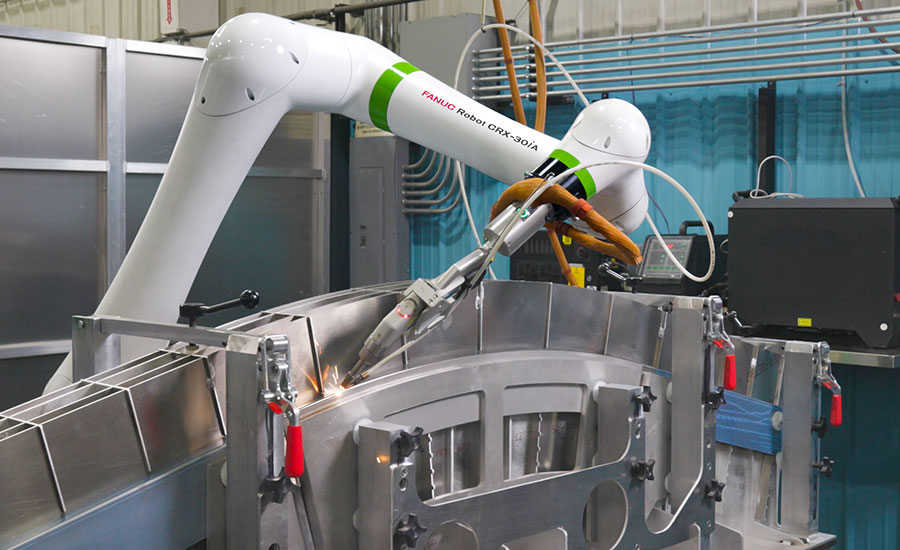
This cobot is laser welding a stainless steel escalator part. Photo courtesy Fanuc America Corp.
Diverse Users
Small-to-medium-sized manufacturers are driving demand for collaborative robots today. They’re looking for production equipment that doesn’t include large-scale investment in fixed automation or large robotic arms.
Smaller manufacturers require flexible automation that can easily and quickly be adapted to meet shifting demands. They need systems that can be programmed easily and quickly, and can support multiple types of automation tasks.
Manufacturers in all industries want more flexible automation to adapt with speed and efficiency to changing market conditions and labor supplies. Collaborative automation enables people and robots to work together to make manufacturing more flexible, while maintaining safety and productivity.
Cobots are especially popular with small companies and contract manufacturers, because they don’t require a big capital investment like automated welding cells equipped with traditional six-axis robots. The learning curve is much smaller, and manufacturers don’t need all of the tooling and safeguarding that’s typically associated with welding.
“Welding cobots are being adopted by both small shops and large manufacturers,” says Spartan Robotics’ de Giorgio. “Smaller shops benefit due to their lower upfront cost and ability to handle skilled tasks without needing a highly trained operator. Smaller fabrication shops often find it more difficult to attract and retain skilled welders, so cobots help them increase their production capabilities without adding labor.
“Larger manufacturers are increasingly deploying cobots as well—particularly for high-volume, repetitive welding tasks,” explains de Giorgio. “The flexibility, scalability and productivity improvements they offer make them an attractive option for manufacturers of all sizes.”
“Cobots ae being applied across a diverse range of manufacturing,” adds Joe Hoffman, engineering product application segment manager at Fanuc America Corp. “We’re seeing more and more high-volume applications, as well as point-of-use installation for [tasks] that were previously manual. In these cases, a cobot can quickly be programmed to the application and run safely alongside existing operators.
“Integrating positioners safely into a cobot environment is now trending,” says Hoffman. “Companies are also deploying software that solves complex out-of-position welding challenges, such as when a part is too big or can’t be articulated to an optimum welding position.”

Collaborative robots can be easily redeployed and repurposed quickly to work in different parts of a facility. Photo courtesy ABB Robotics
Fanuc’s line of CRX cobots are being used for a variety of fabrication tasks. “The most common application is by far MIG welding,” Hoffman points out. “However, we are seeing an increase in aluminum MIG, as well as plasma and TIG welding. These manual processes require a greater level of skill. But, with labor shortages, cobots are being used for more of these applications.”
“Gas metal arc welding processes, such as MAG and MIG, are commonly used, because consistent wire feed and shielding gas make it robot friendly,” adds Josh Williamson, global product manager for joining technologies and positioners at ABB Robotics. “Its high deposition rates allow for faster welds, and it is versatile, being able to work with steel, stainless steel and aluminum.”
Williamson says that plasma cutting and laser welding are also typical collaborative welding applications. However, the latter requires additional safeguards to protect operators.
ABB’s GoFa cobot features simplified “no-code” platforms with drag-and-drop interfaces that enable operators to program welding robots without a single line of code.
“This allows companies to adopt collaborative welding systems without having to hire robot programmers,” claims Williamson. “Typically, manual welders with no robot experience can program the cobots.”
Welding guns used with cobots are often the same as traditional tooling. “Sometimes, buttons or devices on the mounting flange will be added to make programming simpler,” notes Williamson. “Our partner, Kemppi, offers a torch and power source that can also be used for manual welding applications.”
That flexibility enables a robot to perform part of the task and a human to perform the other. Operators can tackle tactile tasks that require dexterity, while cobots perform monotonous or repeatable tasks.
“Determining the ROI of a collaborative robotic welding system vs. manual welders requires a structured approach that balances costs, productivity, quality and labor availability,” says Williamson.
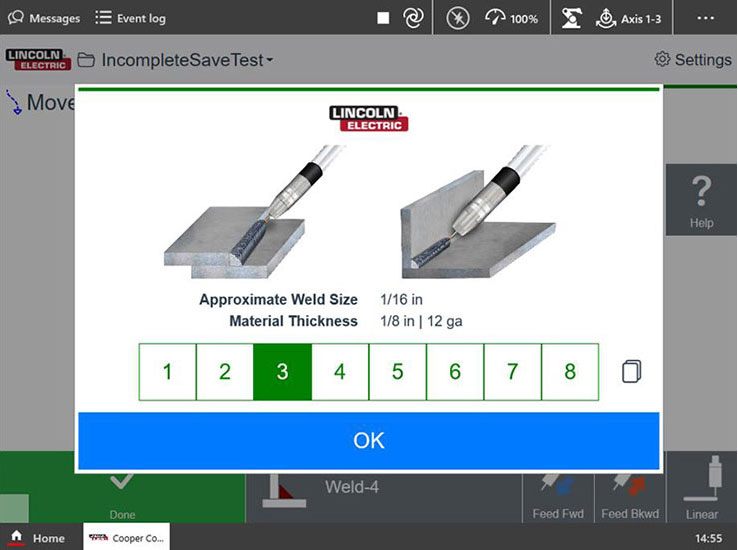
New technology makes it easier than ever to program welding cobots. Illustration courtesy ABB Robotics
Pros and Cons of Using Cobots for Welding
Despite all the hoopla surrounding cobots today, the machines have pros and cons that manufacturing engineers must carefully consider. The technology is exciting, but it’s not ideal for some types of applications. For instance, limited payload capacity and slower operating speeds are two drawbacks.
Cobots tend to have lower capacity than many other types of robots, but they make up for it when to comes to ease of use and deployment. They are also slower than traditional robots.
Engineers who value flexibility and have processes that they can’t solve completely with automation may benefit from investing in collaborative robots. The machines are especially good for applications that need to have a human operator working in the vicinity and engaged with the machine.
For simple applications, cobots can be a better fit than traditional six-axis welding robots. But, as applications become more complex, the advanced tools, language features and integrated options available with the latter typically make them a better choice.
“In general, cobots tend to work a bit slower with lower payloads than traditional industrial robots,” says Spartan Robotics de Giorgio. “However, in applications like welding and plasma cutting, payload is not an issue, since the torch is very light. Movements in between welds may be slightly slower than with an industrial robot, but these moves can still be performed relatively fast and are usually rather short. So, overall cycle time differences are rather insignificant.”
However, collaborative robots do not make sense for all applications, such as high-volume tasks typically found in the appliance or auto industry.
“We have made cobots for more than 10 years, but we don’t recommend them for welding,” notes Charles Adams, business development manager at Kuka Robotics Corp. “We have seen customers that have tried the machines, but then discover traditional industrial robots are a better alternative. That’s primarily because of speed, repeatability and robustness.”

Manufacturers are looking for proven, flexible and easy-to-implement automation to reduce bottlenecks in their fab shops. Photo courtesy Vectis Automation LLC
New Products
As collaborative robots to grow in popularity, many new products and features are being developed.
“We’re adding loads of new features, deployment options and innovations each year—all to help manufacturers tackle more applications, continue to make it even easier and more intuitive for non-programmers to implement, and provide businesses with stable weld quality and productivity,” says Vectis Automation’s Pawley.
“We’ll be unveiling several of these innovations next month at the Fabtech show in Chicago, including our new Clarity reporting system, advanced weave functions and new shape definitions for our plasma cutting tools,” notes Pawley.
Fanuc recently unveiled a new web tool called Cobot-and-Go. It enables manufacturers of all sizes to find ready-to-go collaborative robots that are pre-engineered for welding and other applications. According to Hoffman, it enables companies to deploy collaborative robots easily and quickly.
Other vendors, such as ABB Robotics, have launched new technology that makes programing easier than ever. It recently developed a package in conjunction with Lincoln Electric that features a tablet interface with a built-in welding library.
“A user simply inputs the material type and material thickness, and then moves the robot to the beginning and end of the weld,” says Williamson. “The welding parameters and travel speed of the robot are then set. Upon pushing a button, it’s ready to weld.
“Autonomous robotic welding or automatic programming is another cutting-edge programming system where robots equipped with sensors, AI and advanced vision systems perform welding tasks with minimal or no human intervention,” explains Williamson.
Scalable Robotics, an ABB partner, has launched a collaborative robot welding system that uses a camera to find the area to be welded and automatically creates the program. “No manual coding is required,” Williamson points out. “The system creates a ready-to-run program, even for more complex parts.”
For more information on cobots, read these articles: