Assembly Magazine logo
search
Ask ASSEMBLY AI
cart
facebook twitter linkedin youtube
  • Sign In
  • Create Account
  • Sign Out
  • My Account
Assembly Magazine logo
  • TRENDS
    • Ask ASSEMBLY AI
    • Trends
    • News
    • New Products
  • INDUSTRIES
    • Aerospace
    • Appliance
    • DFMA Assembly
    • Medical Devices
    • Green Manufacturing
    • Lean Manufacturing
    • Machinery Assembly
    • Electronics Assembly
    • Automotive
  • TECHNOLOGIES
    • Adhesives & Dispensing
    • Assembly Presses
    • Automated Assembly Systems
    • Manufacturing Management
    • Manufacturing Software
    • Motion Control
    • Screwdriving & Riveting
    • Robotics
    • Test & Inspection
    • Plastics & Metal Welding
    • Wire Processing
    • Workstations
  • AUTONOMOUS & ELECTRIC MOBILITY
    • AEM Magazine Archives
    • Autonomy
    • Electrification
    • Mobility Services
    • Assembly & Testing
    • AV/EM News
  • MEDIA
    • Ask ASSEMBLY AI
    • Podcasts
    • Assembly News Now
    • Assembly TV
    • Webinars
    • eBooks
  • EVENTS
    • Calendar
    • The ASSEMBLY Show
  • MORE
    • Exclusives >
      • Plant of the Year
      • Capital Spending
    • Buyers Guide >
      • Supplier Insights
    • Classifieds
    • Featured Products
    • Newsletters
    • Store
    • White Papers
    • Columns
    • Sponsor Insights
  • INFOCENTER
    • Assembly & Test Solutions
  • EMAGAZINE
    • eMagazine
    • Archive Issues
    • Advertise
    • Contact Us
    • Sign Up
TechnologiesMedical Devices AssemblyAutomated Assembly SystemsRobotics AssemblyPlastics & Metal Welding Assembly

Cobot Welding System Boosts Output

Manufacturer of dental chairs saves space, reduces costs and increases productivity by mounting a cobot welder to a linear slide.
By John Sprovieri
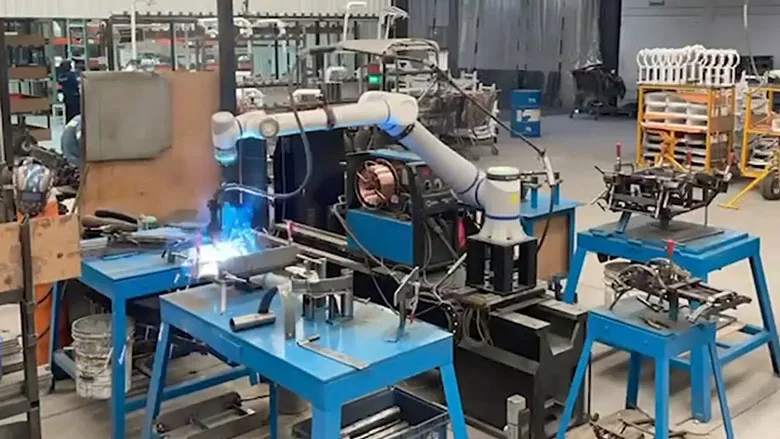
welding cobot mounted to a linear rail
Photo courtesy Dobot

PeyMar engineers mounted a welding cobot to a linear rail. This enables one robot to operate across six welding stations continuously.

March 19, 2026

Dental chairs serve two purposes. The first is to ensure that patients are as comfortable as possible in a stressful environment. The second is to position patients, lighting and instruments so that dentists and hygienists can perform their tasks accurately, efficiently and ergonomically.

PeyMar, a manufacturer of dental chairs based in Mexico City, has been successfully finding that balance since 2014.
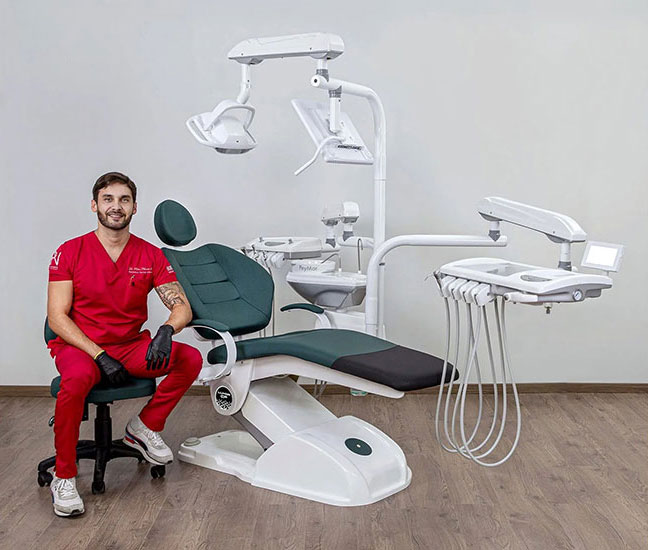
dental chair

Dental chairs must position patients, lighting and instruments so that dentists and hygienists can perform their tasks accurately, efficiently and ergonomically. Photo courtesy PeyMar

To manufacture the chairs, the company must weld a variety of metal frames and components. The welding process posed several challenges for the company, including:

  • Inefficiency: Traditional welding setups required multiple operators and machines for different workstations, leading to bottlenecks and increased cycle times.
  • Space constraints: The shop floor had limited space, making it difficult to accommodate multiple welding stations and equipment.
  • High labor costs: Employing multiple workers for different welding tasks increased costs and management complexity.
  • Integration issues: PeyMar engineers struggled to integrate existing robots with various welding systems and accessories, limiting flexibility and customization.

To address these challenges, engineers developed a custom system that consists of a Dobot CR20A collaborative robot mounted to a linear rail and equipped with a welder from Miller Electric Manufacturing LLC. This configuration enables a single robotic arm to operate across six welding stations continuously, requiring only one employee to manage the process. 

CR20A cobot

The CR20A cobot can carry a maximum payload of 20 kilograms, and it has a maximum reach of 1,700 millimeters. Photo courtesy Dobot

Now, the cobot can weld one component while the operator replaces the completed part, minimizing downtime and maximizing output. By using one robot across multiple stations, PeyMar made the most of its limited floor space. It also reduced costs for labor, capital investment and maintenance.

The CR20A can carry a maximum payload of 20 kilograms, and it has a maximum reach of 1,700 millimeters. The CR20A has a dual-channel end-effector design, which can directly connect to multiple end tools. It also features a visual status indicator at the base for intuitive recognition of operating status.

With an advanced motion control algorithm, the CR20A operates more stably, with residual vibrations reduced by 50 percent during high-speed emergency stops.

Looking for quick answers on assembly and manufacturing topics? Try Ask ASM, our new smart AI search tool. Ask ASM →


PeyMar worker assembling a dental chair

PeyMar has been manufacturing dental chairs in Mexico City since 2014. Photo courtesy PeyMar

Cobot Specifics

Dobot’s new CRA series of cobots have been designed for high-speed, safety and stability. Joint speed has been increased to 223 degrees per second, which is among the fastest in the industry. This improvement allows for a wider range of applications and reduces cycle time for common tasks, such as material handling, by as much as 25 percent.

An EtherCAT bus is used by the joint servomotor, providing a vast bandwidth of hundreds of megabits and a joint response speed in the millisecond range. This enhances the cobot’s speed and trajectory smoothness.

Each cobot is calibrated with a laser calibration system, ensuring an absolute positioning accuracy of under 0.4 millimeter. This enables the robot to tackle high-precision assembly tasks.

The cobot is governed by a stand-alone safety controller that is rated at PLd Cat.3. It features more than 20 safety functions, and it is certified to ISO 13849-1, ISO 10218-1, and ISO/TS 15066. With proper risk assessment, the cobot can collaborate with people without the need for additional fencing.

In the event of a power outage, the robot engages an electromagnetic brake within 18 milliseconds. This ensures position retention within 1 millimeter and safeguards against equipment or product damage.

manual assembly processes

Dental chairs require numerous manual assembly processes. Photo courtesy PeyMar

The cobot can be programmed for “virtual fencing,” enabling engineers to devise safety measures tailored to their unique production settings. As an option, the cobot can be equipped with a “safety skin” that instantly stops the cobot if it should contact a person. This ensures optimal safety at every stage of the assembly process.

The cobots have 24 DI and DO interfaces, supporting both PNP and NPN switching. They are also configured with more than 30 functions for robot control and status feedback, providing convenience and flexibility for integration and control.

Additionally, the cobots come equipped with standard communication methods like Modbus TCP/RTU, EtherNet/IP and Profinet. This aids integration with PLCs, HMIs, and other devices, eliminating worries about communication protocol compatibility.

DobotStudio Pro software simplifies the task of programming the cobot. Programming is accomplished with intuitive and user-friendly “blocks.” By combining various blocks, engineers can easily create flexible programs. At the same time, skilled developers can design intricate programs and manage advanced applications through the provision of adaptable LUA script programming.

dental chairs ready for shipping

PeyMar ships dental chairs worldwide. Photo courtesy PeyMar

A wide range of plug-in accessories is available, including grippers, force sensors, and 2D and 3D vision. By using the ready-to-use APIs from the plugins, engineers can develop applications in a short span of time.

A range of application packages is available, including welding, palletizing and machine tending. By adjusting parameters, programs can be easily created. 

A log enables engineers to access historical status, operation records, and parameter modification information. This allows for swift problem identification and minimizes downtime.

Engineers can leverage offline programming to execute, debug and validate programs without being connected to the robot. The cobot also supports access via computer, tablet or teach pendant. Both wired and wireless connection methods are available.

For more information, visit www.dobot-robots.com.


For more information on cobots, read these articles:
Cobot Welding Catches On
Cobot Welder Raises the Output for Carolina Manufacturer
User-Friendly Robotic Welding System Delivers Fast ROI

KEYWORDS: collaborative robots flexible assembly robotic welding

Share This Story

Looking for a reprint of this article?
From high-res PDFs to custom plaques, order your copy today!

John has been with ASSEMBLY magazine since February 1997. John was formerly with a national medical news magazine, and has written for Pathology Today and the Green Bay Press-Gazette. John holds a B.A. in journalism from Northwestern University, Medill School of Journalism.

Recommended Content

JOIN TODAY
To unlock your recommendations.

Already have an account? Sign In

  • Made in the U.S.A.

    Consumer Products Manufacturing: Made in the USA

    Supply chain lessons learned during the coronavirus...
    Automated Assembly Systems
    By: Austin Weber
  • Best Practices for Press-Fit Assembly

    Best Practices for Press-Fit Assembly

    In manufacturing, ironclad formulas for success are hard...
    Assembly Presses
    By: Jim Camillo
  • aem0523leader-tesla1.jpg

    Tesla Rethinks the Assembly Line

    Engineers at Tesla Inc. have developed a new process that...
    Assembly and Testing
    By: Austin Weber
Manage My Account
  • eMagazine Subscription
  • Assembly Newsletters
  • Online Registration
  • Subscription Customer Service
  • Manage My Preferences

More Videos

Sponsored Content

Sponsored Content is a special paid section where industry companies provide high quality, objective, non-commercial content around topics of interest to the ASSEMBLY audience. All Sponsored Content is supplied by the advertising company and any opinions expressed in this article are those of the author and not necessarily reflect the views of ASSEMBLY or its parent company, BNP Media. Interested in participating in our Sponsored Content section? Contact your local rep!

close
  • ultrasonic welding
    Sponsored bySonobond Ultrasonics

    Engineering Efficiency in High-Performance Assembly: How Ultrasonic Welding Enhances Throughput, Reliability and Quality

  • UV curing system
    Sponsored byDymax

    Why UV Intensity Alone Doesn’t Define Curing Performance

  • wooden pallets
    Sponsored byLEAN Manufacturing Products

    Eliminating Waste on the Shop Floor: Applying Lean Principles to Improve Manufacturing Efficiency

Popular Stories

ASSEMBLY News Now, episode-30: Volvo Redesigns EV Manufacturing

Volvo Redesigns EV Manufacturing

Boeing CEO Kelly Ortberg announces 1 billion investment

Boeing Plans $1 Billion Wichita Investment, Workforce Training Center

automated consumer goods assembly system

Best Practices for Cycle Time Optimization

Watch the latest episode of ANN now!

Events

July 24, 2025

From Shop Floor to CFO: How Manufacturers Are Closing the Loop Between Operations and Finance

On Demand Learn how manufacturers are bridging the gap between the shop floor and ERP systems to gain real-time visibility, streamline operations, and kick-start digital transformation—without waiting years.

Sponsored by:

PicoStratusGreen
July 30, 2025

Buffer Analysis and Design Fundamentals for Manufacturing Excellence

On Demand In this presentation, Dr. Herman Tang shares practical insights from his industry experience and research on buffer management in manufacturing operations.

View All Submit An Event

Poll

Difficult Assembly Processes

Which assembly process gives you the most difficulty?
View Results Poll Archive

Products

Manufacturing Cost Policy Deployment (MCPD) Profitability Scenarios: Systematic and Systemic Improvement of Manufacturing Costs

Manufacturing Cost Policy Deployment (MCPD) Profitability Scenarios: Systematic and Systemic Improvement of Manufacturing Costs

See More Products
Register for webinar - Modernizing Automotive Assembly: Why Upgrading Legacy MES is a Business Imperative

Related Articles

  • vibratory feeder bowl

    Automated System Boosts Output of Auto Parts

    See More
  • nordson selective soldering

    Selective Soldering System Boosts Output at Meter Manufacturer

    See More
  • cobot welder

    Cobot Welder Boosts Output Tenfold

    See More

Related Products

See More Products
  • Resistance Welding: Fundamentals and Applications, Second Edition

  • Welding Processes Handbook, 2nd Edition

  • Welding and Joining of Aerospace Materials, 1st Edition

See More Products

Related Directories

  • DB Cobots

    DB Cobots is a United States based master distributor of Dobot Industrial Collaborative Robots. We stock all models of Dobot Cobots and accessories and provide technical support, service and training. Desktop 4 axis priced at $2,890. 6 Axis Cobot models starting at $19,790. Payloads to 20KG.
  • GlasWeld

×

Never miss the latest news and trends driving the manufacturing industry

Stay in the know on the latest assembly trends.

JOIN TODAY!
  • RESOURCES
    • Advertise
    • Contact Us
    • Directories
    • Manufacturing Division
    • Store
    • Want More?
  • SIGN UP TODAY
    • Create Account
    • eMagazine
    • Newsletters
    • Customer Service
    • Manage Preferences
  • SERVICES
    • Marketing Services
    • Reprints
    • Market Research
    • List Rental
    • Survey/Respondent Access
  • STAY CONNECTED
    • LinkedIn
    • Facebook
    • Instagram
    • YouTube
    • X (Twitter)
  • PRIVACY
    • PRIVACY POLICY
    • TERMS & CONDITIONS
    • DO NOT SELL MY PERSONAL INFORMATION
    • PRIVACY REQUEST
    • ACCESSIBILITY

Copyright ©2026. All Rights Reserved BNP Media, Inc. and BNP Media II, LLC.

Design, CMS, Hosting & Web Development :: ePublishing