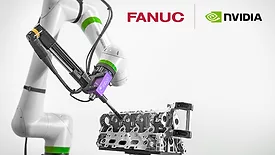
ROCHESTER HILLS, MI — FANUC America is collaborating with NVIDIA to advance the use of physical AI in industrial robotics, combining automation systems with AI computing and simulation technologies to support more adaptive manufacturing environments.
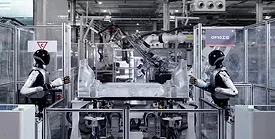
BIRMINGHAM, Mich. — As National Robotics Week highlights advances in automation, one trend is becoming clear: robotics is no longer confined to pilot projects or isolated applications. It is being deployed across production lines to solve specific manufacturing challenges. In many cases, the shift is happening at the process level.
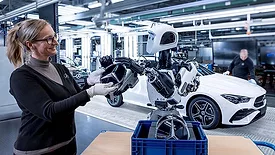
BIRMINGHAM, Mich. — As National Robotics Week highlights the rapid evolution of automation, manufacturers are beginning to deploy a new generation of intelligent robotic systems capable of adapting to real-world production environments.
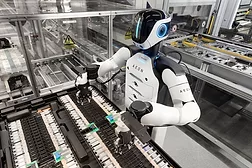
Robotics is no longer defined by motion alone. The next phase of automation is being driven by intelligence — systems that can perceive, decide and adapt in real time on the factory floor.
BIRMINGHAM, Mich. —
As National Robotics Week highlights advances across automation and AI, manufacturers are seeing those innovations move rapidly from concept to production environments.
Industrial robotics is entering a new phase. What began as fixed automation for repetitive tasks is evolving into flexible systems designed to work alongside people, adapt to changing conditions and take on increasingly complex assembly work. Recent developments across manufacturing show a clear shift: robots are no longer just improving efficiency — they are expanding what can be automated.
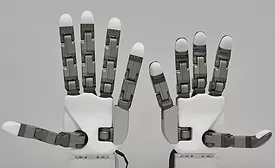
SEONGNAM, South Korea — Tesollo has commercialized a compact five-finger robotic hand designed to enable robots to perform more dexterous manipulation tasks in humanoid and industrial robotics systems. The new DG-5F-S hand features a 20-degree-of-freedom structure intended to support precise grasping and handling of objects in robotic platforms.
Compared with Industry 4.0, where humans mainly act as supervisors, Industry 5.0 elevates human expertise and contextual understanding. The objective is to allow people to focus on high-value cognitive tasks while being supported by intelligent machines that handle routine, hazardous or precision-intensive work.
Although Industry 5.0 is still a relatively new term, engineers are already talking about another buzz word called Physical AI. The term refers to augmenting physical systems with intelligence that scales.