Assembly Lines
New Technology Enables Better Human-Robot Collaboration
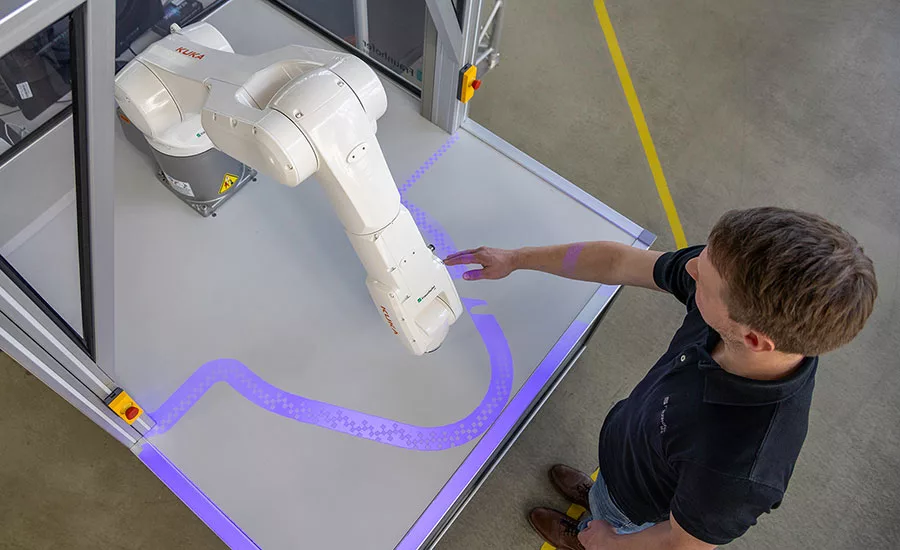
New safety technology generates visible light curtains around the area where a robot is working. The illuminated blue safety lines dynamically adjust to the machine’s movements, enabling safe interaction between humans and robots.
Photo courtesy Fraunhofer IFF
MAGDEBURG, Germany—Engineers at the Fraunhofer Institute for Factory Operation and Automation (IFF) here have developed new technology that ensures safety in AI-generated robot movements and enables better human-machine collaboration.
The technology, called PARU, uses advanced cameras and projectors to display visible warning and protective fields directly around a robot and recognize when people enter the safety zones. After the projector and the two cameras are calibrated, virtual expectation images are generated as the first step.
Then, the system projects a visible light curtain around the robot and the component that is to be picked up in accordance with the distance formula set out in the ISO/TS 15066 standard.
“This light curtain acts as a safety line, visualizing for employees the protective space that humans must keep clear,” says Norbert Elkmann, Ph.D., head of the robotic systems department at Fraunhofer IFF. “If any part of a body comes into contact with the line, [work] is interrupted. The cameras recognize that there is a discrepancy between what they expect to see and the real-world image.
“Depending on the situation, the robot halts its movement right away or slows its speed,” explains Elkmann. “The safety areas are adjusted dynamically to the machine’s movements, as PARU always considers the robot’s current status, making it ideal for use in cognitive robotics.
“Our technology is unique,” claims Elkmann. “No other system allows for a smaller distance between humans and robots, while observing the specifications set by the applicable standards and also needing so little space. This is possible because the cameras and sensors recognize not only torsos, arms and heads, but even fingers.”
Another advantage is that the projection can also show people where the robot will be moving as its next step, further enhancing trust in working with machines. The additionally coded visible safety lines work independently of ambient lighting angles and conditions. If the cameras or projectors stop working, the entire system is automatically switched off.
Looking for quick answers on assembly and manufacturing topics? Try Ask ASM, our new smart AI search tool. Ask ASM
Elkmann and his colleagues also recently developed a computer-aided system that makes human-robot collaboration applications efficient, cost-effective and safe.
“Digital assistants support the risk assessment and safety approval processes, and make it easier for new entrants in particular to comply accurately and efficiently with the full range of obligations under the EU’s Machinery Directive,” says Elkmann. “Unlike the collision measurement feature, the safety approval tool works entirely digitally. It takes parameters such as collision force and pain threshold into account to determine the robot’s maximum permitted speed.
“The modules can optionally be incorporated into any kind of robot controls or existing simulation environments for planning purposes to precisely align economic specifications with applicable safety requirements,” explains Elkmann. “This prevents planning errors and saves on engineering costs.”
The system was devised based on data collected from years’ worth of unique tests with subjects, which have yielded new threshold limits and other key biomechanical indicators for safe human-robot collaboration. Collision and clamping loads set on a specially designed pendulum were used to identify the pain threshold through tests of more than 100 human subjects.Looking for a reprint of this article?
From high-res PDFs to custom plaques, order your copy today!