NDT | Test & Inspection
Best Practice Nondestructive Testing for EV Battery Packs, the Equivalent Channel Method
SAE International’s Battery Standards Testing Committee recently issued a recommended practice that established nondestructive in-line production test methods for evaluating water leak tightness for propulsion battery packs.
.webp?t=1755548746)
Battery pack failure modes. Image Source: INFICON
By 2030, the Union of Concerned Scientists predicts that the percentage of new car and truck sales in the United States that are electric vehicles (EVs) will reach 50 percent. Globally, EV sales accounted for more than one in every five vehicles sold in 2024. As developing economies outside of China, Europe and the U.S. add purchase subsidies and incentives, their share of EVs to internal combustion engine (ICE) driven vehicles is also expected to increase.
One of the challenges as EV production ramps up to meet worldwide demand is quality, especially where EV propulsion batteries are concerned. Because of the volatility of their lithium-ion or sodium-ion based electrolyte when exposed to water, these batteries must be manufactured to be liquid-water tight to prevent failures and catastrophic events. In individual battery cells, the introduction of water vapor can cause acid to form. In battery packs, the ingress of water can cause short circuiting and lead to battery fires, which have destroyed a growing number of vehicles, consumer garages and other commercial structures.
Manufacturers have for the most part mastered the safe production of metal-ion batteries to prevent fires in small consumer goods such as pacemakers, smartphones and vape pens. However, the form factor of EV traction batteries – from battery cells to fully assembled battery modules – has made testing them a challenge for suppliers and automakers alike. North American EV battery manufacturers only test a fraction of the cells they assemble into modules for both electrolyte leakage and for water-vapor ingress. This number is estimated to be somewhere between 15 to 20 percent.
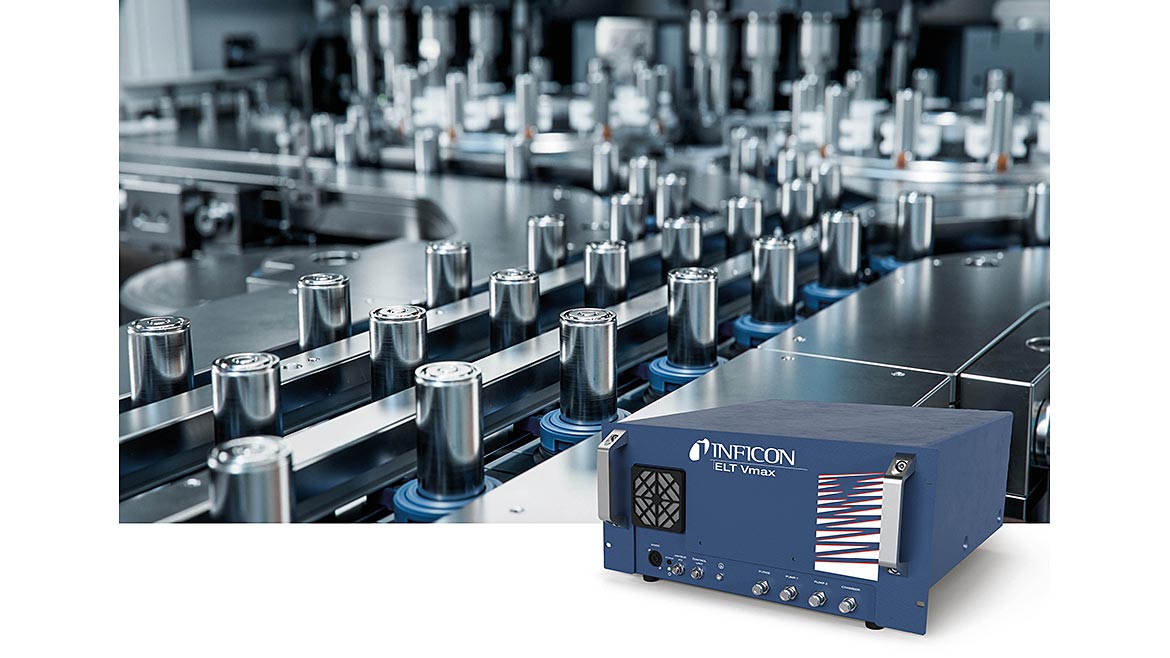
Leak testing battery cells in production by direct electrolyte leak testing. Image Source: INFICON
This is woefully inadequate to ensure quality in the manufacturing of such a significant element in an electric vehicle and should be on the order of 100 percent to ensure safety for consumers in daily operation. In fact, battery makers should test at every step in the manufacturing process, from the production of each battery cell to when it is assembled into a module and then into a pack.
Once the pack is assembled, the supplier or automaker should also test the cooling system for glycol leakage within the pack to further prevent quality and safety issues.
Industry Standards Help Battery Manufacturers Improve Quality
Until recently, leak testing of lithium-ion battery packs for EVs was left to the discretion of the battery manufacturer in terms of the type and level of testing that was conducted. In 2023, SAE International’s Battery Standards Testing Committee comprising more than 20 companies involved in the manufacture and testing of EV batteries, was tasked with providing recommended practices for evaluating liquid leak-tightness in EV battery packs. The committee’s first recommended practice defined common performance test procedures that could be used for comparative purposes. Although the recommended practice did not define performance requirements, it allowed battery manufacturers to define them for their products.
In early 2024, the Battery Standards Testing Committee published a technical information report that presented a methodology for evaluating battery pack leak tightness for water ingress protection. This report looked at nondestructive test methods to meet the IPX7 water ingress standard established by the International Electromechanical Commission (IEC) to keep water out of sensitive electrical and electronic devices, which is one of electronics’ biggest hazards.
Looking for quick answers on assembly and manufacturing topics? Try Ask ASM, our new smart AI search tool. Ask ASM
The rationale for the information report is as follows:
“Vehicles using high voltage systems for electrified propulsion are expected to be introduced to the market in increasing quantities. These vehicles include, but are not limited to, plug-in electric vehicles (EV) and hybrid electric vehicles (HEV). These vehicles include Rechargeable Energy Storage Systems (RESS) battery packs that might be mounted in locations that are exposed to water, either through rain/snow weather conditions or relatively low levels of standing water. Users of these vehicles are anticipated to have some amount of assurance that such water exposure will be unlikely to result in harmful water leakage into a battery pack. Common (and regulatory) functional test requirements for water ingress is per IEC 60529, IPX7 level, which is a destructive test and isn’t applicable for an in-line production testing. This information report offers a method to convert these functional requirements into end-of line nondestructive quality assurance tests of battery packs.”
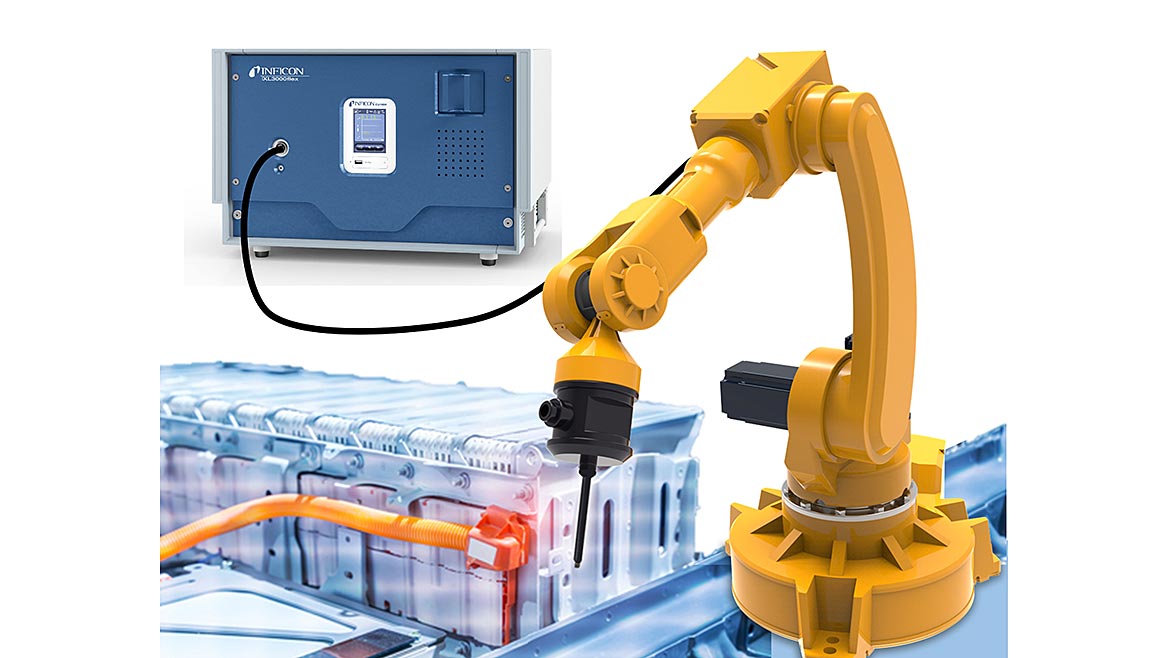
Leak testing of assembled battery packs via robotic sniffer leak testing. Image Source: INFICON
In January 2025, the Battery Standards Testing Committee issued J3277/1_202501, a recommended practice that established nondestructive in-line production test methods for evaluating water leak tightness for propulsion battery packs. Using the Selected Equivalent Channel (EC) method defined in SAE J3277, its purpose is to achieve results equivalent to the IEC 60529 standard’s IPX7 standard. The recommended practice looks at ways to provide nondestructive end-of-line leak testing for battery pack assemblies and coolant systems.
The (EC) method establishes a production leak tightness requirement for a battery pack design by correlating it with a simplified channel geometry, ensuring the pack meets or exceeds its functional requirements. The EC method involves analytically and empirically obtaining the specific geometry of the equivalent channel (EC) for a given battery pack design. This geometry is determined by considering product design limitations. The EC method aims to correlate the simplified channel geometry with the actual battery pack’s leak tightness behavior.
The EC method can help ensure that battery packs meet or exceed their functional requirements. It provides a standardized approach for evaluating leak tightness in battery pack designs.
Testing Using the Equivalent Channel Method
In practice and in production environments, after ensuring cells are leak-tight, and modules properly constructed, assembled battery packs can be tested using test gas, typically helium, to discern leak rates that conform with manufacturers’ standards. Packs are pressurized to above atmospheric pressure with tracer gas and industry-standard robotically controlled sniffer probes are moved near to all seals or other potential leakage locations to ensure leak tightness. This is accomplished at production line speeds.
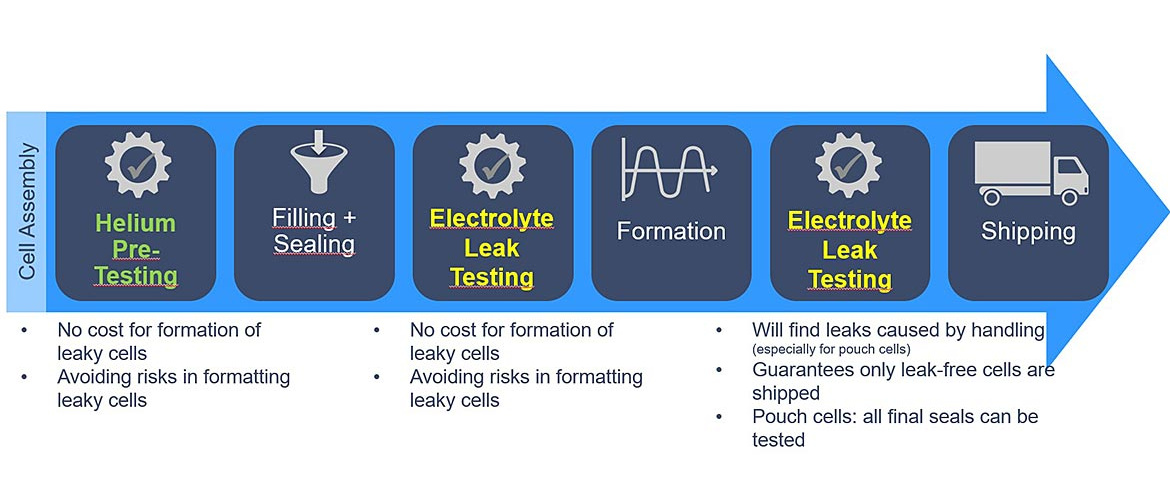
Leak testing steps in the battery production value chain. Image Source: INFICON
Testing in this manner ensures that battery packs are within tolerance for water ingress. Using the Equivalent Channel (EC) method sidesteps a variety of test issues. For instance, battery pack housings are constructed from a variety of materials: steel, aluminum or composite. Each has differing properties for wetting of any existing leak channels and, as very small channels are nominally blocked by the liquid, may exhibit false leak-tightness using outmoded testing like IP7; water vapor may still enter through these very small channels. Therefore, testing to 10-5 is a minimum for ensuring liquid and atmospheric moisture leak tightness.
Helium Leak Testing: Precision Detection for Quality Assurance
Helium leak testing offers a significant advantage in its exceptional sensitivity, capable of identifying leaks as small as 10⁻⁹ atm cc/s—equivalent to just one-billionth of a cubic centimeter of gas escaping per second at atmospheric pressure. This high level of precision makes it an invaluable tool for ensuring product integrity, particularly in applications where leak-tight performance is critical.
In addition to its sensitivity, helium testing is nondestructive, meaning components such as batteries remain undamaged during inspection. Its reliability and repeatability makes it a preferred method in quality-driven manufacturing environments.
When the channel diameter falls below a certain threshold, no liquid penetration occurs, allowing the system to be classified as leak-tight. However, gases can still pass through these extremely fine leakage paths. This characteristic enables reliable detection and identification of potential leakage channels using test gas during a system pre-test.
However, there are some challenges to consider. The process requires costly equipment, including vacuum chambers and mass spectrometer-based leak detectors, and demands tightly sealed testing environments to prevent false readings.
Leakage of coolant – especially if a glycol-water mix – has a high potential for eventual cell-level issues if 100-percent cell integrity is not ensured. Internal glycol (or other coolant media) circuits can also be tested using pressure decay or test gas, sometimes at the same test station if so constructed.
What is missing from this discussion is the requirement for every cell to be free from not only initial electrolyte leakage, but the eventual ingress of water molecules in the form of vapor or humidity. Cells are constructed at a negative pressure that may, over time, decay through porosities readily tested by the EC method, which ensures that cell integrity remains intact over a battery cell-module-pack’s lifetime. SAE is currently in discussion of a standard similar to J3277 for battery cell—cylindrical, prismatic or pouch—nondestructive testing.
Why it matters to Quality professionals
In the automotive industry, we frequently focus on improving metrics like cost, scrap, rework, sustainability, warranty and sometimes even reputation in measuring our efforts. We also need to keep in mind that we work with technology, materials, and design elements – all of which can be dangerous under certain circumstances and could exhibit failure that could potentially injure or kill consumers who buy our company’s products. Ensuring that we thoroughly test our products for safety and resistance to environmental factors that could make them dangerous is crucial to our success and the future of our industry. It might only take one horrific failure to occur before all manufacturers require 100-percent testing of battery cells and modules.
Looking for a reprint of this article?
From high-res PDFs to custom plaques, order your copy today!