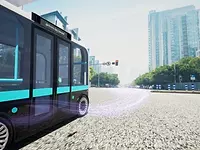
Acoustic Sensors May Improve Autonomous Vehicle Safety

Acoustic sensors enable this prototype vehicle to “hear.” Photo courtesy Fraunhofer Institute for Digital Media Technology
ILMENAU, Germany—Engineers at the Fraunhofer Institute for Digital Media Technology (IDMT) have developed a vehicle that can hear. Acoustic sensors enable it to “hear,” just like cameras, lidar and radar enables cars to “see.” The goal is to improve autonomous vehicle safety.
“Being able to perceive exterior sounds and attribute them accurately is a crucial part of attentively observing the full traffic environment,” says Moritz Brandes, who leads the Hearing Car project at Fraunhofer IDMT. “After all, many situations on the road are preceded by an acoustic signal. Take an approaching emergency vehicle, for example, which alerts people to its presence by using a siren.”
Brandes and his colleagues are deploying microphone technology that can stand up to wind and weather. The devices are built into a prototype vehicle’s exterior and are connected to an onboard electrical system.
To minimize the influence of airflow sounds, the engineers are also developing and testing suitable housings and screens for sensors that can detect airborne sounds.
“The number and placement of the microphones are crucial to detecting sounds from the vehicle’s environment,” explains Brandes. “[We have] developed solutions that can stand up to wind and weather and work at extreme temperatures.
“We’ve used our demo vehicle for testing at several locations between Portugal and the Arctic Circle in order to trial the technologies in different conditions,” adds Brandes. “The results are really promising, and they show the potential of our developments for the future of autonomous driving.”
In the future, Brandes believes that acoustic environment analysis technology will be able to detect not only ambulances, but also other sounds, such as human voices or the sounds of children playing, as a vehicle turns into an area of calm traffic.
“Acoustics does not require a clear line of sight, like optical systems do, so [a vehicle could] literally hear what’s coming around the corner,” says Brande. “This will allow automated driving systems to respond and operate with increased caution, much like a human driver who hears children playing before they can be seen. In addition, exterior noises will be transmitted into the vehicle interior via the headrest during certain driving maneuvers to call the driver’s attention to important sounds in the surrounding area.”
Looking for quick answers on assembly and manufacturing topics? Try Ask ASM, our new smart AI search tool. Ask ASM
Looking for a reprint of this article?
From high-res PDFs to custom plaques, order your copy today!