Assembly Lines
Collaborative Robots May Be Prone to Privacy Problems
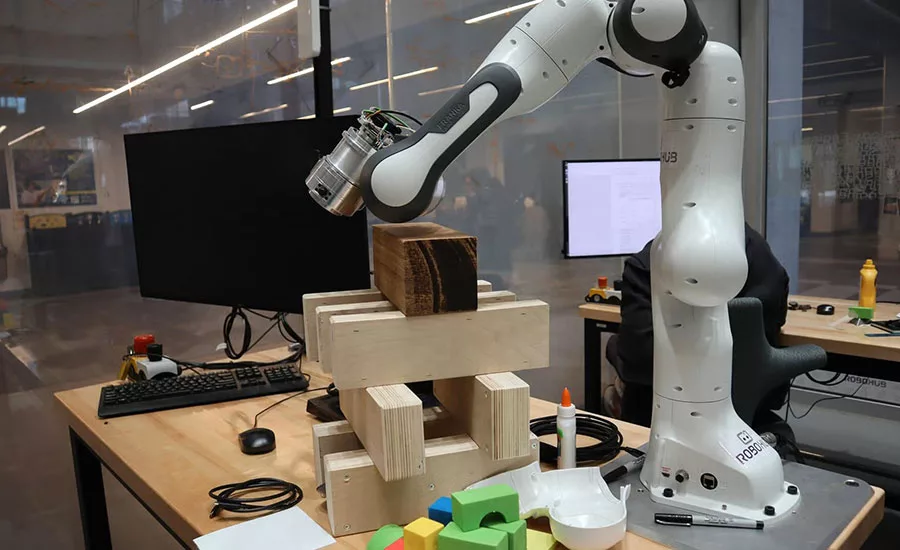
Many robots suffer from a serious security weakness.
WATERLOO, ON—According to a recent study conducted by the University of Waterloo, many collaborative robots suffer from a serious security weakness. A team of engineers discovered that hackers can identify a cobot’s action with a 97 percent accuracy rate.
“Despite their popularity, collaborative robots could be exploited in malicious attacks,” warns Yue Hu, Ph.D., a professor of mechanical and mechatronics engineering who was involved in the research project. “If a hacker notices any command patterns during a procedure, he or she could infer sensitive information, even when commands are encrypted.
“In the robotics community, there’s an increased interest in controlling [machines] remotely by sending commands over a network,” says Hu. “The robot could be anywhere, like a hospital, factory or another country. Many people don’t realize that once these robots are hooked into the network, they are exposed to security risks.”
According to Hu, previous research efforts have focused on privacy concerns in teleoperation robotics, where humans control robots in real-time by using joysticks or virtual reality interfaces. His study focused on script-based robots, where machines perform preprogrammed commands with minimal human intervention.
Hu and his colleagues investigated techniques that could identify a robot’s actions by analyzing its network traffic. They developed a classification technique based on signal processing, which is found in products like noise-cancelling headphones. It analyzes and transforms signals for information extraction or quality improvement.
The engineers conducted experiments by instructing a Kinova Gen3 robotic arm to perform four actions. They collected 200 network traces that were exchanged between the robot and its controller.
By analyzing what type of commands were being sent, they discovered that robot commands can create traffic subpatterns, which can be detected by common signal processing techniques, particularly signal correlation and convolution.
“Certain design choices could prevent leakage and make a system’s network steadier,” claims Hu. “Some of [our] proposals include changing the system’s interface, like its application programming interface timing, or employing a smart traffic shaping algorithm at run-time.”
Looking for quick answers on assembly and manufacturing topics? Try Ask ASM, our new smart AI search tool. Ask ASM
Looking for a reprint of this article?
From high-res PDFs to custom plaques, order your copy today!