All-Climate Battery Addresses Extreme Temperature Challenges

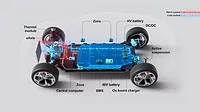
A new all-climate battery features an internal heating element that optimizes materials for use in hot and cold environments. Illustration courtesy Chao-Yang Wang/Wen-Ke Zhang/Pennsylvania State University
UNIVERSITY PARK, PA—Lithium-ion batteries don’t like cold weather. Unfortunately, that can create a winter driving headache for electric vehicles owners in many parts of Asia, Europe and North America.
Engineers at Pennsylvania State University have developed a battery that addresses those challenges and can operate in many extreme climate conditions. The all-climate battery (ACB) features an internal heating element that optimizes materials for high stability and safety in hot environments, while supporting operation in cold environments. It avoids compromising stability and safety in one climate to improve performance in another.
According to Chao-Yang Wang, Ph.D., a professor of mechanical engineering who is heading up the R&D project, previous approaches have proven incapable of simultaneously improving efficiency at lower temperatures and increasing stability at higher temperatures. “There has always been a tradeoff and a fundamental design flaw,” he points out.
“Although external heating or cooling mechanisms are used to help keep batteries operational today, these bulky, power-intensive systems are inefficient and require frequent maintenance,” says Wang. “Even with external temperature management, lithium-ion batteries lose performance at cold temperatures and experience reduced capacity and stability at high temperatures. Maintaining reliable operation at external temperatures ranging from -30 to 45 C severely limits their [use] in extreme environments.
“This is the key aspect of our research,” notes Wang. “By optimizing the materials used for hot temperatures and implementing an internal heater to warm the battery, in turn improving performance at low temperatures, [we] address this thermal roadblock.”
Wang and his colleagues adjust the material makeup of the electrodes and electrolytes in the ACB to better handle hot environments. Their internal heating structure is composed of a thin film of nickel foil that is only about 10 microns thick. This structure, which is powered entirely by the battery, allows the system to self-regulate temperature, while adding virtually no weight or volume.
This increases the number of environments batteries can reliably operate in, widening their operational temperature range from -50 to 75 C. In addition to improved versatility, removing external thermal management systems offers performance benefits.
Looking for quick answers on assembly and manufacturing topics? Try Ask ASM, our new smart AI search tool. Ask ASM
“By incorporating thermal management into the battery itself, we significantly cut down on both the space the batteries take up, as well as the other variables associated with external heating or cooling,” explains Wang. “The cost, power consumption and need for maintenance are significantly reduced.”
Wang claims that ACBs could be further optimized to operate at temperatures as high as 70 to 85 C with proper development and testing, which will be necessary to support the growing scale of systems that rely on batteries for power storage.
“Our society is only growing more power-dependent, and shows no sign of slowing down,” says Wang. “As we continue to develop technology like data centers, advanced drones and electric vehicles that require tons of power, we will have to continue improving the batteries that power them.”
Looking for a reprint of this article?
From high-res PDFs to custom plaques, order your copy today!