Robotics
Humanoid Robots Complete Trial Project at BMW Assembly Plant
The robots accumulated 1,250 hours of run-time.
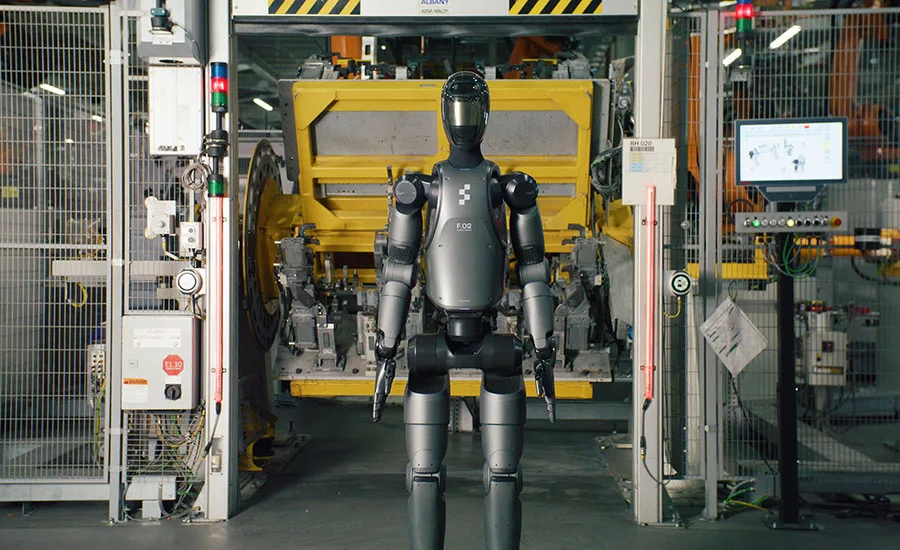
BMW recently conducted a test of humanoid robots in its body shop.
Photo courtesy BMW Group
SPARTANBURG, SC—Two humanoid robots have completed an 11-month pilot project at BMW’s assembly plant here.
During that time, the Figure 02 robots from Figure AI ran 10-hour shifts Monday through Friday, accumulating 1,250 hours of run-time. The robots loaded more than 90,000 parts and contributed to the production of more than 30,000 BMW X3 vehicles.
While deployed at BMW, the robots performed a classic pick-and-place task by loading sheet metal parts into a welding machine. The robot picked sheet metal parts from racks or bins and placed them on a welding fixture. A traditional six-axis industrial robot then welded and fed the parts into the main line.
The robots had three goals to meet: cycle time, placement accuracy, and interventions. To meet the cycle time goal, the robot was required to load the sheet metal parts within 37 seconds and complete the entire task in 84 seconds. In addition, the robots were expected to have a 99 percent success rate per shift in loading the sheet metal accurately. Figure AI also tracked the number of times a human must pause or reset the robot, with the goal being zero per shift.
“The challenge of this use case is in balancing speed and precision—placing parts within a 5-millimeter tolerance in just 2 seconds. To meet this, the robot had to achieve precise yet adaptive locomotion, allowing rapid, accurate foot placement and real-time responsiveness to environmental changes. To meet that goal, Figure engineers developed advanced hand-eye coordination algorithms and built field-calibration tools for consistent cross-robot performance.
Figure AI did not share data on how well the humanoids performed in meeting those goals. However, the company did say the pilot project taught it how to improve the robot for its Figure 03 design.
“Six months of daily runtime yielded invaluable insights for our mechanical and reliability teams,” a company press release says. “Across more than 1,250 operational hours, Figure 02 recorded minimal hardware failures while generating critical data that informed the build procedures, component architecture, and mechanical design of Figure 03.”
The robot’s forearm was the company’s top hardware failure point at BMW. It says the forearm subsystem is challenging due to its tight packaging and dexterity requirements, which necessitate 3 degrees of freedom and thermal constraints.
“Figure 02’s forearm contained a microcontroller-based PCB that distributed communications between the main computer and the wrist actuators,” the release says. “For Figure 03, we completely redesigned the wrist electronics to eliminate both the distribution board and dynamic cabling. Each wrist’s motor controller now communicates directly with the main computer, reducing complexity, improving reliability and simplifying thermal management.”Looking for quick answers on assembly and manufacturing topics? Try Ask ASM, our new smart AI search tool. Ask ASM
Looking for a reprint of this article?
From high-res PDFs to custom plaques, order your copy today!