New Tool Controller Increases Flexibility, Improves Maintenance
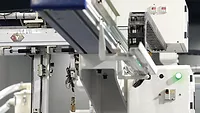
During the ASSEMBLY Show in Rosemont, IL, Russ Hughes, product marketing manager at Desoutter Tools, joined ASSEMBLY Audible to discuss his company’s new tightening platform, AXON. Hughes discusses how AXON solves assembly challenges, such as managing diverse tools that require backup controllers onsite, reducing downtime, enabling live data analytics, supporting sustainability goals, and shrinking equipment footprints.
Q: What are some of the biggest challenges manufacturers face today in managing diverse assembly tools across production lines—and how do platforms like AXON help address them?
Russ Hughes: Backup tools, backup controllers, and keeping backups. With our previous generation of tools and controllers, we had several controllers for different tool lines.
With AXON, our goal was to make it compatible with all the tools we had made as far back as 2010. So now we have one controller that will manage all our tools. It really saves manufacturers the headache of keeping separate backup pieces of equipment for different tools. Now we have a single controller that handles everything.
Q: Live monitoring and data access are becoming standard expectations—why is real-time visibility so critical in modern assembly environments?
Hughes: We want to catch errors before they’re shipped out the door. That’s the biggest challenge. With the real-time location services we have with nexonar, manufacturers can error-proof assembly. With DeMeter, with the live data analytics and the operator notifications, manufacturers can catch things up front and avoid the headache of a recall or working things out in the field. It really saves time.
Q: How does AXON support sustainability goals, such as reducing CO₂ emissions or optimizing energy usage on the shop floor?
Hughes: We have big sustainability goals at Desoutter corporate. In North America, we got away from using plastics and Styrofoam in our packaging. We made sure our packaging materials are recyclable. The CO2 emissions required to make our products are lower than those for the previous products. The energy usage is much less.
Q: Can you talk about the importance of footprint optimization in today’s manufacturing spaces—and how AXON’s compact design plays a role?
Hughes: Real estate is expensive at assembly plants. Manufacturers want to put more and more into smaller spaces. What we did with the AXON was make it 30 percent smaller than the previous model to help save space and production, and it’s worked quite well. We’re having success with it, mainly because of the diversity of the two ranges it can do and the size of the controller.
Q: Tool diversity is often a challenge—how does AXON help manufacturers standardize without sacrificing flexibility?
Hughes: AXON will run everything—all of our cable tools made as far back as 2010. It’ll do handheld tools and fixtured tools. You no longer need one system for a fixed application and another for a handheld application. A single controller does everything.
Looking for quick answers on assembly and manufacturing topics? Try Ask ASM, our new smart AI search tool. Ask ASM
Q: Maintenance and uptime are critical—what innovations in AXON help reduce downtime and improve serviceability?
Hughes: The AXON was designed for a couple of different running modes. We call it autonomous mode right now because we need the drive and a module. Traditionally, if something were to go down with the controller, you must take the controller off and put a new one up. AXON is a modular system.
We have a servo drive and the brains, which we call the XS module. If one part goes down, you can remove the module, put it on a new drive, and everything is retained in the module. It’s like a removable integrated memory controller. It makes things simpler and brings things online quicker.
Q: How does AXON integrate with other digital tools or platforms to support broader Industry 4.0 strategies?
Hughes: We have one protocol. It communicates to a host of other devices. We have our data analytics systems and a process controller that it communicates to. It’s pretty diverse as far as open communication with other production systems.
Q: Looking ahead, what role do you see platforms like AXON playing in shaping the future of connected assembly?
Hughes: The AXON is going to grow for sure. It’s made to replace everything we have out there. We’re looking to run it in what we call driven mode. Our industrial Smart Hub Connect, launched in 2019, would be the driving force behind the servo.
It’s going to be a modular system. Once we’re able to connect this and run it in driven mode, you really see the power of it.
Learn more about Desoutter’s products and services. Catch Desoutter at our next event, The Manufacturing & Automation eXchange (MAX) in Nashville, TN, March 25-26, 2026.

This episode of ASSEMBLY Audible is brought to you by Desoutter Tools.
Looking for a reprint of this article?
From high-res PDFs to custom plaques, order your copy today!