Robotics
Hybrid Drives Turn Robots Into Precision Machining Tools
New technology could enable six-axis robots to approach the precision of classic machine tools.
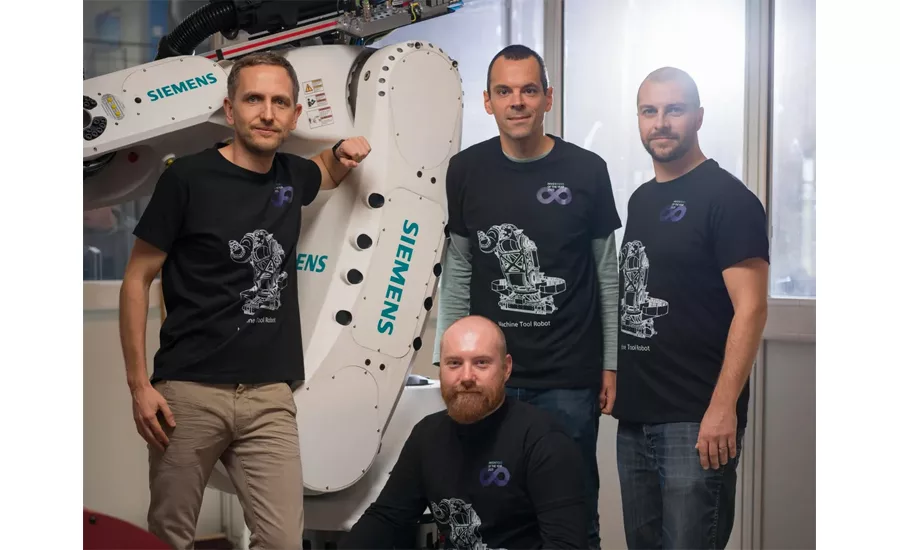
STADE, Germany—Robots are great tools for manufacturing and assembly processes that require motion, such as cutting, welding, dispensing, sanding and painting. They are less good at machining solid steel or following complex milling paths. That’s because what robots offer in flexibility, they lack in stiffness.
A new technology developed by researchers at Siemens and the Fraunhofer Institute for Manufacturing Technology and Advanced Materials (IFAM) promises to overcome that limitation. Their new hybrid drive literally gives robots new power, without sacrificing precision.
The concept is based on combining two fundamentally different types of drive: direct drives work with high precision and speed, but are too heavy and too expensive to be used as the sole drive system of a robot. Indirect drives are robust and powerful, but less sensitive. By intelligently combining both systems in a single drivetrain, a hybrid drive is created that offers the best of both. The result is a robot that remains stable, with minimal vibrations, even at high feed rates. The technology enables a six-axis robot to approach the precision of classic machine tools.
“This invention enables a robot to both add material and remove material. In other words, we have 3D printing and milling in one system. A component is created layer by layer and then expertly refinished without the need to re-clamp or change machines. Ultimately, the robot becomes a kind of Swiss Army knife for manufacturing—depending on the task, it can print, mill or repair,” explains David Bitterolf, senior expert for mechatronic systems at Siemens and one of the researchers involved in the project. “This not only saves time, energy and costs, but also space in manufacturing. At the same time, processes become more flexible and sustainable.”
The technology is already being tested in pilot projects with several manufacturers. The goal is to demonstrate that robots with the new drive can reliably follow paths even in demanding machining tasks. The technology could enable small- and medium-sized enterprises to create more compact, efficient manufacturing cells that combine additive and subtractive processes.
The new drive architecture opens up groundbreaking possibilities in robot axis control. The researchers are working on optimizing the algorithm and examining how the hybrid principle can be transferred to other machine classes. The goal is a new generation of robots that combine maximum path accuracy with precision, versatility and sustainability in machining processes.Looking for quick answers on assembly and manufacturing topics? Try Ask ASM, our new smart AI search tool. Ask ASM
Looking for a reprint of this article?
From high-res PDFs to custom plaques, order your copy today!