Real-Time Measurement Method Extends EV Battery Lifespan
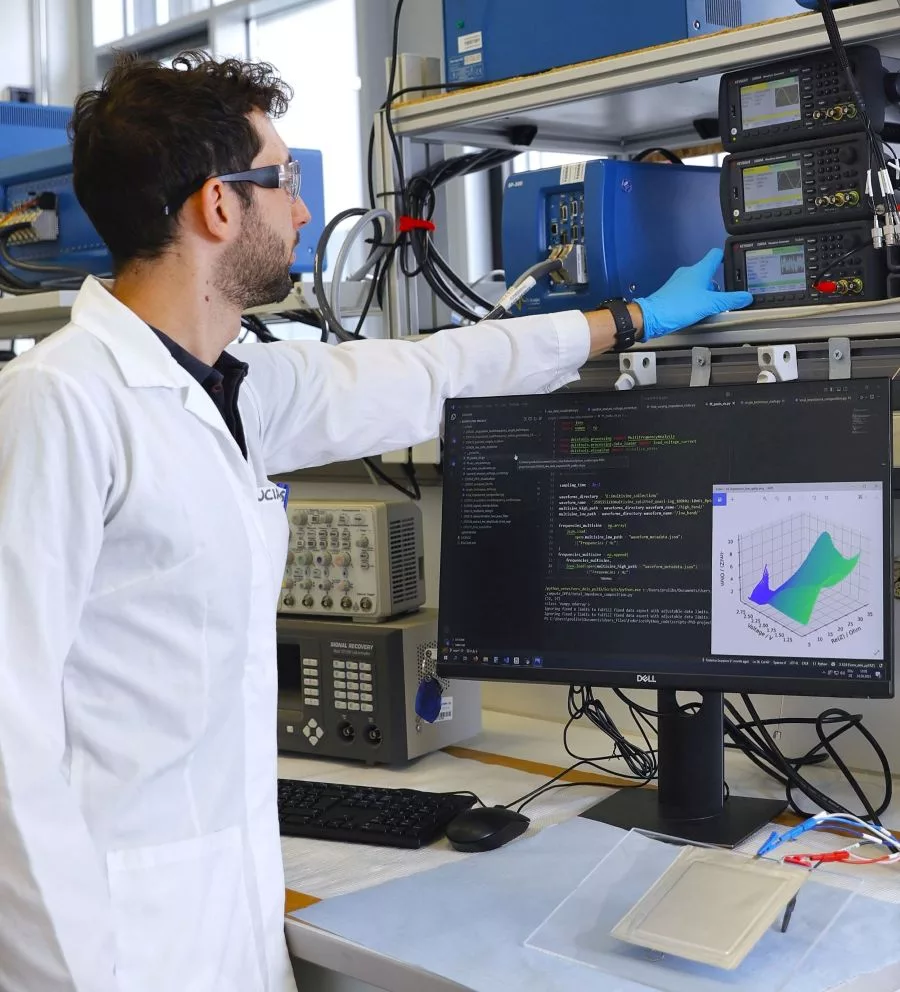
Engineers have developed a process for optimizing battery management systems in electric vehicles. Photo courtesy Fraunhofer Institute for Manufacturing Technology and Advanced Materials
BREMEN, Germany—Engineers at the Fraunhofer Institute for Manufacturing Technology and Advanced Materials (IFAM) have developed a process for optimizing battery management systems in electric vehicles. Their goal is to make batteries safer and extend their lifespans.
Traditionally, the most effective way to measure a battery’s capacity and state is impedance spectroscopy. Impedance, which provides information on a battery state of charge, cannot be measured directly; instead, it is calculated from the relationship between current and voltage.
However, collecting all the necessary data requires time-consuming measurements and analytical methods. On top of that, measuring impedance has only been possible in a resting state so far. It can typically take as much as 20 minutes before the data needed to characterize the battery is ready and available.
Fraunhofer IFAM engineers developed dynamic impedance spectroscopy technology, which makes it possible to calculate measurements in real time. It provides a detailed, accurate and in-depth picture of what is going on inside a battery. It’s faster and more accurate than alternative methods.
“Dynamic impedance spectroscopy opens up new possibilities for optimizing battery management, thereby extending the batteries’ lifespan,” says Hermann Pleteit, Ph.D., a Fraunhofer scientist who is leading the R&D project. “It also paves the way for these batteries to be used in safety-critical applications.”
The discharging or charging current is overlaid by a multi-frequency test signal. The different frequencies make it possible to draw conclusions regarding the status of certain components or processes inside the battery. The response signal from the current and voltage is measured up to 1 million times a second.
All of the data from the high-resolution measurement method flows into a data processing system that is running at the same time. A software program uses this information to calculate the evolution of the impedance values and then make inferences concerning the state of the relevant battery cell.
Looking for quick answers on assembly and manufacturing topics? Try Ask ASM, our new smart AI search tool. Ask ASM
To obtain results in real time in spite of the vast volume of data generated by the high-resolution measurements, Pleteit and his colleagues devised a clever trick: “We developed algorithms that significantly reduce the volume of data before the analysis without dropping relevant information,” he explains. “In line with these advances, real-time control of all aspects of the battery’s state through impedance spectroscopy offers significant advantages.”
According to Pleteit, battery management systems can use the impedance data to immediately register when a cell becomes locally overheated while driving. Then, they simply turn that cell off or reduce the power. This eliminates the need for conventional temperature sensors, which are placed on the outside of the battery cell and register thermal issues with a delay.
“There are also advantages to EV chargers,” claims Pleteit. “For example, this technology could be used to decide between extra-fast charging and charging that is slower, but also reduces battery wear.
“During a brief pause at a rest stop, the battery management system charges the battery quickly, while also ensuring that there are no dangerous temperature spikes and the internal components are not unduly stressed,” says Pleteit. “If the vehicle is plugged into a charger for several hours, the management system charges the battery slowly to reduce wear and extend its lifespan.”
Impedance spectroscopy technology can be used with a variety of chemistries, including lithium-ion, lithium-sulfur, sodium-ion and solid-state batteries.
Looking for a reprint of this article?
From high-res PDFs to custom plaques, order your copy today!


.webp?height=200&t=1755548746&width=200 "Battery-pack failure modes")