Assembly Lines
Dürr Unveils Robot System That Prints Designs Directly on Car Bodies
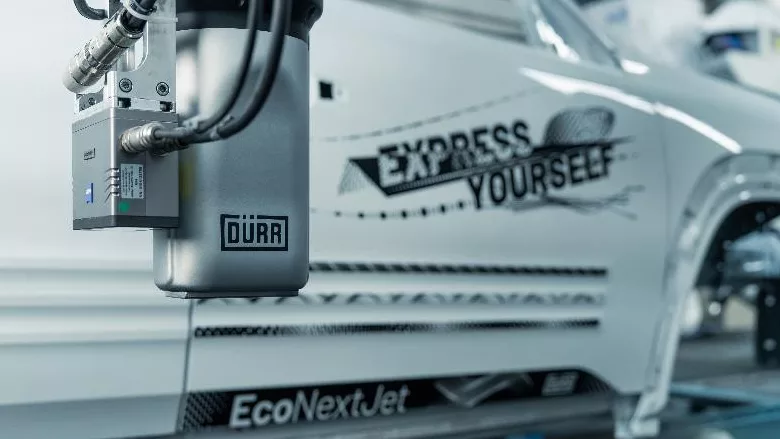
SOUTHFIELD, Mich. — Dürr is rolling out a new high-resolution paint application system that lets automakers print complex graphics, patterns and lettering directly onto vehicle bodies, replacing the manual step of gluing on films and decals.
The system, called EcoNextJet, integrates custom designs into the paint shop process and is aimed at automakers responding to growing demand for vehicle personalization.
Until now, custom paint patterns often required workers to apply multi-layer films by hand — a labor-intensive step that can create visible edges and generate difficult-to-recycle waste, Dürr said.
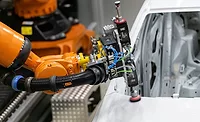
EcoNextJet uses drop-on-demand technology, attaching a printhead with 2,000 individually controllable nozzles to a painting robot. Each nozzle dispenses paint only when needed, producing what Dürr describes as a paper-thin image with about five micrometers of paint film thickness and resolution up to 720 dots per inch.
“The lines printed by EcoNextJet are as fine as a human hair,” said Timo Beyl, manager of new technologies at Dürr. After clear coating, he said, “you can’t feel it anymore.”
Dürr said the printhead can apply two colors at the same time and uses the same paint used elsewhere on the vehicle, which the company said helps simplify the process and maintain consistent finish quality.
A software program developed by Dürr controls the robot’s path and calculates the point of impact for each drop, including on convex and vertical surfaces.
Looking for quick answers on assembly and manufacturing topics? Try Ask ASM, our new smart AI search tool. Ask ASM
EcoNextJet was developed in partnership with paint manufacturer Axalta and printhead manufacturer XAAR. Dürr handled process integration, robotics and software.
“Our customers want their designers to have more freedom, especially when it comes to high-resolution graphics,” said Frank Herre, director of automotive paint shop at Dürr.
Dürr said the system is available for initial testing at its test centers in Michigan and Germany. The company said the film-free process can reduce waste and save labor time while expanding design options for manufacturers.
Looking for a reprint of this article?
From high-res PDFs to custom plaques, order your copy today!