Reversible Adhesives for Sustainable Manufacturing
A new class of reversible adhesives—hydrogels—are gaining attention for their tunability, elasticity and biocompatibility.
Permanent adhesives rely on strong interfacial chemical interactions and high cohesive strength, producing durable bonds that are not intended to be separated without damage. These adhesives are highly effective in structural applications, but pose challenges for disassembly, recycling or repairs.
Reversible adhesives, by contrast, exploit dynamic and weaker interactions, such as hydrogen bonding, ionic crosslinks, metal-ligand coordination or supramolecular host-guest complexes. Other formulas incorporate stimuli-responsive mechanisms that enable controlled debonding.
Either way, the central challenge lies in balancing adhesion strength with reversibility: The adhesives must provide sufficient interfacial strength for practical use, while still allowing clean, on-demand detachment. This functional trade-off has motivated increasing interest in soft, dynamic materials, such as hydrogels, which combine tunable chemistry, reversible crosslinking and environmental responsiveness. As a result, hydrogels have emerged as a promising platform for sustainable and reversible adhesives.
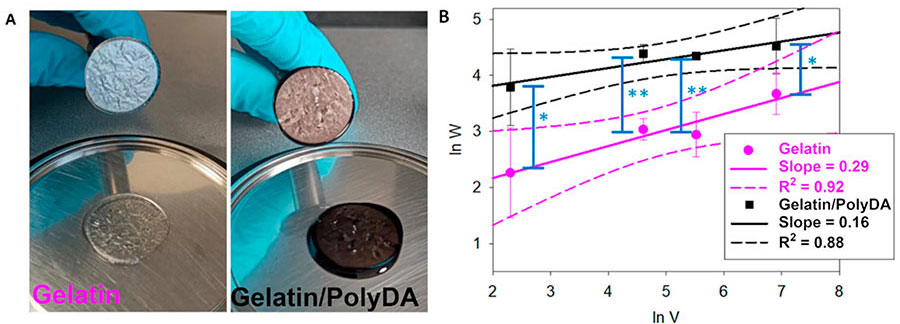
Hydrogel adhesives operate through a combination of interfacial adhesion and bulk dissipation. This behavior is illustrated here, using a representative system from a catechol-based hydrogel adhesive, obtained by combining gelatin and polydopamine (PolyDA), in which adhesion strength extracted from rate-controlled pull-off tests increases sharply with loading rate. The photographs (left) show the cohesive nature of gelatin hydrogels: with and without PolyDA. The graphs (right) show the logarithm of the tensile work per unit area, as a function of the peeling rate. Illustration courtesy University of Florence
Discovered in the 1960s, hydrogels are three-dimensional polymer networks capable of retaining large amounts of water within their structure. They are fabricated through crosslinking polymer chains to form stable networks.
To create hydrogels, two crosslinking methods are employed: physical and chemical. Physical crosslinks arise from non-covalent interactions, such as ionic interaction, hydrogen bonding, crystallization and hydrophobic interactions. They can also result from thermally induced sol-gel transitions, based on lower or upper critical solution temperatures, or from ultrasonication-mediated phase transitions.
Chemical crosslinks involve covalent bonding mechanisms, including photo-polymerization, enzyme-induced crosslink, and various “click” chemistry reactions, including Michael type-addition, Diels-Alder cycloaddition, oxime formation and Schiff base formation.
Hydrogels can be synthesized from a wide range of precursors, including natural polymers, such as alginate, chitosan, gelatin or hyaluronic acid; chemically modified biopolymers; or synthetic polymers, such as polyacrylamide, polyethylene glycol and polyvinyl alcohol. This versatility allows precise control over their chemical composition, degradation profile and mechanical performance.
Looking for quick answers on assembly and manufacturing topics? Try Ask ASM, our new smart AI search tool. Ask ASM
The reversible nature of hydrogels arises not only from their dynamic chemistry, but also from the interplay between interfacial interactions and bulk mechanical behavior. In this context, it is useful to distinguish the two main contributions that govern hydrogel adhesion.
Hydrogel adhesives operate through a combination of interfacial adhesion, which is driven by surface chemistry, wetting and displacement of interfacial water layers, and bulk dissipation, which is governed by viscoelastic losses, reversible sacrificial bonds and network architecture.
The balance between these mechanisms depends on loading mode and environmental conditions. For example, peel tests largely reflect dissipative energy release within the hydrogel matrix and often result in cohesive failure, whereas tack tests at short contact times are more sensitive to interfacial bond formation and frequently exhibit adhesive failure. Lap-shear tests probe both contributions simultaneously, with the observed failure mode dictated by network toughness and interfacial bonding quality.

This illustration summarizes the main adhesion mechanisms of hydrogels: (a) mechanical interlocking, (b) wet adhesion, (c) diffusion theory, (d) Van der Waals force, (e) hydrogen bond, (f) ionic bond, (g) covalent bond and (h) coordination complex. Illustration courtesy University of Florence
Because these behaviors depend on dynamic bonding, the kinetics of reversible motifs play a central role in determining macroscopic adhesion. The characteristic relaxation time (t) or association (kon) and dissociation rates (koff) set the timescale for reversible vs. dissipative responses. When deformation is slower than 1/t, reversible bonds reorganize during loading, producing moderate adhesion and reversible-set behavior. At rates faster than 1/t, bond rupture becomes effectively irreversible, yielding higher peak forces and dissipative, often cohesive, failure.
Plotting adhesion strength against pulling rate (rate x t) defines a characteristic triggerable debonding window, showing how hydrogel adhesion can be modulated by strain rate. Such rate-dependent adhesion trends have been reported across diverse hydrogel adhesives, where measurements of pull-off force or peel energy as a function of deformation rate reveal characteristic interfacial and bulk-dominated properties.
This mechanistic framework links hydrogel structure and bonding dynamics to macroscopic performance. Therefore, from an adhesive perspective, hydrogels present several intrinsic advantages. Their low polymer-chain density imparts softness and flexibility, depending on polymer composition and concentration, crosslinking density, swelling ratio, temperature, presence of additives, and other factors. Their high water content ensures hydration, facilitates ion and molecule diffusion, and supports stimuli-responsive behavior.
The hydrated networks also form intimate contact with wet or irregular surfaces, an essential feature for biomedical applications where traditional adhesives often fail. Moreover, by tailoring their molecular design through the incorporation of dynamic bonds, functional motifs or hybrid backbones, hydrogels can achieve reversible and strong yet reversible adhesion.
Effective adhesion depends on the interplay among bond chemistry, interfacial topology and the surface properties of the substrates.
Formulations for Sustainability
Conventional adhesives have historically prioritized performance, such as strength, durability and versatility, over environmental responsibility. Most adhesives are derived from petrochemical feedstocks and often contain volatile organic compounds (VOCs), toxic curing agents or non-degradable polymers. These adhesives have significant drawbacks, including high environmental persistence, limited recyclability and potential occupational and environmental hazards.
The growing emphasis on green chemistry and the circular economy has redirected research toward sustainable adhesives, seeking materials that balance bonding performance with renewability, recyclability and reduced toxicity. However, despite technical advances, economic factors have limited their large-scale commercialization.

This illustration shows the various applications for hydrogel adhesives based on adhesion strength and reversibility performance. Illustration courtesy University of Florence
Sustainable formulations increasingly employ:
- Natural polymers, such as polysaccharides (cellulose, starch or chitosan) and proteins (gelatin or soy).
- Polyesters derived from renewable monomers (polylactic acid or polyhydroxyalkanoates).
- Polymers obtained through microbial fermentation (polyhydroxy-butyrate or polyhydroxy-valerate).
Significant progress has also been achieved by eliminating VOCs in pretreatment steps and replacing solvents with aqueous formulations.
These bio-inspired strategies not only replace fossil-derived components, but also introduce intrinsic features such as biodegradability, and potential features such as self-healing and responsiveness to environmental stimuli. Nevertheless, bio-based polymers often suffer from lower mechanical stability, batch-to-batch compositional variability, and limited long-term durability when compared to synthetic analogues.
For these reasons, hybrid adhesives integrating renewable or degradable segments within synthetic matrices have emerged as promising alternatives that balance performance, cost and sustainability.
Sustainability must consider the entire material life cycle, from synthesis to disposal. Ideally, sustainable materials should be derived from a renewable source, enable recycling or reuse, and exhibit low toxicity and optimal biodegradability.
Traditional thermoset adhesives are irreversibly crosslinked, preventing the separation and recycling of bonded components. In contrast, recent developments in chemically recyclable or stimuli-debondable adhesives allow controlled disassembly.
Similarly, biodegradable adhesives play a crucial role in biomedical and environmentally transient applications, where materials must safely degrade after use. Hydrogels derived from natural polymers are highly biocompatible and biodegradable, typically degrading through hydrolytic or enzymatic pathways and leaving minimal residues.
Obviously, sustainability must be context-dependent. Some applications can benefit from natural polymers or recyclable formulations, others will still require synthetic formulations to ensure durability, stability or regulatory compliance.

Inspired by nature, researchers have developed new hydrogel adhesives based on mussels, gecko feet and the suction cups on octopus tentacles. Illustration courtesy University of Florence
Adhesion Testing
Quantitative assessment of adhesion performance is crucial for correlating material design with practical function. Adhesion is an inherently interfacial phenomenon that depends not only on the chemical nature of the adhesive and substrate, but also on viscoelasticity, surface roughness, contact time and environmental conditions.
For hydrogel-based reversible adhesives, these dependencies are further complicated by the dynamic nature of water-mediated interactions and environmental responsiveness. Consequently, reliable characterization requires integrating classical adhesion tests with surface-sensitive and dynamic analytical techniques that capture both macroscopic and molecular contributions to adhesion and reversibility.
Conventional mechanical tests remain the foundation for quantifying adhesive strength. These methods are standardized and allow comparisons across different formulations and substrates. Importantly, their implementation relies on precise mechanical instrumentation, typically universal testing machines, texture analyzers, or microforce testers, which enable controlled loading and accurate force-displacement measurements.
Peel tests measure the force required to separate an adhesive layer from a substrate at a controlled rate and angle, typically 90 or 180 degrees. For hydrogel-based adhesives, which are often soft and hydrated, the peel test provides insight into wet adhesion mechanisms and the role of polymer chain mobility. Peel resistance can vary significantly with peeling rate and water content, highlighting the interplay between reversible bonding and dissipative energy losses.
Tack measures the instantaneous adhesion developed upon brief contact under low pressure and is particularly relevant for skin patches, biomedical interfaces and soft robotic applications. Hydrogels with fast-forming reversible bonds can display high tack yet maintain reversibility, making this test ideal for quantifying rapid, repeatable adhesion.
Shear tests evaluate resistance to parallel forces at the interface, providing a measure of cohesive strength under sustained load. Lap shear geometries are especially useful for assessing load-bearing or structural performance. For reversible hydrogels, cyclic shear or step-strain tests can reveal hysteresis, stress relaxation and self-recovery behavior, properties that directly connect mechanical performance to reversibility and dynamic bonding.
Although not strictly considered as adhesion tests, uniaxial tensile and compression measurements provide valuable information about bulk mechanical integrity and deformation behavior, both of which influence adhesive performance. For hydrogels, such measurements are essential to assess the interplay between network elasticity, water content and reversible bonding.

Hydrogel adhesives show promise in wound-healing applications. This diagram shows how an injectable Gel-CS hydrogel can be used for shape-adaptive, reversible tissue adhesion, even in highly acidic gastric environments. Illustration courtesy University of Florence
Surface and Interfacial Characterization
While mechanical tests provide quantitative measures of adhesion strength, a deeper understanding of the underlying adhesion mechanisms requires investigation of the interfacial region at the micro- and nanoscale. Adhesion originates from a complex interplay of physical, chemical and topographical factors at the contact interface, which cannot be fully captured by bulk measurements alone.
Fortunately, a variety of analytical techniques are available for this purpose.
Atomic force microscopy (AFM) measures nanoscale adhesion forces between a probe and surface, allowing direct quantification of single-bond interactions or mapping of adhesion heterogeneity. For hydrogels, AFM can reveal the contribution of specific reversible motifs, such as hydrogen bonding, π-π stacking, or metal-ligand coordination to total adhesion energy.
Contact angle measurements provide information on surface wettability and energy, influencing initial contact and bonding strength. Dynamic contact angle hysteresis can capture how water migration or swelling alters adhesion over time, an especially critical factor for hydrogels where interfacial hydration governs performance.
Rheological characterization quantifies the viscoelastic balance between storage and loss moduli. Time-temperature superposition and frequency sweeps provide insight into bond dynamics and recoverability. The ability of a hydrogel adhesive to dissipate and restore energy under cyclic strain directly correlates with reversible adhesion capacity.
Spectroscopic methods such as Fourier transform infrared, Raman, or X-ray photoelectron spectroscopy can identify chemical changes at the interface, including oxidation of catechols, ion exchange, or polymer rearrangement during adhesion and debonding. Confocal or fluorescence microscopy enables visualization of diffusion processes or interpenetration between adhesive and substrate, particularly for hydrated biological tissues.
Other valuable methods include micro- and nano-indentation and rheology for probing local mechanical heterogeneity, scratch and fracture testing for evaluating wear and failure mechanisms, and in situ optical or scattering techniques for observing interfacial evolution during adhesion and debonding. The study of water properties through spectroscopical or thermal analyses can also be useful, as it plays a key role in determining the final structural and characteristics of hydrogel.

This illustration shows how hydrogel adhesives can be used to create an electronic sensor that can be attached to the skin. Illustration courtesy University of Florence
Metrics for Reversibility and Reusability
Beyond measuring absolute adhesion strength, evaluating the reversibility and reusability of hydrogel adhesives is essential for understanding their functional lifetime and sustainability. Reversible adhesion implies that the adhesive can undergo repeated bonding and debonding cycles without significant loss of performance or structural integrity. Quantitative metrics are therefore needed to assess fatigue resistance, recovery, and environmental stability.
Reversibility is commonly quantified by performing repeated adhesion-debonding cycles under identical conditions while monitoring changes in peak adhesion force or work of separation. The adhesion retention ratio, defined as the percentage of initial adhesion maintained after a given number of cycles, is a straightforward indicator of reusability. Cyclic tests can be implemented in peel, tack or shear configurations. For hydrogel-based adhesives, performance typically depends on reversible network dynamics and water retention.
Long-term mechanical durability can be probed through cyclic loading or sustained shear tests to evaluate fatigue life and creep behavior. Reversible hydrogels that rely on dynamic covalent or supramolecular bonds often exhibit time-dependent recovery, which can be characterized by tracking residual deformation, energy dissipation or hysteresis reduction over successive cycles.
Hydrogels are highly sensitive to environmental factors such as humidity, temperature, pH and ionic strength. Stability testing under controlled environmental chambers or rheo-mechanical setups can reveal the influence of these parameters on adhesion retention. Reporting adhesion metrics before and after environmental exposure provides insight into practical performance and lifetime.
In dynamic or supramolecular hydrogels, the ability to restore adhesion after mechanical damage or debonding can be quantified using recovery efficiency, typically expressed as the ratio of recovered to initial adhesion strength after a resting period. Complementary rheological measurements of modulus recovery after large strain can support these observations, linking macroscopic reversibility to molecular-level dynamics.

This illustration shows the results of tests for measuring interfacial toughness (top), shear strength (middle), and tensile strength (bottom) of hydrogel adhesives. Illustration courtesy University of Florence
Latest Developments
Hydrogels have long attracted attention for their exceptional combination of biocompatibility, elasticity, and intrinsic self-healing capability. Their high water content and soft, hydrated structure closely mimic the extracellular matrix, making them ideal for biomedical applications, such as drug delivery, wound dressings and tissue regeneration scaffolds.
Beyond these traditional domains, recent advances in tough, stimuli-responsive, and optically tunable hydrogel adhesives have broadened their utility to antibacterial fibers, soft robotics, wearable sensors and flexible electronics.
The latter are particularly intriguing application. Hydrogel-based adhesives are revolutionizing soft robotics, flexible sensors and wearable bioelectronics, where strong yet reversible bonding, stretchability and conductivity are critical. Flexible electronics have become essential in human health monitoring and diagnostics, capable of detecting physical signals and electrophysiological signals.
Conductive hydrogels integrate 3D hydrated polymer networks with electronic or ionic pathways, enabling them to serve as both structural scaffolds and functional sensors. Compared to traditional metal-based stretchable sensors, hydrogel adhesives provide tissue-like mechanical properties, self-healing capability and biocompatibility, making them ideal for human-machine interfaces. These smart hydrogels can convert external stimuli—including heat, pressure, voice, strain and light—into measurable electrical signals, while maintaining high stretchability, sensitivity, light weight, potential self-healing, flexibility and biocompatibility.
Recent progress in hydrogel adhesives has increasingly focused on physically responsive adhesives that allow controlled detachment through external triggers, such as temperature changes, near-infrared irradiation or UV exposure.
Editor’s note: This article is a summary of a longer research paper. To read the entire paper, click here.
For more information on adhesives, read these articles:
Adhesive Bonding: Thermally Removable Adhesive Bonds
Reversible Adhesive Facilitates Repairs, Recycling
Dual-Cure Potting Compound and Other New Bonding Products
Looking for a reprint of this article?
From high-res PDFs to custom plaques, order your copy today!