Assembly Lines
Sensor System Automatically Monitors Human-Machine Interaction
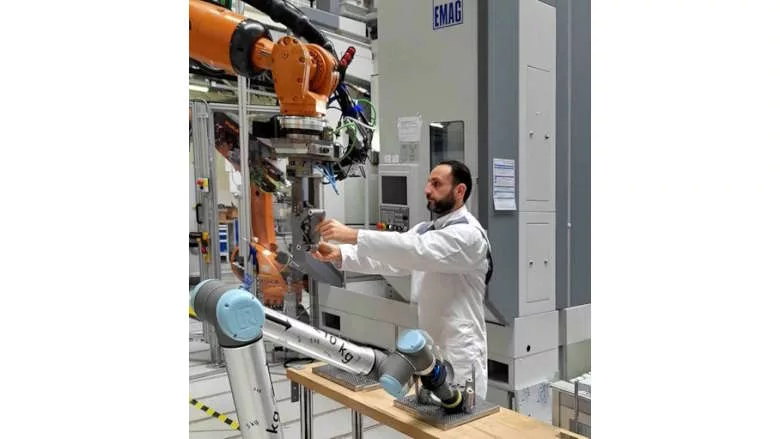
The NeurOSmart technology platform combines sensor technology with AI-supported data processing and energy-efficient chips that mimic the way the human brain works.
ITZEHOE, Germany—Engineers at the Fraunhofer Institute for Silicon Technology (ISIT) recently developed a system that enables close collaboration between humans and robots. NeurOSmart combines several technologies, including a lidar system that continuously monitors shared workspaces; AI-supported chips that evaluate signals directly in the sensor system; and neuromorphic chip technology that functions like a human brain.
“Collaboration with the machine is risk-free for humans,” says Shanshan Gu-Stoppel, Ph.D., head of optical systems at Fraunhofer ISIT. “The sensor system monitors the area in which humans and robots move from a bird’s eye view.”
Movable microelectromechanical system mirrors project the laser across the entire work area and generate a high-resolution 3D image. A key feature of NeurOSmart is the direct integration of data processing into the sensor system.
AI-based algorithms bundle the incoming signals and identify areas of special interest in the scene. The sensor can then be precisely aligned for subsequent analyses, saving power and reducing the data rate. The next step, comprising actual evaluation of the data that serves as the basis for controlling the robot, is also performed directly in the sensor system.
The Fraunhofer engineers are focusing on the concept of neuromorphic computing and have developed a special accelerator chip. The processor consists of many small computing units that are interconnected on a wafer in a matrix. Each chip acts as a thinking cell and makes its own decisions. This technology is based on the way the human brain works.
Only a few milliseconds elapse between signal reception, evaluation and the mechanical response of the robot arm. This enables safe collaboration, even with heavy-duty robots, which the AI slows down or stops when a person comes too close to it. By simulating the entire robot cell, the engineers were able to simulate hazardous situations for training purposes that cannot be replicated in real life.
Looking for quick answers on assembly and manufacturing topics? Try Ask ASM, our new smart AI search tool. Ask ASM
Looking for a reprint of this article?
From high-res PDFs to custom plaques, order your copy today!