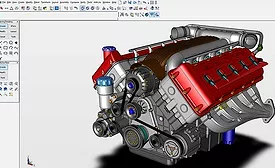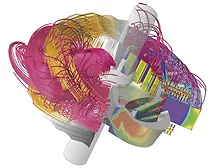
STOCKHOLM—Hexagn AB and JSOL Corp. have formed a strategic partnership to to accelerate EV power train design with virtual prototyping and multi-physics simulation.
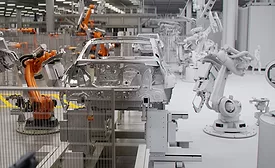
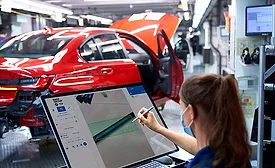
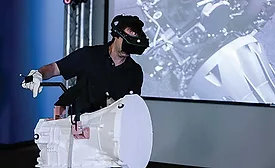
MUNICH—Simulation is helping BMW design assembly lines at the company’s new factory under construction in Debrecen, Hungary, more than two years before the scheduled official launch of series production.
BMW has been at the forefront of Industry 4.0 for years. For example, the company was an early adopter of additive manufacturing, and today prints hundreds of thousands of production parts annually.
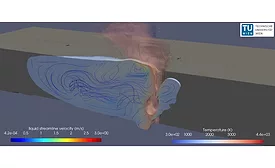
VIENNA—Researchers at the Technical University Wien (TU Wien) here have developed multiphysics software that can simulate the ability of dynamic beam lasers from Civan Advanced Technologies Ltd. to weld various materials.
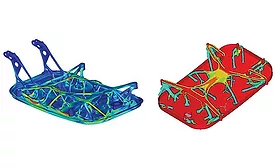
Computer-aided-design (CAD) software has a been friend to part designers and manufacturing engineers for decades, which is old news. The good news is this type of software is friendlier than ever, enabling both specialists to perform functions ranging from analyzing the strength of an assembly, to determining the best design for a given set of parameters.
To survive in today's new world of technology, mobility and market changes, the automotive supply chain has no choice but to perform future scenario planning for the long term.
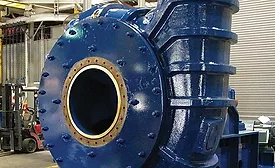
Manufacturers in agriculture, mining, petroleum and other industries rely on centrifugal slurry pumps to move thick, particle-filled liquids. These heavy-duty pumps feature a rotating impeller that uses centrifugal force to move water and solids through pipelines over short and medium distances.
The appeal of 3D printing is strong and growing among manufacturers in all sectors. For those in the aerospace industry, this technology offers a way to quickly and economically produce lighter parts that reduce airplane mass and fuel consumption.
In my first job after I received my engineering degree, I was designing hardware and writing software for embedded products for industrial applications. I had a simulator for the microcontroller.
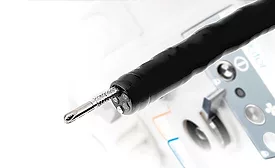
Bringing a medical device to market is a daunting prospect for even the largest manufacturers. There's nurturing a concept from prototype to finished product; determining how and where to manufacture it; conducting trials for safety and efficacy; and getting FDA approval.