LONDON—A new consortium called ASCEND (Aerospace and Automotive Supply Chain Enabled Development) has been established to accelerate composite material technologies used in next-generation vehicles.
DARMSTADT, Germany—Engineers at the Fraunhofer Institute for Structural Durability and System Reliability have developed a lightweight battery pack made out of carbon-fiber composites that weighs 40 percent less than traditional aluminum enclosures.
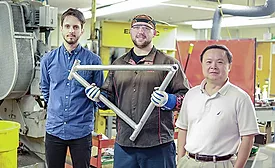
MIAMISBURG, OH—Allite Inc., a materials supplier specializing in lightweight products, has partnered with Weis Manufacturing to codevelop the first racing bicycle frame made entirely from the magnesium.
LOS ANGELES—Engineers at the University of California, Los Angeles (UCLA) have developed a way to weld an aluminum alloy that was difficult to join in the past.
If it rolls, floats or flies, lightweighting is one of the biggest challenges facing manufacturers today. The push for new materials is forcing engineers in a variety of industries to explore cost-effective alternatives and develop new assembly processes.
For the past decade, carbon-fiber composites have been the darling of the aerospace sector, receiving countless praise and widespread attention. Reinforced polymers have dramatically changed the way that many types of airframes are designed and built.
Efforts to reduce vehicle weight have mostly focused on aluminum, plastics and composites, but another lightweight material is also getting attention: magnesium. The ninth most abundant element in the universe, magnesium is as strong as steel, but 33 percent lighter than aluminum, 60 percent lighter than titanium, and 75 percent lighter than steel.
Back in the day, engines were the exclusive domain of cast iron and steel. But, during the past decade, more lightweight materials, such as aluminum and hard thermoplastics, have been slowly creeping under the hood. The Holy Grail, an engine made almost entirely out of plastic, is finally close to reality.