Assembly Lines
Humanoid Robotic Welders to Tackle Shipyard Automation
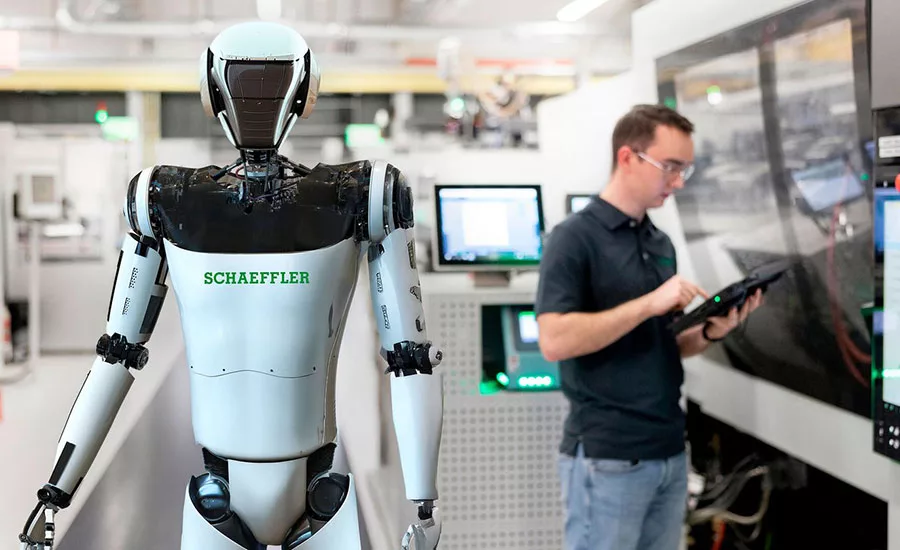
Humanoid robots are being developed for use in shipyards and other manufacturing environments.
Photo courtesy Schaeffler Group
HOUSTON—Shipyards depend on an army of skilled welders to build aircraft carriers, container ships, ferries, tankers, submarines and other vessels. However, like all industries, they are facing a severe labor shortage.
HD Korea Shipbuilding & Offshore Engineering (HD KSOE) and HD Hyundai Robotics believe that humanoid robots are the answer. In conjunction with Persona AI, they are developing bipedal machines specifically designed for shipyard welding tasks.
The goal is to enhance productivity and improve workplace safety in shipyards. The initiative will deliver prototype humanoids by the end of 2026, with field testing and full commercial deployment scheduled to begin in 2027.
Persona AI will lead the development of humanoid hardware, in addition to AI-based control and learning algorithms. Vazil will develop the welding tools and build the industrial testing environment. HD KSOE will support deployment in live shipyard settings and provide field engineering data. HD Hyundai Robotics will contribute welding-path AI training data and performance validation.
“Welding humanoids will not only boost productivity, but also significantly reduce the burden on workers and greatly enhance safety,” says Dong-ju Lee, senior vice president of HD KSOE. “By developing robots optimized for shipyard tasks, we aim to set a new paradigm in shipbuilding automation. Our goal is a smart shipyard where humans and intelligent robots collaborate seamlessly.”
“As heavy industry faces growing labor constraints—especially in high-risk trades like welding—the need for rugged, autonomous humanoid robots is more urgent than ever,” claims Nicolaus Radford, CEO of Persona.
“By developing humanoids capable of precision welding, we will elevate shipyard automation to the next level,” adds Sungwon Kim, chief technology officer at Vazil.
Looking for quick answers on assembly and manufacturing topics? Try Ask ASM, our new smart AI search tool. Ask ASM
However, despite all the hype and widespread interest in human-machine collaboration, demand for humanoids may not as fast as some people think. A recent report by Interact Analysis predicts the market will grow relatively slow, reaching over 40,000 units by 2032 with a revenue of $2 billion.
“The humanoid robot market is currently experiencing substantial hype, fueled by a large addressable market and significant investment activity,” explains Rueben Scriven, research manager at Interact Analysis. “However, despite the potential, our outlook remains cautious due to several key barriers that hinder widespread adoption, including high prices and the gap in the dexterity needed to match human productivity levels.”
According to Scriven, other challenges to widespread adoption of humanoids include regulatory and safety concerns, dexterity limitations, cost and questions over whether humanoid configuration are the optimal form-factor for most AI-enabled robotic tasks and applications.
Although the majority of components used to create humanoid robots have been developed in-house, Scriven predicts there will be a gradual standardization of form-factors as the market matures. “The need for small, lightweight and highly integrated components with very high torque density has necessitated in-house production, but components will slowly shift to being off-the-shelf,” he explains.
Given the relative immaturity of the market at present, Scriven has observed significant diversity in design trends, with small humanoid robots often equipped with planetary drives and wider variation with larger, adult-height robots. There are also regional variations, with many Chinese vendors favoring high-speed motors with harmonic reducers for most joints and more robust, cost efficient high-torque motors with planetary gearboxes for key areas such as hip joints.
At the recent Hannover Messe trade show in Germany, Schaeffler Group displayed a variety of off-the-shelf components that can be used to assemble humanoid robots, such as linear and rotary drives. The Tier One automotive supplier has already developed electric motor and power electronics that can be used to drive humanoid limbs and joints.
For instance, a lightweight variant and more compact design variant of the XZU bearing has been developed by Schaeffler specifically for the humanoid market. “Thanks to improved friction behavior and high tilting rigidity, these bearings allow the movements of humanoid systems to be controlled more efficiently and precisely,” says David Kehr, president of humanoid robotics at Schaeffler.
“[We are] transferring proven technical solutions to humanoid robots, and in doing so is systematically driving their ongoing development,” explains Kehr. “Our goal is to be a strong technology partner to manufacturers of humanoids.”Looking for a reprint of this article?
From high-res PDFs to custom plaques, order your copy today!