Dispensing Cyanoacrylates
The key to cost-effective bonds with these adhesives is putting the right amount in the right place.
Cyanoacrylate adhesives (CA) quickly form tough and durable bonds with a wide variety of substrates including plastics, metals, ceramics and glass. Furthermore, no mixing, refrigeration or special handling-other than respecting the caustic nature of CAs-is required.
The high bond strength and rapid cure rate without the need for heat, light or catalysts have led to widespread use of CAs in a number of industries, including electronics and medical device assembly. For example, their rapid cure rate is often advantageous where fast-tack fixturing is a priority. On the other hand, they can be particularly difficult to dispense with precision and repeatability. Continuous improvement in dispensing systems is allowing CAs to penetrate new assembly markets, especially where cost, cure speed, precision and repeatability are paramount.
Cyanoacrylates are one-part acrylic resins that cure rapidly in the presence of moisture, in particular, the hydroxide ions that exist in water. CAs are available in a wide range of viscosities, from thin fluids to viscous gels, to meet a wide variety of specific needs. Many component assembly applications call for a CA with very low viscosity, such as a medical device that requires wicking, or capillary action, to draw the adhesive into a bonding area between mating components. One such example is an elbow being fitted and bonded onto tubing.
At the other end of the spectrum, a CA in the form of a very viscous gel might be required to fill a gap, in which case the material may incorporate an agent to reduce fixturing time and ensure a cure. Gels are available that can be used to fill gaps greater than 0.01 inch without the adhesive flowing out of the gap. Various agents are also available for toughening CAs to improve peel and impact strength, and for reducing brittleness when filling gaps.
In between these two extremes of viscosity are a host of other adhesive formulations for a multitude of applications including golf clubs, automotive components, appliances and electronic assemblies. CAs can be used to form a bond tough enough for the most demanding application. For example, they can form a bond between a golf club head and the shaft that will withstand the centrifugal and impact forces created by the swing of the club and impact with the ball.
Cyanoacrylates bond especially well to metal, ceramic and glass surfaces--and also to tissue, which can be a benefit or a problem. CAs bond skin instantly and are commonly used to close incisions following surgery. On the other hand, inadvertently bonding fingers or eyelids can be an unpleasant experience. Note, however, that while CAs offer superb bond strength, they have low shear strength, so rubbing one finger against the other will usually help break the bond and free the fingers.
Toxicity should also be kept in mind. The vapor given off by a CA can be irritating to the eyes, mucous membranes and lungs. Good ventilation is essential for health reasons. It can also help control blooming, which can occur when the CA being dispensed volatizes in the presence of humidity and forms minute white crystals. Note, however, that blooming only affects appearance; it has no adverse effect on the quality of the adhesive bond.

The CA Challenge
The forte of cyanoacrylates is their rapid cure. Once exposed to moisture, polymerization begins immediately and the CA gels quickly. This rapid fixturing typically occurs within a minute or less. Reaching full bond strength, however, can take several hours or more, although it can be accelerated by heating.But because CAs cure rapidly in the presence of moisture, any moisture-including humidity in the ambient air-can be a concern in storing and using CAs. If moisture can infiltrate through the walls of a plastic applicator bottle, the adhesive can begin to cure inside well before the assembly process is complete. As a result, the adhesive can thicken to the point where it is difficult to dispense, especially with any degree of accuracy and consistency. In such instances, discarding the adhesive and its packaging may be the only available option.
Controlling the exposure to moisture determines the fixturing time for any given CA formulation. Without moisture, polymerization won’t begin and subsequent bonding cannot occur. Alternatively, curing can be accelerated with the use of agents such as acetone, which is found in nail polish remover, or toluidine, which is an organic compound used in manufacturing dye. However, accelerated curing usually results in some loss of bond strength.
Successful and cost-effective application of cyanoacrylates demands that the environment in which the adhesive is being stored and used must be tightly controlled. The adhesive must be kept in an air-tight container, with minimal exposure to the atmosphere-especially humidity. When dispensing CAs, condensation from refrigeration, perspiration, or just breathing on a surface can produce unanticipated problems. Moisture of any kind anywhere in the dispensing system-within a syringe, for example-can lead to unwanted polymerization and increased difficulty in dispensing the adhesive.
The Right Amount in the Right Place
Using a cyanoacrylate adhesive in a one-off manual application is easy; Geico’s Caveman could do it. However, dispensing cyanoacrylates cost-effectively in a manufacturing application is another matter entirely! The “golden rule” in dispensing a CA is that superior bonds are achieved with thinner, not thicker, layers of adhesive.Contrary to what one might think, more adhesive does not usually produce better results than less, unless insufficient adhesive is being dispensed. Excess adhesive is a waste of material and time. More importantly, excess adhesive may not cure correctly or might not cure at all. Consistently dispensing the thin and uniform coating that is required for a good bond is arguably the major challenge in using cyanoacrylates in production.
Cyanoacrylate adhesives have been dispensed from tubes or squeeze bottles for years, and they still are, particularly for consumer applications such as mending ceramics and assembling plastic models. Operating requirements in manufacturing are much more stringent, especially in terms of minimizing waste, which requires close control of how CAs are stored and dispensed.
Various types of dispensing systems have been adapted for dispensing CAs in manufacturing applications, including pinch tubes, diaphragm valves and pneumatic-actuated syringe dispensers. The viscosity of the CA formulation required, and the level of performance that can be accepted, are determining factors in choosing one of these systems for a particular application.
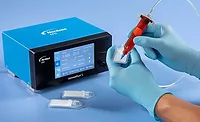
A recent development for dispensing CAs is the air-free syringe dispenser. The syringe and piston are made of polypropylene and polyethylene respectively, which minimizes air and moisture infiltration. The piston and tip cap are coated with a noncontaminating release agent to inhibit bonding between the adhesive and the plastic surfaces. This effectively eliminates premature curing of the adhesive that could restrict the motion of the piston in the syringe and cause variations in the shot output.
The air-free dispenser accommodates changes in viscosity during the dispensing process. The piston is advanced in the syringe by a linear actuator driven by a stepper motor in the gun. The linear drive system ensures that a specific volume of material is displaced during each dispensing cycle, including during ramp up and ramp down. Repeatability of ±5 percent can be expected for any selected shot size, and the minimum shot size is 0.00023 milliliter. A programmable end-of-cycle “draw-back” prevents dripping of the adhesive.
It is important to exercise great care at all times when working with cyanoacrylate adhesives. Prepackaged syringes of CA minimize the risk of inadvertent contact with the adhesive. That said, plastic gloves and safety glasses with eye shields are strongly recommended for personnel protection. The assembly area should also be well ventilated to minimize exposure to the pungent vapor given off by CAs.
Teflon tips must be used in dispensing CAs to prevent clogging, and to ensure the smooth flow of adhesive that is essential to precise applications. Even so, if the dispenser will not used for several hours, the tip should be removed and replaced with a tip cap to prevent moisture from permeating the adhesive exposed at the opening of the tip, which will inititate curing.
Looking for a reprint of this article?
From high-res PDFs to custom plaques, order your copy today!