Screwdriving & Riveting
60 Years of Assembly: Tools Work Smarter, Not Harder
Demand for ergonomics, controlled fastening and data gathering has driven innovation in power tools.
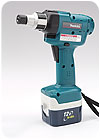
Electric and pneumatic fastening tools have come a long way since ASSEMBLY magazine debuted in 1958, evolving from big, heavy and dumb, to small, light and intelligent. In short, comparing today’s power tools with those of yesteryear is like comparing a Model T with a Lincoln Navigator.
During the past 60 years, every manufacturer of power tools has found innovative ways to meet the same three market demands: improved ergonomics, better fastening control, and increased traceability.

Ergonomics
Ergonomics is a watchword on today’s assembly lines, but it wasn’t always. Power tools didn’t start changing in terms of ergonomics until about 40 years ago. In the late ’70s, customers suddenly began demanding tools that were less heavy and more comfortable. (Perhaps not so coincidentally, the Occupational Safety and Health Administration opened its doors in 1971.)
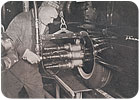
In the 1950s, assembly lines were mostly equipped with pneumatic tools. They looked like props from the early Flash Gordon movies. They were a lot slower than today’s tools. They were large, heavy and hard to hang on to. They were certainly not ergonomic.
“Today, we make tools to match the fastening application,” adds Robert Arthur, vice president of Michigan Pneumatic Tool Co. “Back then, tool companies took more of a one-size-fits-all approach.”
Arthur knows a thing or two about the history of power tools. His company got its start after World War II, buying air tools that were no longer needed to build tanks and P-38s, and then reselling them to manufacturers eager to make Fords and Frigidaires. Today, Michigan Pneumatic still maintains the largest inventory of used air tools in the world.
The sliding-vane rotary motor that powers today’s air tools emerged in the 1920s. Prior to that, air tools were piston-driven, says Arthur. The vane motor made air tools smaller, lighter and more powerful than the piston motor. However, they were still heavier than today’s air tools, primarily because the bodies of the tools were thick steel castings.
Advances in machine tools and precision metal cutting technology enabled power tool manufacturers to replace castings with machined parts made from strong, lightweight metals, such as titanium and aluminum. The development of high-strength plastics and composites allowed tool manufacturers to reduce the weight of their products even further-and improve comfort and ergonomics at the same time.
For example, Ingersoll Rand's premium pneumatic impact wrench weighs about 4 pounds, yet it delivers 50 percent more torque and power than previous tools.
Pulse tools, which were specifically designed to be ergonomic, were introduced in 1965. Pulse tools apply torque to a fastener through a series of a pulses from a hydraulic motor. “The pulse tool was probably the biggest innovation in power tools---at least for fasteners 6 to 10 millimeters in diameter,” says Arthur.
Electric tools followed a similar path to better ergonomics. In the 1950s, electric tools were powered by large, heavy motors. For example, an early miter saw from Makita USA Inc. had a cast iron base and weighed more than 75 pounds. “You saw a lot of ‘battleship’ tools on the market,” recalls Steven Tayler, Makita’s vice president of business development. “They were heavy and very durable, but over time, manufacturers focused on putting something a little more user-friendly in the operator’s hands.”
If the air motor in pneumatic tools hasn’t changed much in the past 50 years, the motors in electric tools have changed dramatically. “Duty cycle was an issue with early electric tools,” says Curt Logee, vice president of sales for Kolver USA (Westford, MA). “The motors would get pretty hot, and that decreased the life of the tool. Today, rare earth magnets have made motors more powerful and efficient. The motors still get warm, but it’s much better than it used to be.”
Cordless tools emerged in the early 1970s, but they didn’t reach the assembly line until the mid-1980s. When cordless tools were introduced, “there were questions about how much power they could develop and how long they could run,” says Tayler. “Over time, there was a lot of refinement in product design, materials, motors and batteries. In the 1970s, cordless tools were powered by nickel-cadmium batteries. Today, they’re powered by lithium-ion batteries, which are lighter and longer lasting.”
Today, assemblers are increasingly replacing air tools and corded electric tools with cordless models with torque-control clutches. “Our customers are looking for alternatives to air tools, because of the costs associated with compressed air,” says Tayler. “And, because cordless tools are not tethered to a fixed position, you don’t have to replumb air lines when there are changes to the line.”
Tools Get Smart
As ergonomic as today’s tools have become, the biggest advances in the technology have been in accuracy and control. In the ’50s, fastening tools were basically "get ’er done" equipment. Today, assemblers have unprecedented control over the fastening process. Thanks to advances in sensors and computers, assemblers can tighten threaded fasteners by torque, angle or both. Tools can be programmed to tighten fasteners in a specific sequence, to vary fastening speeds, and to run down a fastener, back it off, and run it down again. Tools can adjust fastening parameters automatically depending on the specific assembly in front of the operator, and many are accurate to within ±5 percent or less of the set torque value.
Sensors and computers have also enabled engineers to error-proof the fastening process, says Logee. Today, intelligent tools automatically adjust fastening parameters depending on which bit or socket is attached. And, if the tool is fixtured in a support arm equipped with rotary and linear encoders, engineers can match individual tools or bits to specific fastening locations. “If the operator tries to install a fastener in an incorrect location, the tool won’t activate,” says Logee.
Whether operators are using pneumatic, electric or cordless tools, engineers want data about the fastening process, and today’s technology gives them all they can handle. Today’s tools routinely collect data on torque, angle and number of fasteners installed. Fastening data can be tied to individual assemblies through identification codes, while aggregate data can be analyzed to spot trends. Drifting torque values could be a sign that tools require maintenance or a shipment of fasteners is defective.
Fifty years ago, engineers hardly concerned themselves with such data, even if they could get it. Competition was not as fierce, quality expectations were lower, and society was less litigious.

The Future
Suppliers of power tools foresee that the same forces that have shaped their products over the past 60 years will continue to affect them during the next several decades. Tools will continue to get lighter, quieter, smarter, more powerful and more accurate. “Tools will get smaller,” says Logee. “Control boxes have already shrunk from the size of shoebox to a baseball.”
In addition, suppliers expect energy efficiency to be key market differentiator for future power tools. Alternative power sources, such as fuel cells and solar energy, are bound to figure in the future of power tools.
Cordless tools will see further improvement in motors and batteries, and radio frequency identification technology will ensure that the tools are used only in specific locations. “Cordless tools will become more powerful, more ergonomic and more productive,” predicts Tayler. “I see more and more processes going cordless in the future.”
As for markets, the automotive, appliance, aerospace and machinery industries will continue to be the largest consumers of power tools. The burgeoning medical device industry will increase demand for small, high-precision fastening tools.
In addition, recycling will emerge as an important new market. “I see a growing need for disassembly tools,” says Arthur. “You can’t just tear stuff apart if you want to salvage certain parts.”
Looking for quick answers on assembly and manufacturing topics? Try Ask ASM, our new smart AI search tool. Ask ASM
Looking for a reprint of this article?
From high-res PDFs to custom plaques, order your copy today!