Assembly Magazine logo
search
Ask ASSEMBLY AI
cart
facebook twitter linkedin youtube
  • Sign In
  • Create Account
  • Sign Out
  • My Account
Assembly Magazine logo
  • TRENDS
    • Ask ASSEMBLY AI
    • Trends
    • News
    • New Products
  • INDUSTRIES
    • Aerospace
    • Appliance
    • DFMA Assembly
    • Medical Devices
    • Green Manufacturing
    • Lean Manufacturing
    • Machinery Assembly
    • Electronics Assembly
    • Automotive
  • TECHNOLOGIES
    • Adhesives & Dispensing
    • Assembly Presses
    • Automated Assembly Systems
    • Manufacturing Management
    • Manufacturing Software
    • Motion Control
    • Screwdriving & Riveting
    • Robotics
    • Test & Inspection
    • Plastics & Metal Welding
    • Wire Processing
    • Workstations
  • AUTONOMOUS & ELECTRIC MOBILITY
    • AEM Magazine Archives
    • Autonomy
    • Electrification
    • Mobility Services
    • Assembly & Testing
    • AV/EM News
  • MEDIA
    • Ask ASSEMBLY AI
    • Podcasts
    • Assembly News Now
    • Assembly TV
    • Webinars
    • eBooks
  • EVENTS
    • Calendar
    • The ASSEMBLY Show
  • MORE
    • Exclusives >
      • Plant of the Year
      • Capital Spending
    • Buyers Guide >
      • Supplier Insights
    • Classifieds
    • Featured Products
    • Newsletters
    • Store
    • White Papers
    • Columns
    • Sponsor Insights
  • INFOCENTER
    • Assembly & Test Solutions
  • EMAGAZINE
    • eMagazine
    • Archive Issues
    • Advertise
    • Contact Us
    • Sign Up
Lean Manufacturing AssemblyScrewdriving and Riveting AssemblyWorkstations Assembly

Error-Proofing Manual Assembly
Mixed-Model Assembly Is Key to Profitability

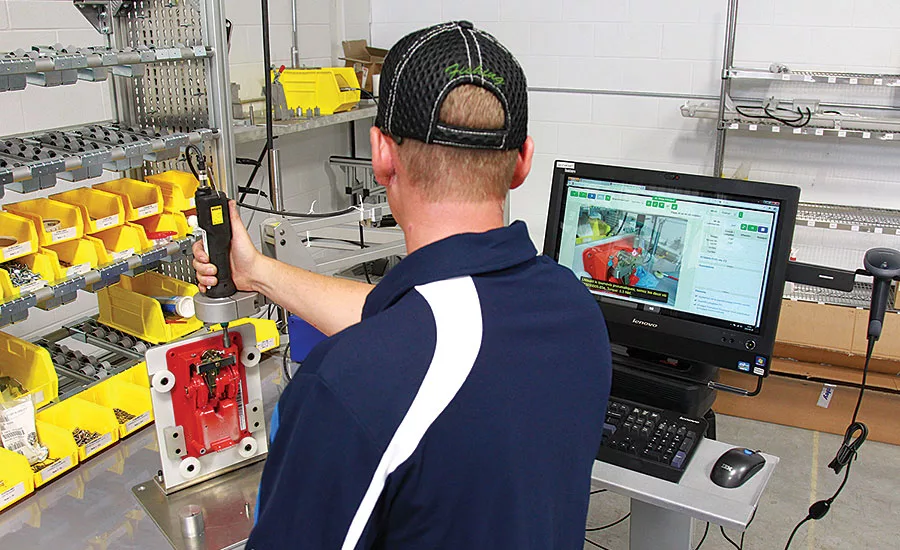
Today, flexibility is more important than ever because of shrinking product life cycles and increasing demand for built-to-order products. Photo courtesy Visual Knowledge Share Ltd.

December 6, 2005

When it comes to manufacturing, the best assembly process in the world can still fall prey to such prosaic constraints as operator fatigue, inattentiveness, time pressure, and plain-old carelessness. The results-scrap, waste and decreased profits-are something manufacturers can ill afford in a competitive world.

To maximize quality and efficiency, U.S. manufacturers are increasingly embracing the Japanese concept of poka-yoke (pronounced POH-kah YOH-kay), or mistake-proofing. Poka-yoke devices are mechanisms that prevent mistakes from being made or that make mistakes obvious at a glance. Besides reducing the cost of scrap, rework and warranty claims, mistake-proofing provides a less obvious benefit: It gives workers time to think about how to improve the assembly process. Instead of acting as mere extensions of their machines, operators are free to manage their environment.

The most common sources of product defects are errors in setting up workpieces and equipment, omitted processing steps, processing errors, missing parts and wrong parts. More often than not, the devices for preventing these errors are simple and inexpensive, especially in the context of manual assembly. In some cases, errors can be prevented by changing the shape of the part or the fixture. In others, electronics come into play. A sensor can be installed to ensure that an assembly process won't begin until the correct part has been installed in the correct position; a limit switch can be used to make certain that the correct number of assembly steps has been performed.

A classic example of a poka-yoke device is a parts kit. All the parts required for an assembly are loaded into the kit, which is typically a thermoformed plastic tray. Cavities in the tray are designed to match the shape and number of parts in the assembly. Before beginning an assembly, the operator immediately knows if any parts are missing. Similarly, if any parts are left over after assembly, the operator knows it was done incorrectly.

In the book Poka-Yoke: Improving Product Quality by Preventing Mistakes (Productivity Press, 1988), editor Nikkan Kogyo Shimbun offers an example of how a product design can be modified to prevent mistakes. An electrical products company made a timer switch that was equipped with a frequency selection mechanism allowing it to be used in areas with either 50- or 60-hertz power. The 50- and 60-hertz gears were installed next to each other on the same shaft. The only difference between the two gears was three teeth, making it difficult to tell the gears apart with the naked eye. Because the gears fit interchangeably on the shaft, assembly errors were common.

To error-proof the assembly, engineers modified the holes in the gears and the shape of the shaft to that the gears could only fit on the shaft one way. In addition, the 50-hertz gear was molded in white plastic and the 60-hertz gear was molded in blue plastic, so they could be identified at a glance. Installation errors were eliminated at no increase in product cost.

In this same vein, mistakes can often be prevented by re-examining the assembly entire line for sources of error. For example, in a modular workstation environment, a manufacturer can set up a progressive system in which each operator is responsible for adding just one component of the assembly. This helps with error-proofing, because each operator has only one task to do and can be trained to do it very well.

Looking for quick answers on assembly and manufacturing topics? Try Ask ASM, our new smart AI search tool. Ask ASM →

Similarly, by better organizing the workstations on a line, a manufacturer can reduce the chance that operators will make simple, but expensive mistakes. For example, a workstation's uprights can be equipped with clearly marked, color-coded part bins. Document holders can display assembly drawings or instructions. A manufacturer might even install a flat-screen computer monitor to display the different steps in an assembly process, making it easy for operators to access information via a touch-screen interface.

When installing threaded fasteners, engineers should take a good hard look at their product designs with an eye toward reducing the number and types of fasteners being used. In addition, setting up a line so that one operator is responsible for installing one type of fastener will reduce the possibility that an operator will install the wrong hardware.

In our next issue: Error proofing using electronic process monitoring and in automated assembly.

KEYWORDS: error-proofing manual assembly manual production methods manual vs. automatic assembly parts kitting poka-yoke

Share This Story

Looking for a reprint of this article?
From high-res PDFs to custom plaques, order your copy today!

Recommended Content

JOIN TODAY
To unlock your recommendations.

Already have an account? Sign In

  • Made in the U.S.A.

    Consumer Products Manufacturing: Made in the USA

    Supply chain lessons learned during the coronavirus...
    Automated Assembly Systems
    By: Austin Weber
  • Best Practices for Press-Fit Assembly

    Best Practices for Press-Fit Assembly

    In manufacturing, ironclad formulas for success are hard...
    Assembly Presses
    By: Jim Camillo
  • aem0523leader-tesla1.jpg

    Tesla Rethinks the Assembly Line

    Engineers at Tesla Inc. have developed a new process that...
    Industries
    By: Austin Weber
Manage My Account
  • eMagazine Subscription
  • Assembly Newsletters
  • Online Registration
  • Subscription Customer Service
  • Manage My Preferences

More Videos

Sponsored Content

Sponsored Content is a special paid section where industry companies provide high quality, objective, non-commercial content around topics of interest to the ASSEMBLY audience. All Sponsored Content is supplied by the advertising company and any opinions expressed in this article are those of the author and not necessarily reflect the views of ASSEMBLY or its parent company, BNP Media. Interested in participating in our Sponsored Content section? Contact your local rep!

close
  • ultrasonic welding
    Sponsored bySonobond Ultrasonics

    Engineering Efficiency in High-Performance Assembly: How Ultrasonic Welding Enhances Throughput, Reliability and Quality

  • UV curing system
    Sponsored byDymax

    Why UV Intensity Alone Doesn’t Define Curing Performance

  • wooden pallets
    Sponsored byLEAN Manufacturing Products

    Eliminating Waste on the Shop Floor: Applying Lean Principles to Improve Manufacturing Efficiency

Popular Stories

ASSEMBLY News Now, episode-30: Volvo Redesigns EV Manufacturing

Volvo Redesigns EV Manufacturing

Boeing CEO Kelly Ortberg announces 1 billion investment

Boeing Plans $1 Billion Wichita Investment, Workforce Training Center

GE Appliances Worker on Line

GE Appliances Expands Factory AI With 800 Gemini Enterprise Agents

Watch the latest episode of ANN now!

Events

July 24, 2025

From Shop Floor to CFO: How Manufacturers Are Closing the Loop Between Operations and Finance

On Demand Learn how manufacturers are bridging the gap between the shop floor and ERP systems to gain real-time visibility, streamline operations, and kick-start digital transformation—without waiting years.

Sponsored by:

PicoStratusGreen
July 30, 2025

Buffer Analysis and Design Fundamentals for Manufacturing Excellence

On Demand In this presentation, Dr. Herman Tang shares practical insights from his industry experience and research on buffer management in manufacturing operations.

View All Submit An Event

Poll

Difficult Assembly Processes

Which assembly process gives you the most difficulty?
View Results Poll Archive

Products

Manufacturing Cost Policy Deployment (MCPD) Profitability Scenarios: Systematic and Systemic Improvement of Manufacturing Costs

Manufacturing Cost Policy Deployment (MCPD) Profitability Scenarios: Systematic and Systemic Improvement of Manufacturing Costs

See More Products
Register for webinar - Modernizing Automotive Assembly: Why Upgrading Legacy MES is a Business Imperative

Related Articles

  • How to Decrease Training and Rework Costs in Manual Threaded Assembly with Poka-Yoke and Error-Proofing

    How to Decrease Training and Rework Costs in Manual Threaded Assembly with Poka-Yoke and Error-Proofing

    See More
  • Manual Assembly Presses Are Simple and Flexible

    See More
  • Assembly in Action: Manual Assembly Line Gets An Upgrade

    See More

Related Products

See More Products
  • Assembly Processes: Finishing, Packaging, and Automation

  • november 2019 assembly

    ASSEMBLY November 2019 Issue

See More Products

Related Directories

  • Assembly & Automation Technology Inc.

    Assembly & Automation Technology delivers intelligent automation systems integrating machine learning, computer vision and smart robotics for industrial, medical and biotechnical applications. Our AI-enhanced assembly machines, robotic systems and vision-guided quality control optimize productivity while reducing human error. We engineer custom automated solutions that learn, adapt and continuously improve manufacturing processes.
×

Never miss the latest news and trends driving the manufacturing industry

Stay in the know on the latest assembly trends.

JOIN TODAY!
  • RESOURCES
    • Advertise
    • Contact Us
    • Directories
    • Manufacturing Division
    • Store
    • Want More?
  • SIGN UP TODAY
    • Create Account
    • eMagazine
    • Newsletters
    • Customer Service
    • Manage Preferences
  • SERVICES
    • Marketing Services
    • Reprints
    • Market Research
    • List Rental
    • Survey/Respondent Access
  • STAY CONNECTED
    • LinkedIn
    • Facebook
    • Instagram
    • YouTube
    • X (Twitter)
  • PRIVACY
    • PRIVACY POLICY
    • TERMS & CONDITIONS
    • DO NOT SELL MY PERSONAL INFORMATION
    • PRIVACY REQUEST
    • ACCESSIBILITY

Copyright ©2026. All Rights Reserved BNP Media, Inc. and BNP Media II, LLC.

Design, CMS, Hosting & Web Development :: ePublishing