Physical AI Will Take Human-Robot Collaboration to the Next Level
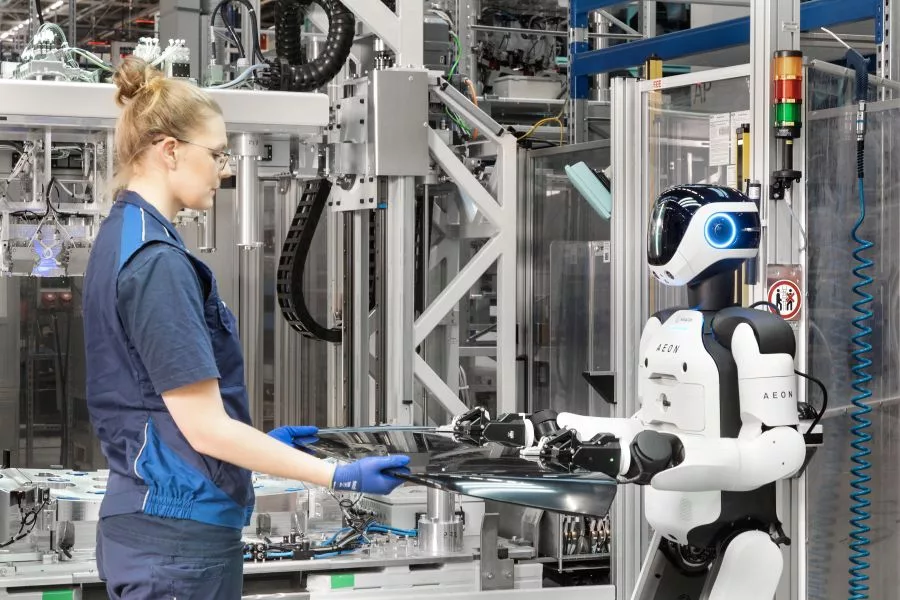
Physical AI will unlock new opportunities for human-robot collaboration in manufacturing. Photo courtesy BMW AG
PARIS—Physical AI marks a shift in robotics from automation to autonomous action in the real world. A new report by the Capgemini Research Institute claims the technology will unlock new opportunities for manufacturers. For instance, it will enable robotics applications that were previously impossible or impractical.
“Physical AI is at an inflection point as technological breakthroughs and market forces converge to accelerate real world deployment at scale,” says Pascal Brier, chief innovation officer at Capgemini. “Advances in foundation models are equipping robots with the intelligence needed to operate autonomously in complex environments, while simulation technologies are compressing training cycles by enabling large scale learning.
An emerging AI robot data flywheel is reinforcing this progress, as deployed systems generate real world data that continuously improves performance and generalization. These gains are amplified by advances in edge computing and batteries, falling hardware costs, new commercial models such as robotics as a service, and connectivity breakthroughs including private 5G and precise wireless positioning.
As reindustrialization efforts accelerate in Europe and the United States, Brier believes that physical AI is emerging as a key enabler. Indeed, he says that reshoring activity is increasingly driving interest in physical AI as a way to support domestic production at scale. Two-thirds of organizations claim it will be a high priority in their automation agenda for the next three to five years.
Improved flexibility is a key benefit, such as the ability to reconfigure production systems and workflows more rapidly than with traditional robotics or fixed automation. Improvements in safety and reduced physical strain are also advantages of investing in the technology.
“Physical AI marks a shift from systems that describe the world to systems that can act within it,” says Brier. “However, robotics has a long history of overpromising, as early breakthroughs created expectations the technology could not yet meet.
“What is different today is not the hype, but the convergence of AI, data and engineering maturity,” notes Brier. “The opportunity is real, provided we focus on what works at scale.
“Deploying physical AI responsibly, safely and progressively will be essential to building trust, with security by design, transparency and human oversight at the core of sustainable human robot collaboration,” warns Brier.
Looking for quick answers on assembly and manufacturing topics? Try Ask ASM, our new smart AI search tool. Ask ASM
Looking for a reprint of this article?
From high-res PDFs to custom plaques, order your copy today!