Assembly Magazine logo
search
Ask ASSEMBLY AI
cart
facebook twitter linkedin youtube
  • Sign In
  • Create Account
  • Sign Out
  • My Account
Assembly Magazine logo
  • TRENDS
    • Ask ASSEMBLY AI
    • Trends
    • News
    • New Products
  • INDUSTRIES
    • Aerospace
    • Appliance
    • DFMA Assembly
    • Medical Devices
    • Green Manufacturing
    • Lean Manufacturing
    • Machinery Assembly
    • Electronics Assembly
    • Automotive
  • TECHNOLOGIES
    • Adhesives & Dispensing
    • Assembly Presses
    • Automated Assembly Systems
    • Manufacturing Management
    • Manufacturing Software
    • Motion Control
    • Screwdriving & Riveting
    • Robotics
    • Test & Inspection
    • Plastics & Metal Welding
    • Wire Processing
    • Workstations
  • AUTONOMOUS & ELECTRIC MOBILITY
    • AEM Magazine Archives
    • Autonomy
    • Electrification
    • Mobility Services
    • Assembly & Testing
    • AV/EM News
  • MEDIA
    • Ask ASSEMBLY AI
    • Podcasts
    • Assembly News Now
    • Assembly TV
    • Webinars
    • eBooks
  • EVENTS
    • Calendar
    • The ASSEMBLY Show
  • MORE
    • Exclusives >
      • Plant of the Year
      • Capital Spending
    • Buyers Guide >
      • Supplier Insights
    • Classifieds
    • Featured Products
    • Newsletters
    • Store
    • White Papers
    • Columns
    • Sponsor Insights
  • INFOCENTER
    • Assembly & Test Solutions
  • EMAGAZINE
    • eMagazine
    • Archive Issues
    • Advertise
    • Contact Us
    • Sign Up
Assembly Breaking News IndustriesTechnologiesGreen Manufacturing AssemblyElectronics AssemblyAdhesives & Dispensing Assembly

Reversible Adhesive Aids Disassembly and Recycling
By Austin Weber
Newcastle University

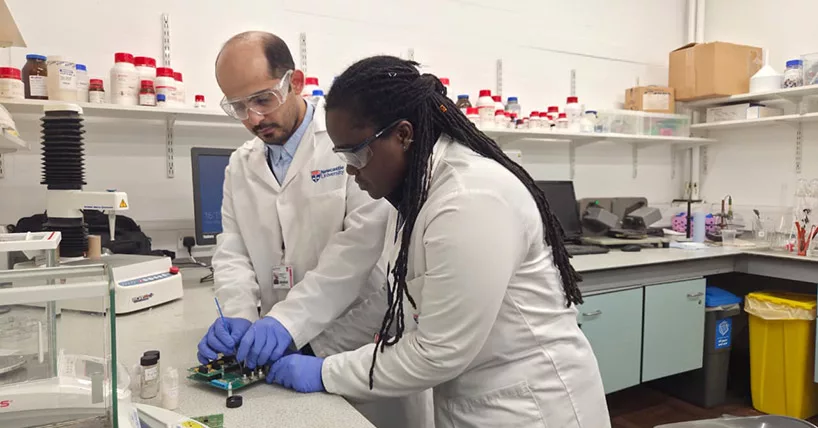
A new type of reversible adhesive that makes disassembling and recycling electronics much easier. Photo courtesy Newcastle University


May 26, 2026

NEWCASTLE, England—Electrical and chemical engineers at Newcastle University have developed a reversible adhesive that makes disassembling and recycling electronics much easier.

The glue is electrically conductive, so it can be used to assemble electronic components, just like solder. Unlike solder, however, a simple wash with a green solvent like acetone, or using an alkaline solution, enables components to be separated for recycling and reuse.

“This is a ‘one-pot’ glue and is water-based, so it does not emit organic solvent vapors and does not require a hardener, unlike some glues,” says Bassam Aljohani, a Ph.D. student in the school of engineering who is working on the R&D project. “It is also as strong as other water-based glues.

“The glue is made in the same way as a paint, but silver particles are added rather than pigments, and this gives the formulation its electrical properties,” explains Aljohani. “Other conducting glues exist, and many of these also include silver for optimal conductivity, but none can easily be debonded.”

According to Aljohani, reversible adhesive will help address challenges associated with electronic waste. “Electrically conductive adhesives have been around for a long time, and making them reversible provides the solution to a very real problem that urgently needs addressing,” he points out. “Being reversible, our glue [makes it possible to recover and reuse] silver, which is important to keep costs down and the environment clean.”

The adhesive is based on current industrial manufacturing processes used for making paint. And, because it’s developed from cheap materials, it can be scaled up easily.

“It is water-based, so it does not have the volatile organic solvents used in many commercial glues,” claims Aljohani. “But, unlike other water-based adhesives, exposure to humid environments does not cause bond failure. The glue works very well on metal surfaces; it also sticks to other surfaces, such as plastics and printed circuit boards.”

“The electronics industry relies on permanent joining methods, including screws, which can make automated recycling more difficult,” adds Ama Asiedu-Asante, Ph.D., an electrical engineer who worked on the project. “There is now increasing recognition that water-based formulations can support more sustainable electronics, and this [breakthrough] demonstrates how they can deliver both performance and reversibility.”

Looking for quick answers on assembly and manufacturing topics? Try Ask ASM, our new smart AI search tool. Ask ASM →

KEYWORDS: adhesive technology bonding electronics industry recycling sustainability university innovation university research

Share This Story

Looking for a reprint of this article?
From high-res PDFs to custom plaques, order your copy today!

Austinweber headshot
Austin has been senior editor for ASSEMBLY Magazine since September 1999. He has more than 21 years of b-to-b publishing experience and has written about a wide variety of manufacturing and engineering topics. Austin is a graduate of the University of Michigan.

Recommended Content

JOIN TODAY
To unlock your recommendations.

Already have an account? Sign In

  • Made in the U.S.A.

    Consumer Products Manufacturing: Made in the USA

    Supply chain lessons learned during the coronavirus...
    Automated Assembly Systems
    By: Austin Weber
  • Best Practices for Press-Fit Assembly

    Best Practices for Press-Fit Assembly

    In manufacturing, ironclad formulas for success are hard...
    Assembly Presses
    By: Jim Camillo
  • aem0523leader-tesla1.jpg

    Tesla Rethinks the Assembly Line

    Engineers at Tesla Inc. have developed a new process that...
    Assembly and Testing
    By: Austin Weber
Manage My Account
  • eMagazine Subscription
  • Assembly Newsletters
  • Online Registration
  • Subscription Customer Service
  • Manage My Preferences

More Videos

Sponsored Content

Sponsored Content is a special paid section where industry companies provide high quality, objective, non-commercial content around topics of interest to the ASSEMBLY audience. All Sponsored Content is supplied by the advertising company and any opinions expressed in this article are those of the author and not necessarily reflect the views of ASSEMBLY or its parent company, BNP Media. Interested in participating in our Sponsored Content section? Contact your local rep!

close
  • ultrasonic welding
    Sponsored bySonobond Ultrasonics

    Engineering Efficiency in High-Performance Assembly: How Ultrasonic Welding Enhances Throughput, Reliability and Quality

  • UV curing system
    Sponsored byDymax

    Why UV Intensity Alone Doesn’t Define Curing Performance

  • wooden pallets
    Sponsored byLEAN Manufacturing Products

    Eliminating Waste on the Shop Floor: Applying Lean Principles to Improve Manufacturing Efficiency

Popular Stories

ASSEMBLY News Now, episode-30: Volvo Redesigns EV Manufacturing

Volvo Redesigns EV Manufacturing

Robots working at Toyota Plant in Japan

Toyota Deploys Geekplus Robots for Factory Material Handling

can of soda pop

The “Diet Coke Problem” as Manufacturers Face Experts Retiring

Watch the latest episode of ANN now!

Events

July 24, 2025

From Shop Floor to CFO: How Manufacturers Are Closing the Loop Between Operations and Finance

On Demand Learn how manufacturers are bridging the gap between the shop floor and ERP systems to gain real-time visibility, streamline operations, and kick-start digital transformation—without waiting years.

Sponsored by:

PicoStratusGreen
July 30, 2025

Buffer Analysis and Design Fundamentals for Manufacturing Excellence

On Demand In this presentation, Dr. Herman Tang shares practical insights from his industry experience and research on buffer management in manufacturing operations.

View All Submit An Event

Poll

Difficult Assembly Processes

Which assembly process gives you the most difficulty?
View Results Poll Archive

Products

Manufacturing Cost Policy Deployment (MCPD) Profitability Scenarios: Systematic and Systemic Improvement of Manufacturing Costs

Manufacturing Cost Policy Deployment (MCPD) Profitability Scenarios: Systematic and Systemic Improvement of Manufacturing Costs

See More Products
ebook

Related Articles

  • Reversible Adhesive Facilitates Repairs, Recycling

    See More
  • robotic disassembly of motherboards and other electronic components

    New Process Automates Electronics Disassembly

    See More
  • fraunhofer.jpg

    Battery Disassembly Process Improves EV Recycling Efforts

    See More

Related Products

See More Products
  • Testing Adhesive Joints: Best Practices

  • Sustainable Manufacturing

  • 0001349.jpeg

    Adhesion and Adhesives Technology 4e

See More Products

Related Directories

  • RecycleMax Inc.

×

Never miss the latest news and trends driving the manufacturing industry

Stay in the know on the latest assembly trends.

JOIN TODAY!
  • RESOURCES
    • Advertise
    • Contact Us
    • Directories
    • Manufacturing Division
    • Store
    • Want More?
  • SIGN UP TODAY
    • Create Account
    • eMagazine
    • Newsletters
    • Customer Service
    • Manage Preferences
  • SERVICES
    • Marketing Services
    • Reprints
    • Market Research
    • List Rental
    • Survey/Respondent Access
  • STAY CONNECTED
    • LinkedIn
    • Facebook
    • Instagram
    • YouTube
    • X (Twitter)
  • PRIVACY
    • PRIVACY POLICY
    • TERMS & CONDITIONS
    • DO NOT SELL MY PERSONAL INFORMATION
    • PRIVACY REQUEST
    • ACCESSIBILITY

Copyright ©2026. All Rights Reserved BNP Media, Inc. and BNP Media II, LLC.

Design, CMS, Hosting & Web Development :: ePublishing