Assembly Magazine logo
search
Ask ASSEMBLY AI
cart
facebook twitter linkedin youtube
  • Sign In
  • Create Account
  • Sign Out
  • My Account
Assembly Magazine logo
  • TRENDS
    • Ask ASSEMBLY AI
    • Trends
    • News
    • New Products
  • INDUSTRIES
    • Aerospace
    • Appliance
    • DFMA Assembly
    • Medical Devices
    • Green Manufacturing
    • Lean Manufacturing
    • Machinery Assembly
    • Electronics Assembly
    • Automotive
  • TECHNOLOGIES
    • Adhesives & Dispensing
    • Assembly Presses
    • Automated Assembly Systems
    • Manufacturing Management
    • Manufacturing Software
    • Motion Control
    • Screwdriving & Riveting
    • Robotics
    • Test & Inspection
    • Plastics & Metal Welding
    • Wire Processing
    • Workstations
  • AUTONOMOUS & ELECTRIC MOBILITY
    • AEM Magazine Archives
    • Autonomy
    • Electrification
    • Mobility Services
    • Assembly & Testing
    • AV/EM News
  • MEDIA
    • Ask ASSEMBLY AI
    • Podcasts
    • Assembly News Now
    • Assembly TV
    • Webinars
    • eBooks
  • EVENTS
    • Calendar
    • The ASSEMBLY Show
  • MORE
    • Exclusives >
      • Plant of the Year
      • Capital Spending
    • Buyers Guide >
      • Supplier Insights
    • Classifieds
    • Featured Products
    • Newsletters
    • Store
    • White Papers
    • Columns
    • Sponsor Insights
  • INFOCENTER
    • Assembly & Test Solutions
  • EMAGAZINE
    • eMagazine
    • Archive Issues
    • Advertise
    • Contact Us
    • Sign Up
Autonomous & Electric MobilityAutomotive Assembly

Ford Pivots From EVs to Energy Storage Systems

When life gives you lemons, make lemonade.
By John Sprovieri
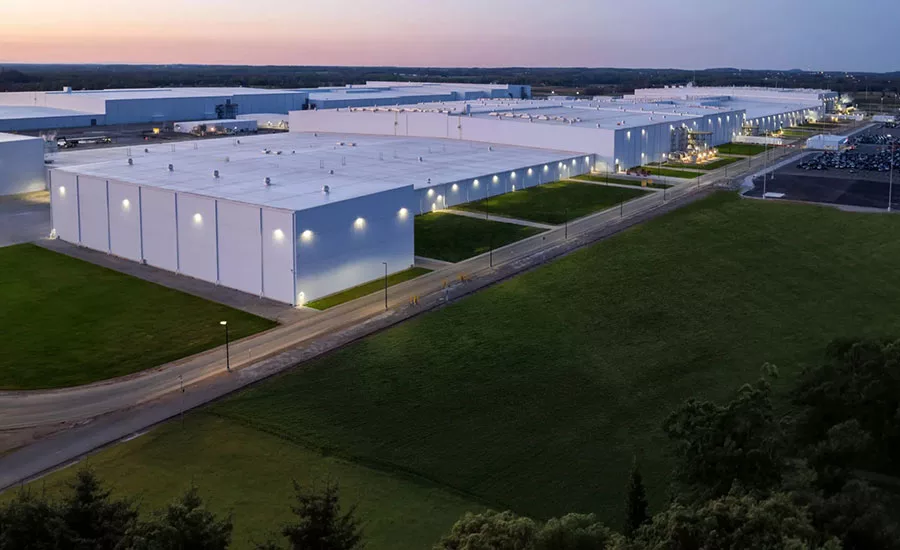
Aerial view of a large industrial warehouse and distribution complex at dusk.
Photo courtesy Ford Motor Co.

Ford’s EV battery factory in Glendale, KY, will soon be making batteries for utility-scale energy storage.

June 30, 2026

Five years ago, Ford Motor Co. and SK Innovation Co. Ltd. announced a joint venture to manufacture batteries for the automaker’s electric vehicles. The two companies invested billions of dollars in the initiative, which was to include a pair of new, state-of-the-art assembly plants: BlueOvalSK Battery Park in Glendale, KY, and BlueOval City in Stanton, TN.

“This is a transformative moment where [we] will lead America’s transition to electric vehicles and usher in a new era of clean, carbon-neutral manufacturing,” Bill Ford, the automaker’s executive chair, said at the time. “With this investment and a spirit of innovation, we can achieve goals once thought mutually exclusive—protect our planet, build great electric vehicles Americans will love and contribute to our nation’s prosperity.”

“This is our moment—our biggest investment ever—to help build a better future for America,” added Jim Farley, president and CEO of Ford. “We are moving now to deliver breakthrough electric vehicles for the many rather than the few. It’s about creating good jobs that support American families; an ultra-efficient, carbon-neutral manufacturing system; and a growing business that delivers value for communities, dealers and shareholders.”

Alas, those bold visions did not materialize, and demand for EVs never met expectations. Then, when the Trump administration nixed the clean vehicle tax credit last year, the bottom really fell out of the EV market.

In December 2025, SK ended its joint venture with Ford, and the automaker announced a $19.5 billion write-down on its EV investments. Much of that sum reflects expenses related to canceling fully electric models that had been years in the making.

Now, Ford is shifting its focus to hybrid vehicles and conventional gas-powered models, and it’s repurposing two new assembly plants that suddenly have nothing to make.

Originally intended to assemble a next-generation electric pickup truck and its batteries, BlueOval City was expected to be operational in 2025. Instead, Ford will just build gas-powered pickups at the factory, which will be renamed the Tennessee Truck Plant in 2029.

Looking for quick answers on assembly and manufacturing topics? Try Ask ASM, our new smart AI search tool. Ask ASM →

At BlueOval SK Battery Park, production of batteries for the all-electric Ford F-150 Lightning began in August 2025 and ended a few months later. Most of the factory’s 1,500-member workforce was laid off in February.

Rather than walk away entirely from that factory, Ford is trying something different. In May, the automaker announced a new venture: Ford Energy, a wholly owned subsidiary that will manufacture battery energy storage systems (BESS) for utilities, data centers, and large industrial customers. Ford Energy plans to produce 20 gigawatt-hours (GWh) of energy storage annually from the factory.
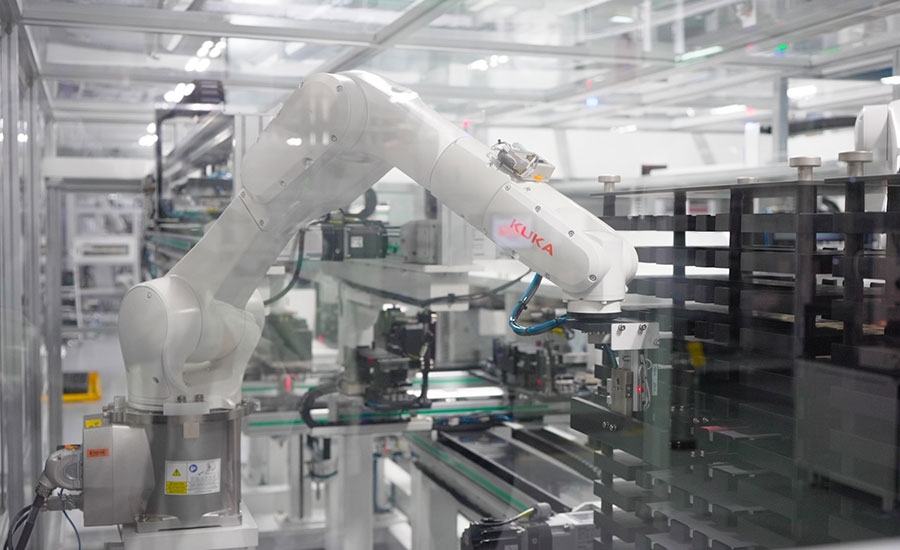
The BlueOvalSK battery assembly plant was highly automated. Photo courtesy Ford Motor Co.

The company’s flagship product is the DC block, a standardized 20-foot containerized BESS built around 512 amp-hour lithium iron phosphate prismatic cells. It comes in two configurations: The FE-250 is a two-hour system, and the FE-450 is a four-hour system. Both deliver 5.45 megawatt-hours of rated energy capacity, operate across a 1,040 to 1,500 voltage range, and integrate liquid-cooled thermal management with a proprietary battery management system.

Ford Energy has already inked a five-year agreement to provide BESS to EDF Power Solutions North America, which operates wind, solar and other green energy systems. The agreement will give EDF the ability to procure up to 4 GWh of BESS from Ford Energy annually, representing a total potential volume of up to 20 GWh. Deliveries are expected to begin in 2028.

The venture is not without risk. Ford has little experience making such batteries, and it will have multiple competitors, including Tesla, LG Energy Solution and former partner SK On, all of whom have been making BESS for a while now.

Still, we applaud Ford for making lemonade out of lemons, and we wish the company nothing but the best.

KEYWORDS: alternative energy battery manufacturing Ford Motor Co.

Share This Story

Looking for a reprint of this article?
From high-res PDFs to custom plaques, order your copy today!

John has been with ASSEMBLY magazine since February 1997. John was formerly with a national medical news magazine, and has written for Pathology Today and the Green Bay Press-Gazette. John holds a B.A. in journalism from Northwestern University, Medill School of Journalism.

Recommended Content

JOIN TODAY
To unlock your recommendations.

Already have an account? Sign In

  • Made in the U.S.A.

    Consumer Products Manufacturing: Made in the USA

    Supply chain lessons learned during the coronavirus...
    Automated Assembly Systems
    By: Austin Weber
  • Best Practices for Press-Fit Assembly

    Best Practices for Press-Fit Assembly

    In manufacturing, ironclad formulas for success are hard...
    Assembly Presses
    By: Jim Camillo
  • aem0523leader-tesla1.jpg

    Tesla Rethinks the Assembly Line

    Engineers at Tesla Inc. have developed a new process that...
    Assembly and Testing
    By: Austin Weber
Manage My Account
  • eMagazine Subscription
  • Assembly Newsletters
  • Online Registration
  • Subscription Customer Service
  • Manage My Preferences

More Videos

Sponsored Content

Sponsored Content is a special paid section where industry companies provide high quality, objective, non-commercial content around topics of interest to the ASSEMBLY audience. All Sponsored Content is supplied by the advertising company and any opinions expressed in this article are those of the author and not necessarily reflect the views of ASSEMBLY or its parent company, BNP Media. Interested in participating in our Sponsored Content section? Contact your local rep!

close
  • ultrasonic welding
    Sponsored bySonobond Ultrasonics

    Engineering Efficiency in High-Performance Assembly: How Ultrasonic Welding Enhances Throughput, Reliability and Quality

  • UV curing system
    Sponsored byDymax

    Why UV Intensity Alone Doesn’t Define Curing Performance

  • wooden pallets
    Sponsored byLEAN Manufacturing Products

    Eliminating Waste on the Shop Floor: Applying Lean Principles to Improve Manufacturing Efficiency

Popular Stories

ASSEMBLY News Now, episode-30: Volvo Redesigns EV Manufacturing

Volvo Redesigns EV Manufacturing

Robots working at Toyota Plant in Japan

Toyota Deploys Geekplus Robots for Factory Material Handling

can of soda pop

The “Diet Coke Problem” as Manufacturers Face Experts Retiring

Watch the latest episode of ANN now!

Events

July 24, 2025

From Shop Floor to CFO: How Manufacturers Are Closing the Loop Between Operations and Finance

On Demand Learn how manufacturers are bridging the gap between the shop floor and ERP systems to gain real-time visibility, streamline operations, and kick-start digital transformation—without waiting years.

Sponsored by:

PicoStratusGreen
July 30, 2025

Buffer Analysis and Design Fundamentals for Manufacturing Excellence

On Demand In this presentation, Dr. Herman Tang shares practical insights from his industry experience and research on buffer management in manufacturing operations.

View All Submit An Event

Poll

Difficult Assembly Processes

Which assembly process gives you the most difficulty?
View Results Poll Archive

Products

Manufacturing Cost Policy Deployment (MCPD) Profitability Scenarios: Systematic and Systemic Improvement of Manufacturing Costs

Manufacturing Cost Policy Deployment (MCPD) Profitability Scenarios: Systematic and Systemic Improvement of Manufacturing Costs

See More Products
ebook

Related Articles

  • Hanjung Logo in Green and Grey

    Hanjung America to Build Energy Storage Manufacturing Facility in Indiana

    See More
  • AIA: Automated Storage Systems Accommodate Twice the Production

    See More
  • GM EV truck.jpg

    GM Unveils Home Energy Storage Solution to Boost EV Appeal

    See More

Related Products

See More Products
  • history.jpg

    Faster, Better, Cheaper in the History of Manufacturing: From the Stone Age to Lean Manufacturing and Beyond

  • The Automotive Body Manufacturing Systems and Processes

See More Products

Related Directories

  • Hänel Storage Systems

    Hänel manufactures automated vertical storage and retrieval solutions that bring inventory to you, saving time and money. Perfect for assembly line parts or temporary buffer storage. Save up to 80% of your floor space, increase inventory accuracy to over 99%, pick more parts in less time and improve inventory security.
×

Never miss the latest news and trends driving the manufacturing industry

Stay in the know on the latest assembly trends.

JOIN TODAY!
  • RESOURCES
    • Advertise
    • Contact Us
    • Directories
    • Manufacturing Division
    • Store
    • Want More?
  • SIGN UP TODAY
    • Create Account
    • eMagazine
    • Newsletters
    • Customer Service
    • Manage Preferences
  • SERVICES
    • Marketing Services
    • Reprints
    • Market Research
    • List Rental
    • Survey/Respondent Access
  • STAY CONNECTED
    • LinkedIn
    • Facebook
    • Instagram
    • YouTube
    • X (Twitter)
  • PRIVACY
    • PRIVACY POLICY
    • TERMS & CONDITIONS
    • DO NOT SELL MY PERSONAL INFORMATION
    • PRIVACY REQUEST
    • ACCESSIBILITY

Copyright ©2026. All Rights Reserved BNP Media, Inc. and BNP Media II, LLC.

Design, CMS, Hosting & Web Development :: ePublishing